Yageo Brand Guidelines
Taiwan’s 1977 resistor maker that bought KEMET and Shibaura.
Aa
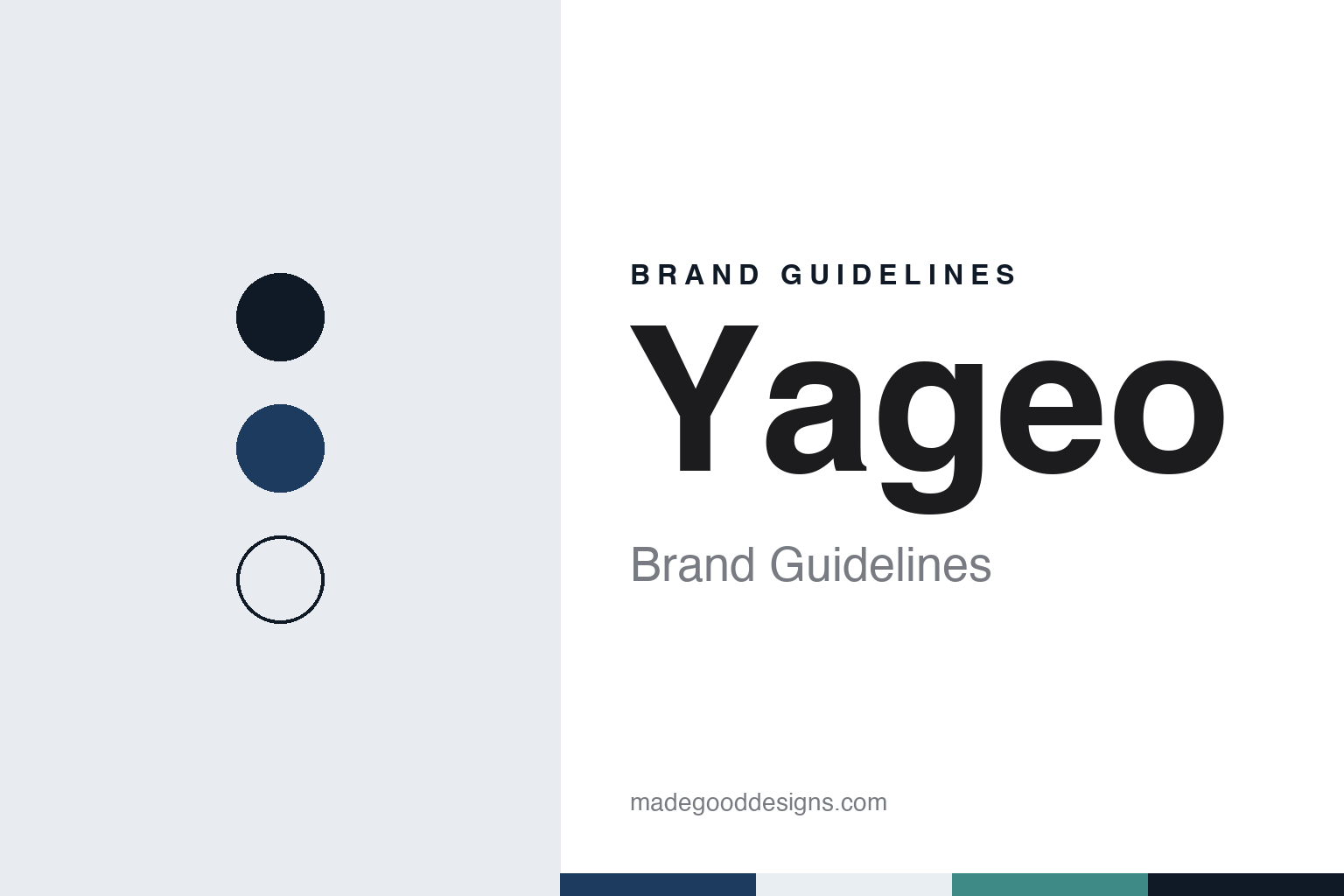
Two constants: a navy, grey and teal palette and an engineering sans register. Abstract homage — not a Yageo product or mark; no component, logo or packaging is reproduced.
Resistors and soldering machines
A Taiwanese start in 1977.
Yageo was founded in Taiwan in 1977. Chinese Wikipedia dates the company to July 1977 and says it began by making automatic soldering machines and carbon-film resistors. English Wikipedia names its founder as Pierre Chen, known in Chinese as Chen Tai-ming, an engineering-science graduate of National Cheng Kung University who remains its chairman; the Taipei Times described him as chairman in 2007.
The company grew first through mergers at home. Chinese Wikipedia says Taiwan Impedance, set up in September 1987, merged with Yageo in November 1989, with Yageo as the surviving company. Its shares began trading over the counter in March 1992, and in October 1993 they were listed on the Taiwan Stock Exchange; Chinese Wikipedia describes Yageo as the first passive-component maker to be listed there.
Acquisitions abroad followed through the 1990s. English Wikipedia lists the purchase of ASJ of Singapore in 1994; of Vitrohm, a resistor maker founded in Denmark in 1933, and the Taiwanese firm Teapo in 1996; and Chilisin in 1997. In 2000, it says, Yageo took over the Phycomp and Ferroxcube names from Philips Electronics; Stellar followed in 2002.
China became a large part of the story. When Yageo opened its Second Suzhou Plant in October 2007, the Taipei Times reported, the company said it had launched operations in China in 1996 and described the new site as the world’s largest single back-end production line for passive components, making chip resistors and multilayer ceramic capacitors. In 2011 a plan to take Yageo private with backing from the investment firm KKR was turned down in June by the Investment Commission of Taiwan’s Ministry of Economic Affairs, Chinese Wikipedia says, which cited the offer price, the level of borrowing involved and the position of minority shareholders.
Colour
Resistors, MLCCs, tantalum and sensors.
Yageo is a maker of passive components — the resistors, capacitors and inductors that sit on almost every circuit board — and English Wikipedia notes that it concentrates on surface-mount parts. Chinese Wikipedia lists its main products as multilayer ceramic capacitors (MLCCs), tantalum capacitors, chip resistors and wireless components, and says that in 2021 Yageo was the largest maker of chip resistors and tantalum capacitors and the third-largest supplier of MLCCs and inductors. The Taipei Times called it the world’s third-largest MLCC maker in October 2025.
Most of that range arrived by acquisition. In 2018 Yageo bought the protection-component maker BrightKing and completed its purchase of Pulse Electronics, a San Diego maker of wireless, power and magnetic parts, according to English Wikipedia. In November 2019 it agreed to buy KEMET, the American capacitor maker, and the deal closed in June 2020; KEMET’s own release of 15 June 2020 said it had become a wholly owned Yageo subsidiary and that its shares were no longer listed. KEMET kept its name, and its tantalum and film capacitors now sit inside the Yageo group (see the KEMET guide).
The group also consolidates brands. In January 2022, English Wikipedia says, Yageo merged Chilisin Electronics and its subsidiary brands Mag.Layers, Magic and Bothhand into Pulse Electronics, retiring those names in favour of Pulse. Sensors became a further line: in October 2022 the company agreed to buy Heraeus Nexensos, a German maker of temperature sensors, and in 2023 it bought Telemecanique Sensors from Schneider Electric, the Taipei Times reported.
Production is spread widely. Chinese Wikipedia lists plants in Kaohsiung in Taiwan, in the United States and Mexico, in Japan, China and South-East Asia, and in Poland, Portugal, the Czech Republic and North Macedonia. In October 2025 Yageo said it had more than 40,000 employees, 61 production sites in 35 countries and 20 research and development centres, the Taipei Times reported.
Typography
Design and documentation.
Passive components are hard to photograph and harder to brand. A multilayer ceramic capacitor in the smallest sizes is a speck that sits like a grain of sand on a fingertip, and a scatter of chips on a fingertip is one way to show that scale. Resistors, inductors, filters and fuses look little different from one maker to the next, so the presentation leans on the company’s name, its colours and the way it pictures the work behind the part.
The pictures repeat across the trade. Reels of tape-and-reel parts, ready for pick-and-place machines, stand for volume. Through-hole resistors with their coloured bands, cut-away capacitors that open up the layers or the wound film inside, and close-ups of ceramic sheets being stacked stand for the craft. Automated inspection lines, with cameras checking each part, stand for consistency, and pictures of factories and laboratories often stand in for the end products the parts go into.
Trade shows are where these brands meet engineers in person. electronica in Munich and CEATEC in Japan are among the fairs where component makers take large stands, and some use them for showpieces that have little to do with a datasheet: Murata, for one, says it demonstrated its bicycle-riding Murata Boy robot at CEATEC JAPAN 2005.
Many of these companies began with a material rather than a product: ferrite, titanium oxide, barium titanate, tantalum or film. Several have changed hands or merged, so names, marks and owners do not always line up. This guide sets out who founded each brand, who owns it now and where it says its parts are made, and marks clearly what rests only on the company’s own word.
Aa
An engineering sans for a component group. (Specimen set in Archivo, a sans STAND-IN; NOT the Yageo logo.)
Shibaura
A contested bid for a Japanese sensor maker.
Yageo’s most closely watched deal came in Japan. In February 2025 it launched an unsolicited tender offer for Shibaura Electronics, a maker of NTC thermistors — small temperature-sensing parts — Digitimes reported in October 2025. Shibaura sought support from the Japanese precision-parts maker MinebeaMitsumi, which made a competing bid, and Yageo raised its own offer twice. Because Shibaura’s sensors were considered sensitive, the deal was reviewed under Japan’s Foreign Exchange and Foreign Trade Act, and Japanese authorities cleared it in September 2025, Digitimes reported; Focus Taiwan reported the clearance on 3 September.
The tender closed on 20 October 2025. The Taipei Times reported that holders of 87.3 percent of Shibaura’s shares had accepted, well above the 50.01 percent threshold, and that Yageo planned to buy the remaining shares and make Shibaura a subsidiary. A Yageo announcement carried by Passive Components Blog in January 2026 said Shibaura had been delisted from the Tokyo Stock Exchange on 13 January 2026 and that Yageo held all of its voting shares from 15 January. Yageo said the purchase was meant to expand its NTC thermistor business, with Shibaura gaining access to its sales network in the Americas and Europe.
Across five decades Yageo has bought established names — Vitrohm, Phycomp, Ferroxcube, Pulse, KEMET and Shibaura among them. KEMET continues as a Yageo subsidiary, while the Chilisin brands were folded into Pulse in 2022. The parent remains a company listed on the Taiwan Stock Exchange, chaired by its founder, English Wikipedia says.
For a design guide, Yageo shows how a component group can carry many inherited names under one parent. Compare KEMET, the American capacitor maker it has owned since 2020, and Murata, the Japanese ceramic-capacitor maker. For this guide we use navy, a ceramic grey and a teal with a sans, an unofficial interpretation; no product or logo is reproduced.
Explore & save
Keep Yageo’s identity on hand — save it to a board in the Made Good inspiration library.
Yageo identity set
Pin the Yageo navy, grey and teal palette and the engineering sans register to your own board.