JSR Brand Guidelines
Japan Synthetic Rubber, a rising arc and the chemistry of the chip.
Aa
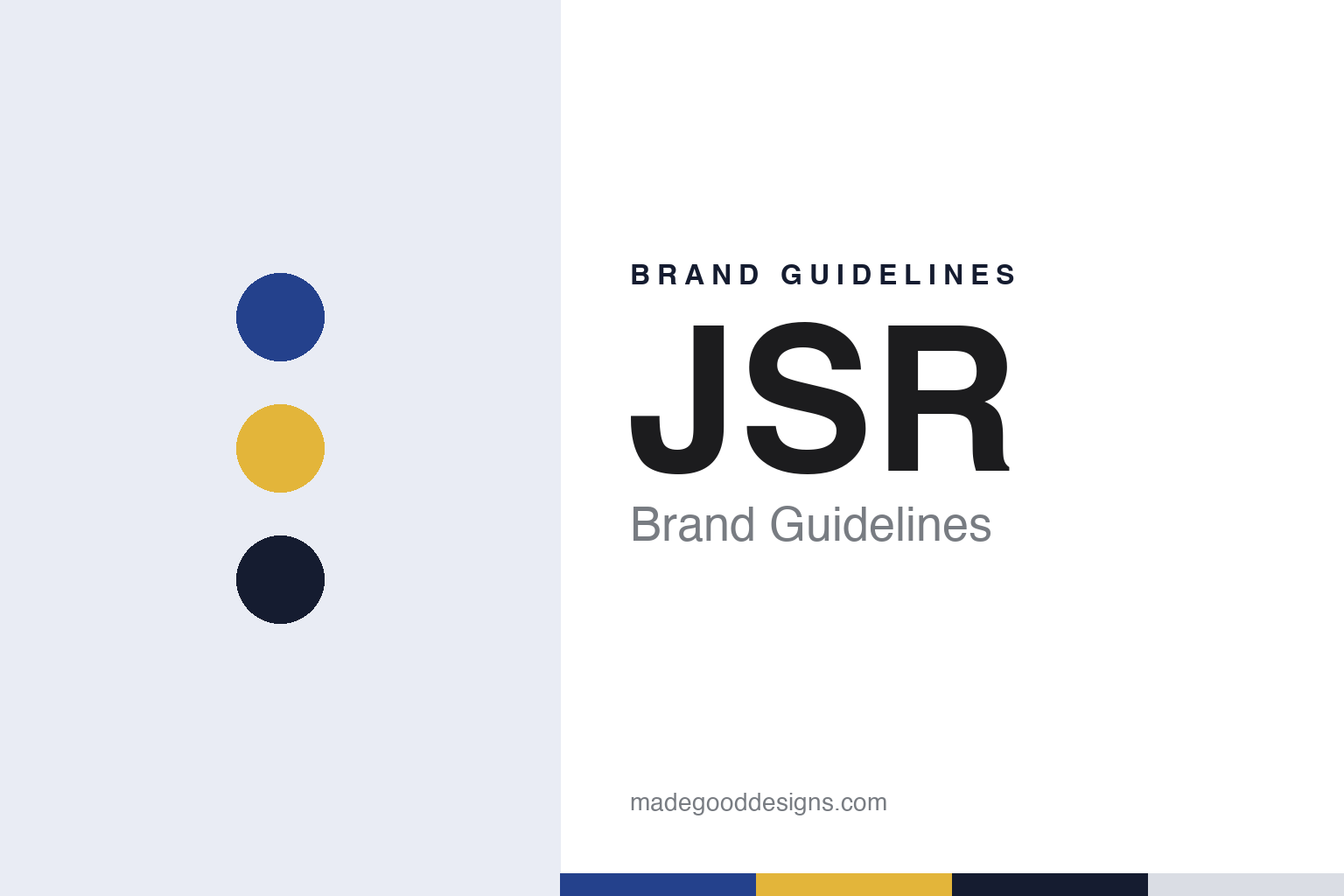
Two constants: a blue and yellow palette and a square-cut sans register. Abstract homage — not a JSR product or mark; no material, logo or symbol is reproduced.
Japan Synthetic Rubber
A company created by law to make rubber at home.
JSR began as Nihon Gosei Gomu, or Japan Synthetic Rubber, founded on 10 December 1957. The company’s own history says it was established under Japan’s special-measures law for the synthetic-rubber industry, and Japanese Wikipedia describes it as a national-policy company created to make synthetic rubber in Japan rather than import it, with the government holding 40 per cent and private companies the rest. Its first president, Japanese Wikipedia notes, was Shojiro Ishibashi, the founder of Bridgestone.
Production started at Yokkaichi in Mie Prefecture in 1960, where, the company says, it began making and selling butadiene, styrene-butadiene rubber and SB latex. Synthetic-rubber latex followed in 1961 and synthetic resins in 1964. A second works at Chiba was completed in 1968 and a third at Kashima in Ibaraki in 1971.
The state did not stay in. In 1969 the Diet passed a law repealing the temporary measures that governed the company, and Japan Synthetic Rubber became, in its own words, a purely private company. Its shares were listed on the second sections of the Tokyo and Osaka exchanges in 1970 and moved to the first sections in 1971.
The company’s history frames the 1970s as the decade in which it answered a severe recession by starting to diversify. That strategy produced the business it is now associated with: in April 1979 the company began selling photoresists, the light-sensitive materials used to pattern circuits on silicon wafers. Optical-fibre coating materials and, in 1988, materials for liquid-crystal displays followed, and a research centre at Tsukuba opened in 1989.
Colour
From rubber to the chemistry of lithography.
By the 1990s the electronics materials had become an international business. In 1993, the company says, it raised its stake in the Belgian venture UCB-JSR Electronics and made it and its American sister company subsidiaries; they are now JSR Micro N.V. and JSR Micro, Inc. A photoresist plant at JSR Micro, Inc. was completed in 1997, and in 2009 JSR opened a new plant for advanced lithography materials to meet demand for ArF photoresists, the grade used with argon-fluoride excimer-laser scanners.
The newest generation of chipmaking uses extreme-ultraviolet light, and JSR followed it on two tracks. In 2016, Japanese Wikipedia records, JSR and the Belgian research centre imec set up a joint company to manufacture and qualify EUV photoresists; it was wound up in March 2026. In 2021 JSR made Inpria of the United States a wholly owned subsidiary, describing it as a pioneer of metal resists for EUV.
Tom’s Hardware reported in May 2026 that JSR held roughly a quarter of the global photoresist market, and that it was ramping a production-scale plant for metal-oxide resist in South Korea using Inpria’s chemistry. The same report described a joint venture formed in early April 2026 with the Taiwanese companies Wah Lee Industrial and LCY Chemical to build JSR’s first photoresist plant in Taiwan, in Yunlin County, expected to start as early as 2028 and to co-develop resists with TSMC. It also reported that JSR had opened an advanced planarization research centre in Hsinchu County with TSMC and Applied Materials, and that in September 2025 JSR settled patent litigation with Lam Research by turning it into a cross-licensing agreement covering dry-resist EUV patterning and etch precursors.
Photoresists are only part of the range. Japanese Wikipedia lists JSR’s electronic materials as resists and multilayer materials, materials and cleaners for chemical-mechanical polishing, precursors for ALD and CVD, and thick-film resists for plating, alongside display, optical and synthetic-resin businesses. Japanese Wikipedia lists its factory at Yokkaichi, with research there, at Kawasaki and at a centre run with Keio University in Tokyo.
Typography
Design and documentation.
Silicon-wafer and chip-materials makers sell to a small number of very large customers, and their public image is built for engineers, investors and recruits rather than shoppers. Most of what they make never reaches a consumer’s hand: a polished wafer, a bottle of photoresist or a photomask is used up or hidden inside a chip long before anything is sold in a shop.
Their pictures tend to come from the factory floor. Corporate reports and websites in this field favour mirror-polished silicon wafers catching the light of a cleanroom, cylindrical crystal ingots drawn slowly out of a furnace, photolithography bays lit in amber to protect light-sensitive resists, and racks of high-purity chemical bottles. People appear mostly as technicians in full-body cleanroom suits, often called bunny suits, with only their eyes showing.
Names in this group often record a history. Shin-Etsu joins two old Japanese provinces, and SUMCO is an acronym of the company formed by a 1999 merger. The palettes in these guides are our own interpretations, not official colours.
The industry meets at its trade shows. SEMICON West in the United States, SEMICON Taiwan in Taipei and SEMICON Japan in Tokyo bring wafer, chemical and equipment suppliers onto the same floor as chipmakers, and booths there show the same vocabulary of wafers, ingots and cleanroom imagery. This guide sets out what can be checked about each company — who founded it, who owns it, where it makes its products — and marks clearly what rests only on the company’s own word.
Aa
A square-cut sans for a name made of initials. (Specimen set in Archivo, a sans STAND-IN; NOT the JSR logo.)
JSR
A blue square and a yellow arc.
The company changed its name at its fortieth anniversary. On 10 December 1997 Japan Synthetic Rubber became JSR Corporation, taking the initials of its English name, and it introduced a new symbol mark. The company explains the mark in its history: the blue square stands for the universe as the source of creation and, for JSR, technical excellence and stability, while the yellow arc rising above it is the first light before sunrise, meaning advanced technology and activity. Its corporate mission today is “Materials Innovation.”
The rubber that gave the company its name has since left. JSR agreed in May 2021 to sell its elastomers business to ENEOS, and Japanese Wikipedia records that the transfer was completed on 1 April 2022, when the carved-out company was renamed ENEOS Materials.
Then JSR itself left the stock market. A fund of the state-backed Japan Investment Corporation (JIC) ran a tender offer through JICC-02 from 19 March to 16 April 2024 and secured more than 84 per cent of the shares, Tom’s Hardware reported; JSR was delisted from the Tokyo Stock Exchange on 25 June 2024. Japanese Wikipedia adds that JICC-02 absorbed the old company on 1 December 2024 and took the name JSR Corporation. In May 2024 JSR bought Yamanaka Hutech of Kyoto, which Tom’s Hardware described as adding CVD and ALD precursor expertise. Under the new owner the group has narrowed towards semiconductor materials: Japanese Wikipedia, citing filings, records the sale of its diagnostics business to Tokuyama on 1 October 2025 and of its bioprocess-materials business to Merck on 31 March 2026. JSR is headquartered in Tokyo’s Minato ward, and Japanese Wikipedia lists a JIC fund as its principal shareholder as of March 2026.
For a design guide, JSR shows how a company named after one material can keep its initials while its business moves to another, and how a symbol can be explained in plain words. Compare Tokyo Ohka Kogyo, another Japanese photoresist maker, and Shin-Etsu Chemical. For this guide we use a deep blue and a warm yellow with a sans, an unofficial interpretation; no product or logo is reproduced.
Explore & save
Keep JSR’s identity on hand — save it to a board in the Made Good inspiration library.
JSR identity set
Pin the JSR blue and yellow palette and the square-cut sans register to your own board.


