ROHM Brand Guidelines
The Kyoto resistor maker that turned into a silicon-carbide chipmaker.
Aa
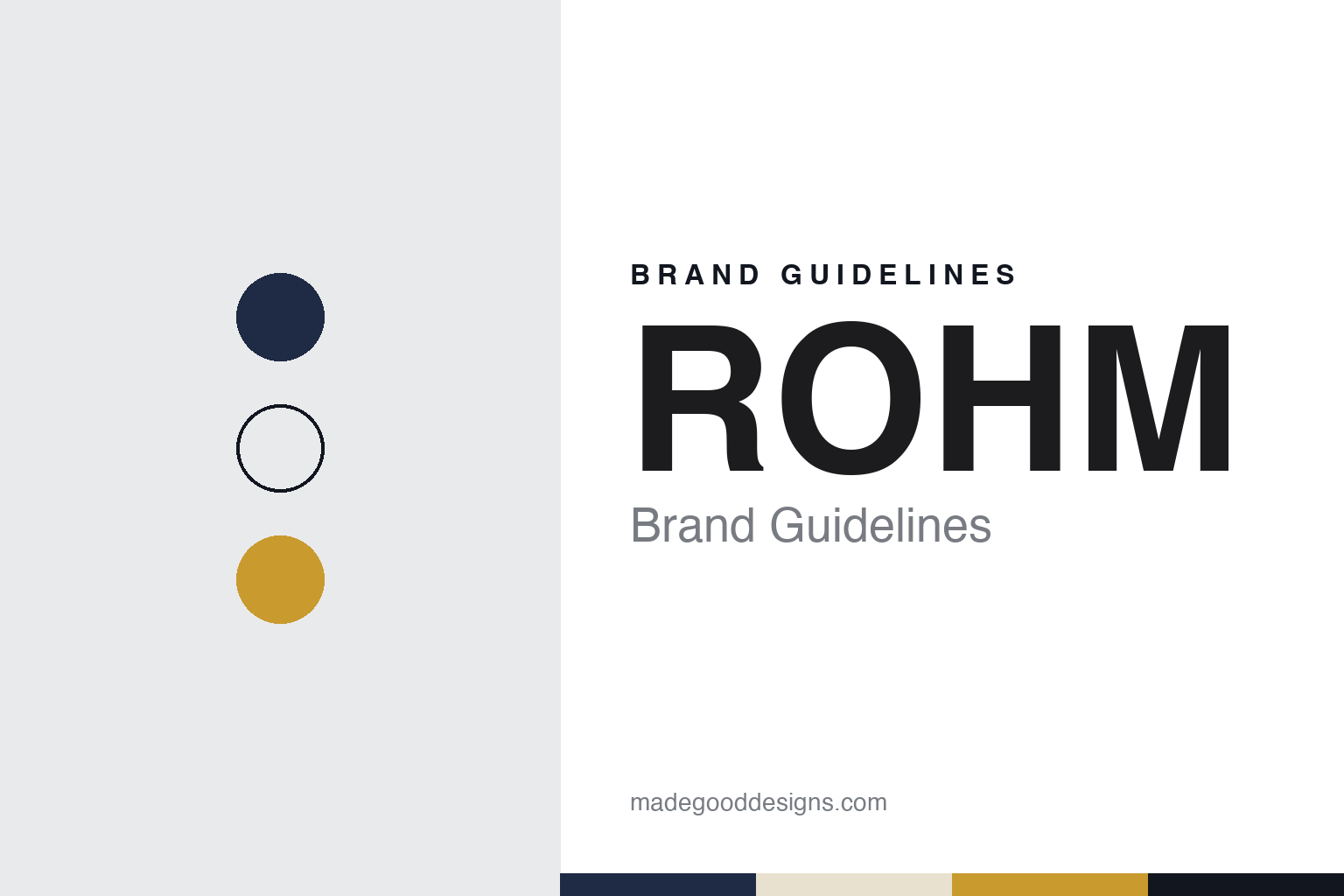
Two constants: a ROHM navy and mustard palette and an Engineered sans register. Abstract homage — not a ROHM product or mark; no chip, logo or nameplate is reproduced.
R.ohm
A resistor patent and a name built from it.
ROHM began in Kyoto in 1954. Japanese Wikipedia says its founder, Kenichiro Sato, built the business on a patent for a carbon-film resistor that he devised while a student at Ritsumeikan University. The company’s own history lists 1954 as the year Toyo Electronics Industry was established and its carbon-film resistors were developed and marketed. The business was incorporated on 17 September 1958 as Toyo Electronics Industry Corporation, the date given both by the company and by English Wikipedia.
The name comes from that first product. English Wikipedia says the company was originally called R.ohm — R for resistor, plus ohm, the unit of electrical resistance — and Japanese Wikipedia gives the same derivation. The company says its trademark changed from R.ohm to ROHM in 1979, and that its registered name changed from Toyo Electronics Industry Corporation to ROHM Co., Ltd. in 1981.
From resistors it moved steadily into semiconductors. Its history lists transistors and switching diodes in 1967, the start of integrated-circuit development in 1969, research on integrated circuits in Silicon Valley from 1971, LEDs in 1973 and thermal printheads in 1974; zener and rectifying diodes followed later in the decade. Japanese Wikipedia says custom LSIs, which combine functions on one chip to a customer’s specification, later became its main line. It listed on the second section of the Osaka exchange in 1983 and on the first section of the Tokyo Stock Exchange in 1989, according to Japanese Wikipedia, and the company says it moved to the Tokyo exchange’s Prime Market in 2022.
Colour
OKI Semiconductor, Kionix and SiCrystal.
Two acquisitions in two years shaped the modern group. In 2008 ROHM bought the semiconductor business of Oki Electric — 95 percent of OKI Semiconductor, now LAPIS Semiconductor, according to Japanese Wikipedia; English Wikipedia says LAPIS designs and makes FeRAM and other LSI chips. In 2009 the accelerometer maker Kionix, Inc. became a subsidiary.
The second 2009 deal pointed to the company’s future. SiCrystal, a German maker of silicon-carbide wafers, was taken over by ROHM that year, Compound Semiconductor reported in April 2022. The magazine traced SiCrystal to research at the University of Erlangen in the early 1990s and to SiCrystal AG, founded in 1997, which first made sample wafers at Eschenfelden in the Upper Palatinate before moving back to Erlangen. ROHM moved its wholly owned subsidiary to the Nordostpark industrial park in Nuremberg, where it makes single-crystal SiC wafers — discs the magazine compared to “a CD without a hole.” SiCrystal employed more than 200 people at the time of that report.
ROHM’s own history then charts its silicon-carbide products: mass production of SiC Schottky barrier diodes in 2010, what it calls the world’s first SiC DMOSFETs in December 2010, full-SiC power modules in 2012, what it calls the world’s first trench-type SiC MOSFETs in 2015, and fourth-generation SiC MOSFETs in 2020. Alongside power devices, English Wikipedia lists power-stage ICs for power supplies, CMOS operational amplifiers, Hall-effect sensors and DC-to-DC and AC-to-DC converters among its products.
Manufacturing is spread across Japan and Asia. The company lists plants established in Thailand in 1987, the Philippines in 1989 and Tianjin, China, in 1993; English Wikipedia records a plant in Kelantan, Malaysia, operating from April 2017 and expanded from 2022. In April 2026 ROHM reorganised its domestic manufacturing companies into two, ROHM Device Manufacturing and ROHM Assembly Manufacturing, the company says.
Typography
Chips, wafers and power.
Analog and power chipmakers sell parts that most people never see. Their products sit inside chargers, cars, motor drives and power supplies, usually as small black packages soldered to a board, so the industry’s visual language has to make something tiny and hidden look solid and precise. The usual answer is the macro photograph: a packaged chip or a power module shot close up against a dark or plain ground, its leads and markings sharp and its edges lit like an object in a catalogue.
Materials are the second subject. Makers that work with silicon carbide tend to show the wafer itself, a thin disc that often looks faintly green or amber under studio light, while gallium-nitride and silicon makers show wafers patterned with rows of dies. These images stand in for the factory, which tends to appear as clean-room suits and wafer carriers rather than as a building.
The third subject is the application. Power-chip makers lean heavily on electric-car chargers, inverters, solar installations and data-centre racks, because those are where their parts do visible work. Closer to the engineer, the pictures shift to evaluation boards on lab benches, probes and cables, and oscilloscope traces showing a clean switching edge — an image that speaks to the people who will design the chip in.
Trade shows complete the picture. Europe’s electronica in Munich and PCIM in Nuremberg, and APEC in the United States, are where many of these companies set out their stands, demonstration boards and new packages each year. In each of these settings the hardware and the technical data are meant to carry the message, with the brand kept to a name on the stand and the board.
Aa
An engineered sans — ROHM in capitals. (Specimen set in IBM Plex Sans, a sans STAND-IN; NOT the ROHM logo.)
ROHM
A quiet name in Kyoto.
ROHM is a quiet brand for a large company. Japanese Wikipedia notes that it does little advertising to the general public and does not print its logo on its products, though engineers recognise its LSI chips by part numbers beginning BD, BU or BH; it also records that Kyoto head-office staff, other than sales, wear mustard or pale-yellow uniforms. The company changed its logo to “ROHM SEMICONDUCTOR” on 17 September 2008 to mark its 50th anniversary, its history says. Its public name in Kyoto is cultural: it took the naming rights to the city’s Kyoto Kaikan hall, which became ROHM Theatre Kyoto in 2016, according to both the company and Japanese Wikipedia, and it set up the ROHM Music Foundation in 1991. It briefly sold LED lighting to households through a subsidiary, AGLED, but sold that business to Iris Ohyama and withdrew at the end of May 2016, Japanese Wikipedia says.
Its ownership became an open question in 2026. In February the car-parts maker Denso proposed acquiring ROHM; on 28 April, Jiji Press reported, Denso withdrew the proposal after failing to win the support of ROHM’s board and special committee, while saying it would continue business cooperation. ROHM, Toshiba and Mitsubishi Electric began talks in March 2026 on integrating their power-semiconductor businesses. On 1 July Jiji Press reported that the negotiations were continuing, that the outcome remained uncertain, and that ROHM’s president, Katsumi Azuma, had said the process was “taking longer than expected.” The company remains headquartered in Kyoto’s Ukyo ward, with 21,756 employees across the group at the end of March 2026, it says.
For a design guide, ROHM shows how a component maker can carry its first product in its name for more than seventy years. Compare Renesas, another Japanese chipmaker shaped by mergers, and Wolfspeed, a silicon-carbide specialist. For this guide we use a deep navy and a mustard yellow with a sans, an unofficial interpretation; no product or logo is reproduced.
Explore & save
Keep ROHM’s identity on hand — save it to a board in the Made Good inspiration library.
ROHM identity set
Pin the ROHM navy and mustard palette and the Engineered sans register to your own board.