Wolfspeed Brand Guidelines
Cree’s silicon-carbide wolf, renamed in 2021.
Aa
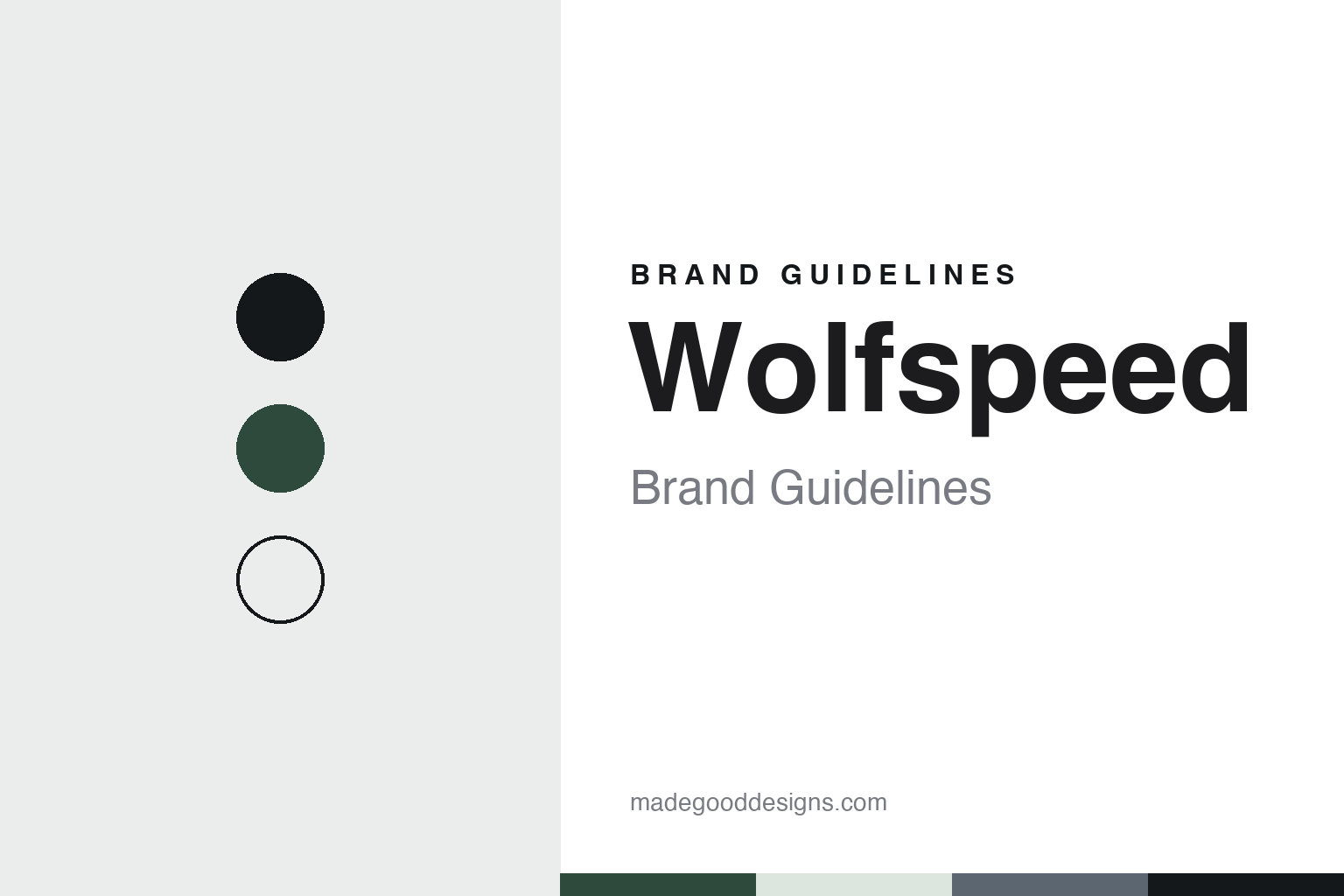
Two constants: a carbide green, slate and pale wafer green palette and an engineering sans register. Abstract homage — not a Wolfspeed product or mark; no chip, wafer, logo or nameplate is reproduced.
Cree Research
Six founders and a hard material.
Wolfspeed began as Cree Research, founded in July 1987 in Durham, North Carolina. English Wikipedia names six founders — Neal Hunter, Thomas Coleman, John Edmond, Eric Hunter, John Palmour and Calvin Carter — and says five of them were graduates of North Carolina State University. Their material was silicon carbide, a hard compound of silicon and carbon that the company learned to grow into wafers; Wikipedia says Cree Research released the first commercial silicon-carbide wafer in 1991.
The company floated on Nasdaq in 1993 under the ticker CREE and was renamed Cree, Inc. in 1999. For much of the next two decades the public knew it for light-emitting diodes and lighting rather than for wafers: it bought Ruud Lighting of Wisconsin in 2011 and sold LED bulbs to consumers, Wikipedia says. Silicon carbide stayed underneath, as a base material for its LEDs and later for power and radio-frequency chips.
A first attempt to separate that business failed. In July 2016 Infineon agreed to buy Cree’s power and RF unit, which by then traded as Wolfspeed; the deal was terminated in February 2017 over US national-security concerns, Wikipedia says, and electrive reported in 2021 that US authorities had vetoed it. Cree went the other way instead and bought Infineon’s RF power business in March 2018.
Colour
From lighting to a pure silicon-carbide company.
Between 2019 and 2023 Cree sold almost everything that was not silicon carbide. Its lighting products division went to IDEAL Industries in May 2019 and continues separately as Cree Lighting; the LED business went to SMART Global Holdings in March 2021, according to Wikipedia. The company itself called this a four-year transformation that divested two-thirds of the business.
On 4 October 2021 Cree, Inc. became Wolfspeed, Inc. and moved its listing to the New York Stock Exchange under the ticker WOLF. electrive reported on 5 October 2021 that Wolfspeed had already been the trademark for the company’s silicon-carbide components for six years, and that once the other units were sold, the trademark became the company name. The company says the name joins “the noble traits of the wolf,” which it lists as leadership, intelligence and endurance, with speed, for how fast it says it innovates and operates. On the same day it announced a supply agreement with General Motors for silicon-carbide devices in the power electronics of GM’s Ultium Drive units, for both 400-volt and 800-volt systems, electrive reported; the new fab in New York State was to make those chips.
The last piece outside silicon carbide went in 2023. MACOM agreed in August 2023 to buy Wolfspeed’s RF business, and the sale was completed in early December 2023, TrendForce reported, quoting the then chief executive Gregg Lowe calling Wolfspeed “the only pure-play silicon carbide semiconductor manufacturer in the industry” — the company’s own description. What remains are two lines: materials, meaning silicon-carbide wafers, and power devices such as MOSFETs, Schottky diodes and power modules. The company aims them at electric vehicles, fast charging, renewable energy and storage, and aerospace and defence, it says, and its website also lists bare die, reference designs and evaluation kits.
Typography
Chips, wafers and the power trade.
Analog and power chipmakers sell parts that most people never see. Their products sit inside chargers, cars, motor drives and power supplies, usually as small black packages soldered to a board, so the industry’s visual language has to make something tiny and hidden look solid and precise. The usual answer is the macro photograph: a packaged chip or a power module shot close up against a dark or plain ground, its leads and markings sharp and its edges lit like an object in a catalogue.
Materials are the second subject. Makers that work with silicon carbide tend to show the wafer itself, a thin disc that often looks faintly green or amber under studio light, while gallium-nitride and silicon makers show wafers patterned with rows of dies. These images stand in for the factory, which tends to appear as clean-room suits and wafer carriers rather than as a building.
The third subject is the application. Power-chip makers lean heavily on electric-car chargers, inverters, solar installations and data-centre racks, because those are where their parts do visible work. Closer to the engineer, the pictures shift to evaluation boards on lab benches, probes and cables, and oscilloscope traces showing a clean switching edge — an image that speaks to the people who will design the chip in.
Trade shows complete the picture. Europe’s electronica in Munich and PCIM in Nuremberg, and APEC in the United States, are where many of these companies set out their stands, demonstration boards and new packages each year. In each of these settings the hardware and the technical data are meant to carry the message, with the brand kept to a name on the stand and the board.
Aa
An engineering sans for a materials company. (Specimen set in Inter Tight, a sans STAND-IN; NOT the Wolfspeed logo.)
Wolfspeed
A fab in New York and a 2025 restructuring.
Wolfspeed’s headline factory is the Mohawk Valley fab at Marcy, in upstate New York. Announced in September 2019, it opened in April 2022, according to Wikipedia, and was planned around 200mm silicon-carbide wafers, electrive reported in 2021. A planned plant at Ensdorf in Germany’s Saarland, announced in February 2023, was delayed in June 2024 and put on indefinite hold in October 2024, citing low demand, Wikipedia says; the car-parts maker ZF, a planned partner in the project, withdrew. Semiconductor Today gave the company’s headquarters as Durham, North Carolina, in January 2026.
The expansion was financed largely with debt. On 30 June 2025 Wolfspeed filed for Chapter 11 bankruptcy protection, with a restructuring plan agreed in advance with lenders and with Renesas Electronics, one of its creditors. A US bankruptcy judge approved the plan on 9 September 2025, and the company emerged on 29 September 2025, Wikipedia says; old shares were cancelled and new ones issued. Compound Semiconductor reported on 30 September 2025 that the restructuring cut total debt by about 70 per cent and pushed maturities out to 2030, under chief executive Robert Feurle and a largely new board.
The final step came in January 2026, when the Committee on Foreign Investment in the United States cleared the issue of Wolfspeed shares to Renesas, which had converted its loan into equity and secured convertible debt and named a director to the board, Semiconductor Today reported on 30 January 2026. The same report said earlier shareholders received a 5 per cent recovery in total. Wikipedia lists the company as trading on the New York Stock Exchange as WOLF.
For a design guide, Wolfspeed shows how a name made for one product line can become the whole company once everything else has been sold. Compare Renesas, now a Wolfspeed shareholder, and Infineon, which once agreed to buy the business. For this guide we use a deep green, a slate grey and a pale wafer green with a sans, an unofficial interpretation; no product or logo is reproduced.
Explore & save
Keep Wolfspeed’s identity on hand — save it to a board in the Made Good inspiration library.
Wolfspeed identity set
Pin the Wolfspeed carbide green, slate and pale wafer green palette and the engineering sans register to your own board.