KEMET Brand Guidelines
Union Carbide’s 1919 metals unit that became a capacitor name.
Aa
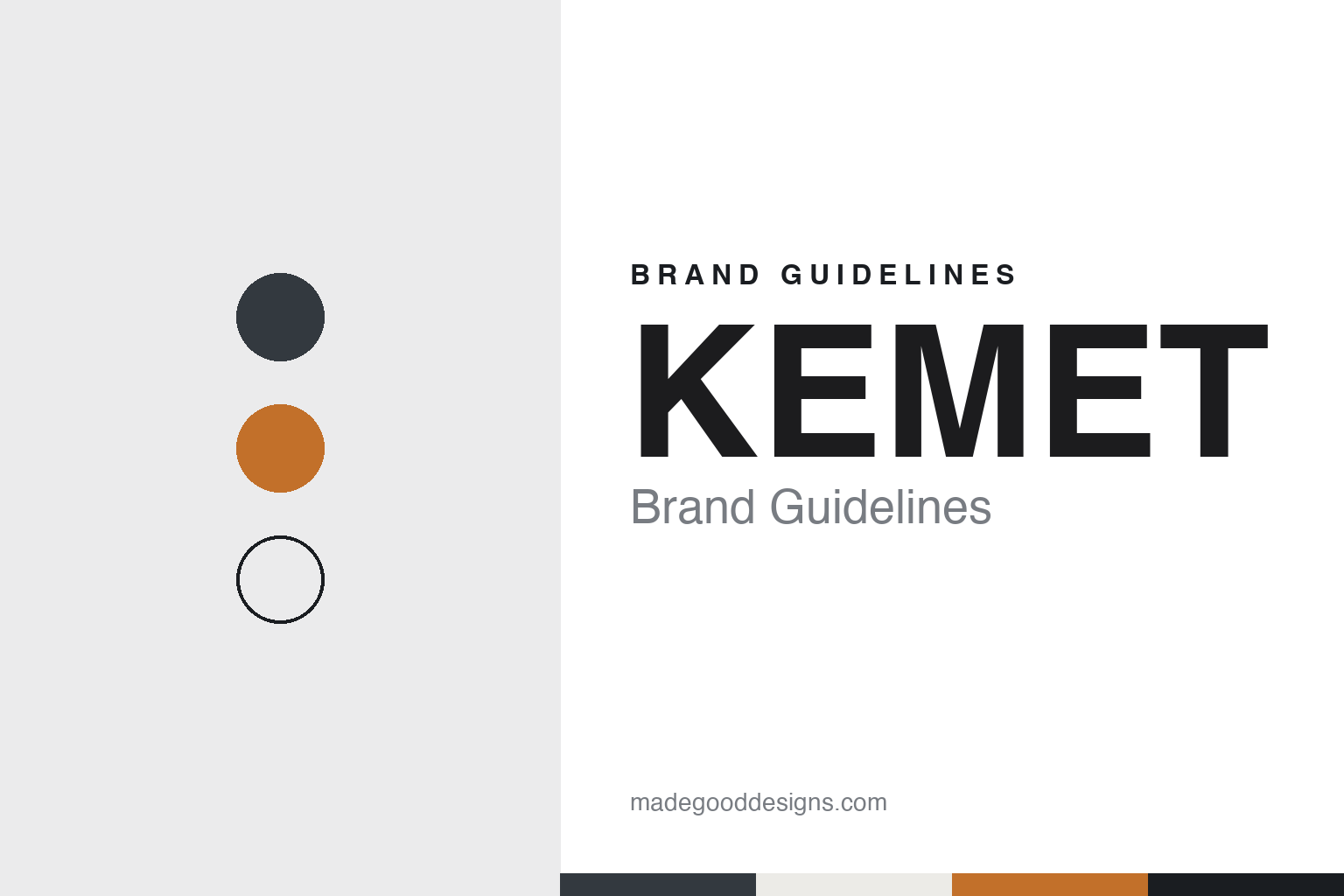
Two constants: a KEMET tantalum grey and kiln orange palette and an Industrial sans register. Abstract homage — not a KEMET product or mark; no component, logo or nameplate is reproduced.
Chemical and metallurgy
A Union Carbide unit in Cleveland.
KEMET began inside an American chemical company. A history of the business in the International Directory of Company Histories, published by Gale, says it was set up in 1919 as a division of Union Carbide to buy the assets of the Cooper Research Company of Cleveland, Ohio, which had invented a promising high-temperature alloy. The name, both that history and English Wikipedia say, was formed from “chemical” and “metallurgy.”
Its first products were parts for vacuum tubes. The Gale history says KEMET used the alloy for grid wires in triode tubes, which regulated the flow of current, and from 1930 made barium-aluminium getters, small parts needed in every vacuum tube. With Union Carbide’s backing it built automatic machinery to make getters in large numbers. During the Second World War, the same history says, demand for vacuum tubes rose sharply as communications, radar and other electronic equipment was produced in quantity, and KEMET went on supplying the tube industry through the post-war boom, including makers of early vacuum-tube computers.
The turn to capacitors came in the 1950s. After Bell Telephone Laboratories developed the transistor and the solid tantalum capacitor, KEMET’s managers chose the tantalum capacitor as the company’s next product, drawing on Union Carbide’s experience with high-temperature metals; English Wikipedia dates the change of focus to 1958. In 1962 KEMET built a capacitor plant in Greenville, South Carolina, which opened in 1963, and in 1969 it added multilayer ceramic capacitors. A plant in Matamoros, Mexico, followed, and the Cleveland plant was phased out, its equipment and staff moving to South Carolina or Mexico, the Gale history says. New plants later opened in Greenwood, South Carolina, and Columbus, Georgia, though the Georgia plant was later closed.
Colour
A buyout in two steps.
Union Carbide let KEMET go in two steps. By the mid-1980s, the Gale history says, the parent had lost interest in capacitors as foreign competition squeezed the business, and in 1987 it sold the unit through a management leveraged buyout, keeping half of the new KEMET Electronics Corporation; the former division head, Dave Maguire, became chief executive. In 1990 Union Carbide sold its remaining shares to KEMET’s management and other investors, including Citicorp Venture Capital, and in 1992 the company went public as KEMET Corporation on the NASDAQ market. English Wikipedia describes 1990 as the year KEMET Electronics was acquired from Union Carbide, ending all ties, and gives the later stock listing as the New York Stock Exchange.
Under Maguire the company put its new capacity into surface-mount tantalum and ceramic capacitors, which can be mounted on both sides of a circuit board, and ran a company-wide quality programme. The Gale history records registration to the ISO 9001 quality standard in 1992 and Ford’s Total Quality Excellence Award, and says that by the mid-1990s KEMET was making capacitors in ten plants in the United States and Mexico.
Growth then came by acquisition. English Wikipedia lists the tantalum business of EPCOS in 2007; the Evox Rifa Group and Arcotronics Italia in 2008; Cornell Dubilier Foil and Niotan in 2012; and a controlling share of NEC Tokin, completed in April 2017, after which that company was renamed TOKIN. It also says KEMET opened an aluminium electrolytic innovation centre in Weymouth, England, in October 2013. By 2020 the range covered tantalum, ceramic, film and electrolytic capacitors as well as magnetics, sensors and actuators; English Wikipedia adds paper capacitors, supercapacitors, EMI filters and relays.
Typography
Passive components.
Passive components are hard to photograph and harder to brand. A multilayer ceramic capacitor in the smallest sizes is a speck that sits like a grain of sand on a fingertip, and a scatter of chips on a fingertip is one way to show that scale. Resistors, inductors, filters and fuses look little different from one maker to the next, so the presentation leans on the company’s name, its colours and the way it pictures the work behind the part.
The pictures repeat across the trade. Reels of tape-and-reel parts, ready for pick-and-place machines, stand for volume. Through-hole resistors with their coloured bands, cut-away capacitors that open up the layers or the wound film inside, and close-ups of ceramic sheets being stacked stand for the craft. Automated inspection lines, with cameras checking each part, stand for consistency, and pictures of factories and laboratories often stand in for the end products the parts go into.
Trade shows are where these brands meet engineers in person. electronica in Munich and CEATEC in Japan are among the fairs where component makers take large stands, and some use them for showpieces that have little to do with a datasheet: Murata, for one, says it demonstrated its bicycle-riding Murata Boy robot at CEATEC JAPAN 2005.
Many of these companies began with a material rather than a product: ferrite, titanium oxide, barium titanate, tantalum or film. Several have changed hands or merged, so names, marks and owners do not always line up. This guide sets out who founded each brand, who owns it now and where it says its parts are made, and marks clearly what rests only on the company’s own word.
Aa
An industrial sans — KEMET in capitals. (Specimen set in Archivo, a sans STAND-IN; NOT the KEMET logo.)
KEMET
A Yageo company since 2020.
The last change of owner came from Taiwan. On 11 November 2019, English Wikipedia says, it was announced that KEMET would be acquired by Yageo, the Taiwanese passive-components group. The deal closed on 15 June 2020: the trade site Passive Components Blog published KEMET’s announcement on 16 June 2020 that it was now a wholly owned subsidiary of Yageo and that its shares were no longer listed on any public market. The announcement described KEMET as established in 1919 and headquartered in Fort Lauderdale, Florida, with 21 manufacturing facilities in 21 countries across the Americas, Asia and Europe, and listed its main products as tantalum, ceramic, film and electrolytic capacitors, magnetics, sensors and actuators.
Since then the name has sat inside a group. In November 2026 the address kemet.com forwards to the YAGEO Group website, which names KEMET among its brands alongside Pulse and Tokin. The name itself is still written in capitals, KEMET, and still carries the chemistry-and-metals origin of its 1919 founding, more than a century later.
The palette here — a tantalum grey and an orange taken from the kiln, where ceramic capacitors are fired — is our own interpretation, not a colour the company publishes.
For a design guide, KEMET shows how a short coined name can outlast its parent and pass between owners intact. Compare Yageo, its owner since 2020, and Kyocera AVX, another maker of tantalum and ceramic capacitors. For this guide we use a tantalum grey and a warm orange with a sans, an unofficial interpretation; no product or logo is reproduced.
Explore & save
Keep KEMET’s identity on hand — save it to a board in the Made Good inspiration library.
KEMET identity set
Pin the KEMET tantalum grey and kiln orange palette and the Industrial sans register to your own board.