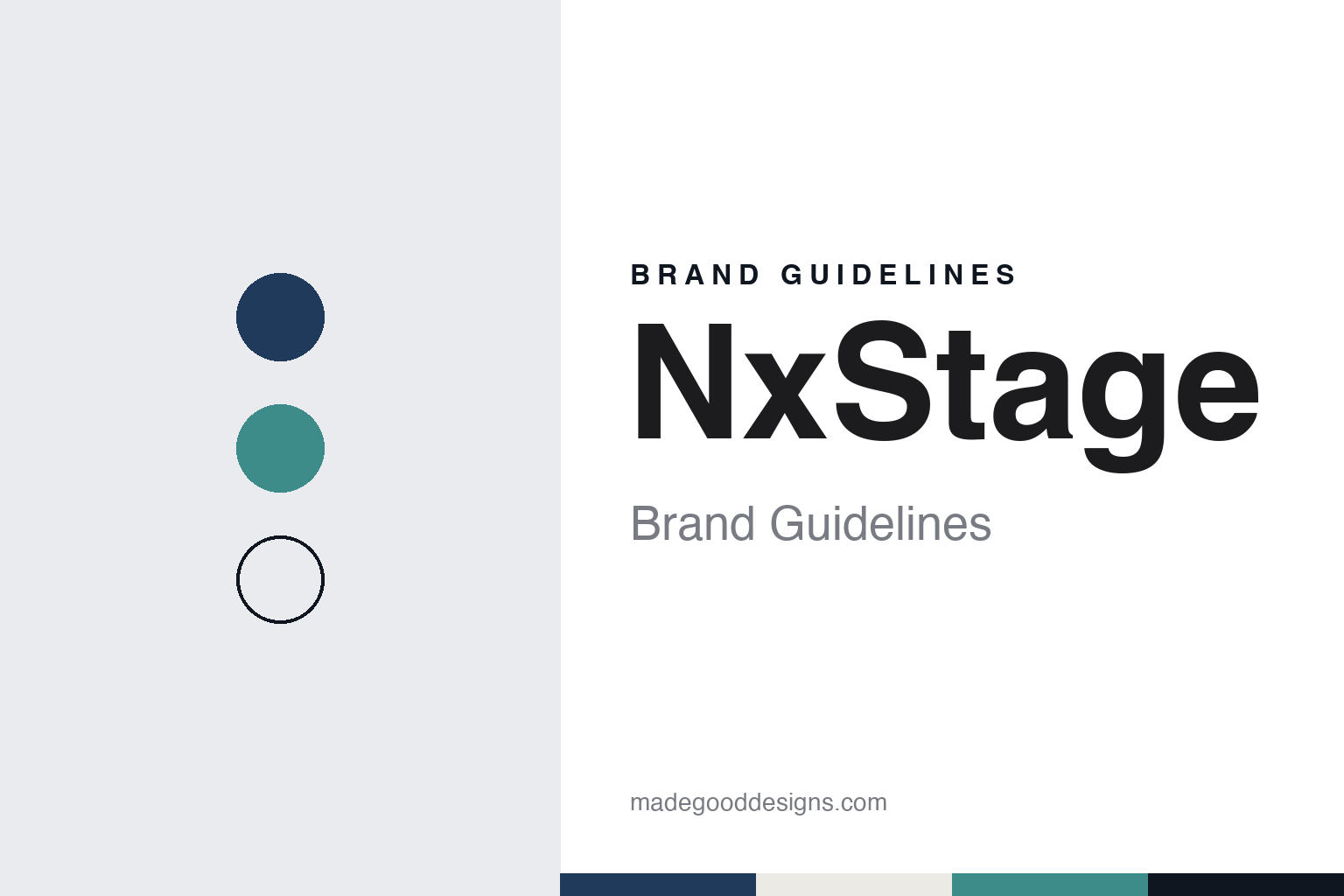
NxStage Brand Guidelines
Lawrence’s portable home hemodialysis maker, now part of Fresenius.
Aa
Two constants: a navy, teal and warm grey palette and a clinical sans register. Abstract homage — not an NxStage product or mark; no machine, logo or nameplate is reproduced.
Lawrence, 1998
Two founders and one machine.
NxStage Medical was founded in December 1998 by C. David Finch Jr., a physician, and Jeffrey H. Burbank, according to English Wikipedia. A company announcement of October 2012, carried by the trade title Trade and Industry Development, said that since its founding NxStage had remained headquartered in Lawrence, Massachusetts. That year it moved into a new headquarters at the Riverwalk Properties site in Lawrence; the ribbon-cutting was set for 15 October 2012, and the listed speakers included Governor Deval Patrick and the company’s chief executive, Jeffrey Burbank.
The company built its business around one machine, the System One. English Wikipedia says NxStage launched it in the critical-care market in 2003 and received Food and Drug Administration clearance for home hemodialysis in June 2005. Fresenius Medical Care, writing about the line in 2023, dates the System One to 2005 and calls it the first portable home hemodialysis machine; the two dates refer to different settings, hospital care first and the home second.
NxStage became a public company through an initial public offering in October 2005, English Wikipedia says, and the 2012 announcement gives its Nasdaq ticker as NXTM. In November 2005 the Massachusetts Medical Device Industry Council, known as MassMEDIC, gave it an innovation award in the start-up category. The 2012 announcement adds that the company was named to Deloitte’s Technology Fast 500 four years running, from 2008 to 2011, and described NxStage as a company that “develops, manufactures and markets” systems for end-stage renal disease and acute kidney failure. It also named the company as a beneficiary of the Massachusetts Life Sciences Center, the state body set up to promote and invest in the life sciences in Massachusetts.
Colour
Home, overnight and solo.
Most of NxStage’s later milestones were about where and when its machine could be used. English Wikipedia records FDA clearance for the System One to be used overnight, while patients sleep, in December 2014, and for solo home hemodialysis without a care partner, during waking hours, in August 2017. Fresenius Medical Care’s 2023 account of the line describes both clearances as firsts for those indications.
The same account fills in the rest of the range: the PureFlow water-purification system in 2006, the Nx2me Connected Health platform in 2014, which Fresenius calls the first connected-health platform for home hemodialysis, and the VersiHD touchscreen cycler in 2017. The “Nx” of the company name runs through the product names: Nx2me for the connected-health platform, and NxRx and NxDocuments for the ordering and training portals that the Fresenius home-therapies site lists today.
On 23 August 2023 Fresenius Medical Care announced FDA 510(k) clearance for VersiHD with GuideMe Software, which it described as a “completely reinvented self-guided interface” for the VersiHD system, giving graphical walk-through guidance to patients and nurses during training and treatment. The company said it would be available first in selected markets in 2023 and that existing VersiHD systems could be upgraded. In that release Fresenius referred to the brand as “NxStage from Fresenius Medical Care,” a form of words that keeps the original name in front while naming the owner.
Typography
Kidney care and its pictures.
Dialysis and kidney-care companies sell to two audiences at once. One is clinical: nephrologists, nurses, technicians and hospital buyers who choose machines, dialyzers and solutions. The other is the patient, who may spend several sessions a week in a treatment chair or carry out dialysis at home. Their imagery tends to answer both: a calm patient in a reclining chair beside a machine, a nurse in a bright, orderly clinic, and close-ups of dialyzers, tubing and the screens of haemodialysis machines.
Home treatment has added a second setting. Peritoneal dialysis and home haemodialysis bring the equipment into kitchens, bedrooms and living rooms, and the companies that make or support it often show machines beside sofas and tables rather than in clinical rooms. Symbols tend to stay simple: kidney shapes, drops, waves and circles that print clearly on a label, a machine housing or a clinic sign.
The trade meets at a few large congresses. The American Society of Nephrology’s Kidney Week, held in Denver in 2026, drew nearly 12,000 participants from close to 100 countries, the society says, and makers such as Fresenius Medical Care list it among their events. In Europe, the European Renal Association holds an annual congress, scheduled for Rotterdam in 2027 and Berlin in 2028, according to the association.
This guide sets out what can be checked about each company: who founded it, who owns it, where it works and what it makes. Where a fact rests only on a company’s own word, we say so, and the colours and typefaces shown are our own interpretation rather than any official brand standard.
Aa
A plain, clinical sans for a home-dialysis name. (Specimen set in Work Sans, a sans STAND-IN; NOT the NxStage logo.)
Fresenius
A start-up name inside a larger group.
NxStage is no longer an independent company. Fresenius Medical Care agreed to buy it, and on 19 February 2019 the US Federal Trade Commission, by a 3–2 vote, required as a condition of the deal that all rights and assets of NxStage’s bloodline tubing set business be transferred to B. Braun Medical. On 26 February 2019 Fresenius Medical Care North America announced from Waltham, Massachusetts, that it had completed the acquisition following approval by US antitrust authorities; the release gives 21 February 2019 as the closing date and says NxStage then had about 3,800 employees worldwide.
The same release described NxStage as a company that “develops, produces and markets” medical devices for home dialysis and critical care, and noted that, like Fresenius Medical Care North America, it had its headquarters in the Boston area. Fresenius said the purchase would let it use its manufacturing, supply-chain and marketing strengths across its dialysis products, services and care-coordination businesses “in a less labor- and capital-intensive care setting.” Its chief executive at the time, Rice Powell, called the closing “an important milestone in enhancing our patients’ choice of dialysis treatment modality.”
Today NxStage lives on as a product brand. English Wikipedia describes NxStage Medical, Inc. as a subsidiary of Fresenius Medical Care. The nxstage.com address now forwards to Fresenius Medical Care’s home-therapies site, which presents the System One, VersiHD and Nx2me under the NxStage name alongside the group’s peritoneal-dialysis products. That site says solo home hemodialysis became available in 2017, when NxStage systems became “the first and only” hemodialysis machines cleared in the US for use without a care partner during waking hours; that is the company’s own description.
For a design guide, NxStage shows how a start-up’s name can outlast its independence when it is attached to a recognisable product family. Compare Fresenius Medical Care, its owner since 2019, and Outset Medical, another US maker of dialysis systems. For this guide we use a deep navy, a river teal and a warm grey with a sans, an unofficial interpretation; no product or logo is reproduced.
Explore & save
Keep NxStage’s identity on hand — save it to a board in the Made Good inspiration library.
NxStage identity set
Pin the NxStage navy, teal and warm grey palette and the clinical sans register to your own board.