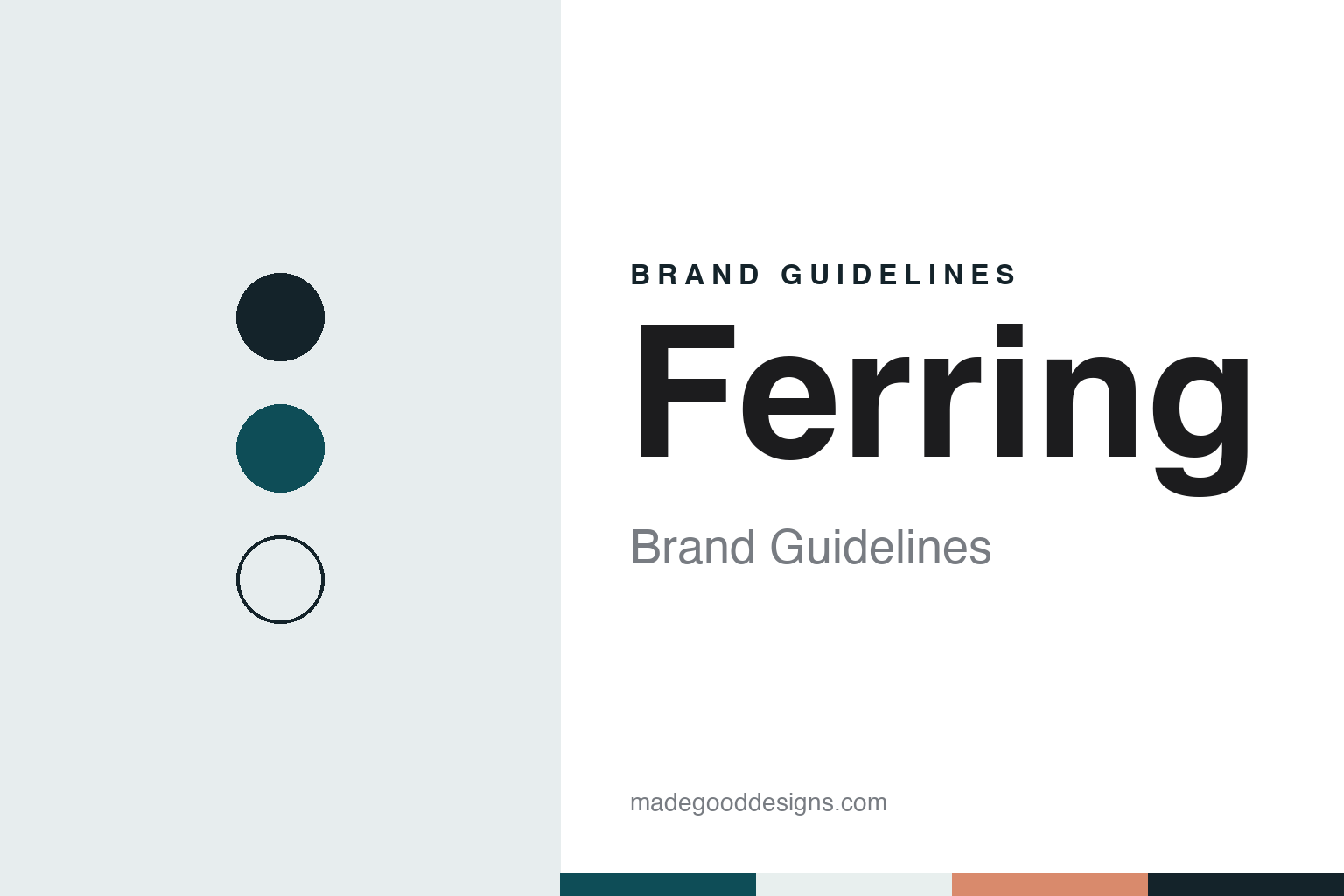
Ferring Brand Guidelines
A 1950 Malmö hormone lab with a Frisian name, now in Saint-Prex.
Aa
Two constants: a teal, mist and coral palette of our own and a humanist sans register. Abstract homage — not a Ferring product or mark; no pack, logo or product is reproduced.
A hormone laboratory in Malmö
Two rented rooms, peptide hormones and an island name.
Ferring began in Malmö, in southern Sweden, in 1950. English Wikipedia says it was founded by Frederik Paulsen and Eva Paulsen as the Nordiska Hormon Laboratoriet, a hormone laboratory; a company timeline published by the market-research firm BCC Research names the co-founder as Eva Frandsen and spells the laboratory’s name slightly differently, so the sources differ on those details. Both agree on the year, the city and the change of name in 1954, when the business became Ferring.
The name points to an island rather than to medicine. The German chemistry encyclopaedia chemie.de, citing the Kieler Nachrichten in 2006, says Paulsen was of German origin, that his parents came from Föhr, one of the North Frisian islands off Germany’s west coast, and that he had moved to Sweden in 1935. In the Frisian language the people of Föhr are called Feringen, and the company name is taken from that word; English Wikipedia gives the same explanation.
The early work was in hormones. BCC Research’s timeline says Ferring moved from rented premises into its first own factory in Malmö in 1956 and began industrial-scale production of the synthetic peptide hormones vasopressin and oxytocin in 1961, a step English Wikipedia calls the company’s first major breakthrough. chemie.de says that in the 1950s and 1960s Ferring was among the early companies in the commercial synthesis of pituitary hormones, and that the development of desmopressin, sold as Minirin, was a decisive step; BCC Research dates the launch of Minirin to 1972.
Germany came early in the company’s growth. chemie.de says the German subsidiary, Ferring Arzneimittel, was founded in 1956, six years after the parent company, and moved from Düsseldorf to Kiel in 1973; BCC Research dates Ferring’s first production site in Kiel to the same year.
Colour
From hormones to reproductive and maternal health.
English Wikipedia lists Ferring’s main areas as reproductive health, maternal health, gastroenterology and urology. It also says Ferring has been developing treatments for mothers and babies for more than 50 years. The path into fertility medicine is visible in BCC Research’s timeline: it dates Ferring’s first infertility product, Menogon, to 1993, and the launch of Tractocile, an atosiban medicine for use in pre-term labour developed by Ferring’s own researchers, to 2000.
The headquarters moved twice. English Wikipedia says that as the company grew its head office moved from Sweden to Copenhagen and then to Switzerland, where the group is now based in Saint-Prex, on Lake Geneva. In Copenhagen Ferring ran a research centre in the Ferring Tower in Ørestad, which English Wikipedia says was sold in 2021 and renamed.
Research also spread to the United States. English Wikipedia says the Dutch subsidiary Ferring B.V. expanded to the US in 1980, that the Ferring Research Institute was set up in San Diego in 1996 for peptide research, and that it moved into a new building in the Sorrento Valley area in February 2009. It also says Ferring runs its own manufacturing in several European countries and in South America, China, India and the United States.
Acquisitions brought in new areas. English Wikipedia says that in October 2011 Ferring bought Cytokine PharmaSciences and its Scottish subsidiary Controlled Therapeutics, with a focus on obstetrics. In April 2018, the trade publication DCAT Value Chain Insights reported on 10 April, Ferring agreed to buy Rebiotix of Roseville, Minnesota, a clinical-stage company working on treatments based on the human microbiome, whose lead candidate was then in phase III development; the report also listed Ferring’s research ties with Sweden’s Karolinska Institute. English Wikipedia adds that in November 2019 Ferring and Blackstone Life Sciences set up a gene-therapy company, FerGene, for a bladder-cancer candidate.
Typography
How mid-sized drug makers present themselves.
Europe’s mid-sized drug makers tend to present themselves through their origins. Many began as a single pharmacist, doctor or industrialist with a laboratory, and their corporate histories still open with a founder, a town and a first product. Family holding companies and foundations often remain in the background as long-term shareholders, and the companies’ own timelines give as much space to new factories and research centres as to the medicines that came out of them.
The visual language that follows is restrained. Corporate sites and annual reports favour photographs of scientists at the bench, production lines seen through glass, and patients in ordinary settings — at home, at work, outdoors — rather than in hospital. Long-serving research campuses, some in use for half a century or more, appear again and again as proof of continuity, alongside newer laboratories in biotech districts abroad.
Identity systems are usually simple: a short word mark or set of initials, a single deep blue or green as the lead colour, and a clean sans for running text. Because prescription medicines cannot be advertised to the general public in the European Union, much of the visible branding lives at medical congresses rather than in shop windows: the dermatology meeting of the EADV, the multiple sclerosis congress of ECTRIMS and the reproductive-medicine meeting of ESHRE are among the places where these companies set up stands, posters and symposia for specialists.
This guide sets out what can be checked about each company — who founded it, who owns it, where it makes and researches its medicines, and how its history is told — and marks plainly what rests only on the company’s own word. The palettes and typefaces shown here are our own interpretations, not official brand assets.
Aa
A humanist sans — clear, clinical, unshowy. (Specimen set in Figtree, a sans STAND-IN; NOT the Ferring logo.)
Ferring
A family company with an island’s name.
Ferring has stayed in private hands. English Wikipedia describes it as privately owned, and chemie.de says the company is wholly privately held and has been led by the founder’s son, also named Frederik Paulsen. English Wikipedia says the group has its own operating subsidiaries in more than 50 countries and sells its products in more than 100.
The family link to Föhr reaches beyond the company name. chemie.de says the founder set up the Ferring Stiftung, a foundation, in 1988 to support the Frisian language, known on the island as Fering, and Frisian culture, and to fund research into living conditions on Föhr and in the surrounding region.
The company’s work has also stayed close to its start. Ferring’s first products were peptide hormones, and chemie.de says its research and development still centres on therapy with synthetic peptides, applied in fertility, urology, gastroenterology, endocrinology and obstetrics. The 2018 Rebiotix purchase added microbiome research alongside that work, DCAT Value Chain Insights reported.
For a design guide, Ferring shows how a private, founder-led company can carry a regional origin story in a single short word while its medicines and its offices move across borders. Compare Novo Nordisk, another Nordic company that grew out of hormone work, and Roche, a Swiss drug maker with family roots. For this guide we use a deep teal, a pale mist and a soft coral with a sans, an unofficial interpretation; no product or logo is reproduced.
Explore & save
Keep Ferring’s identity on hand — save it to a board in the Made Good inspiration library.
Ferring identity set
Pin the Ferring teal, mist and coral palette and the humanist sans register to your own board.