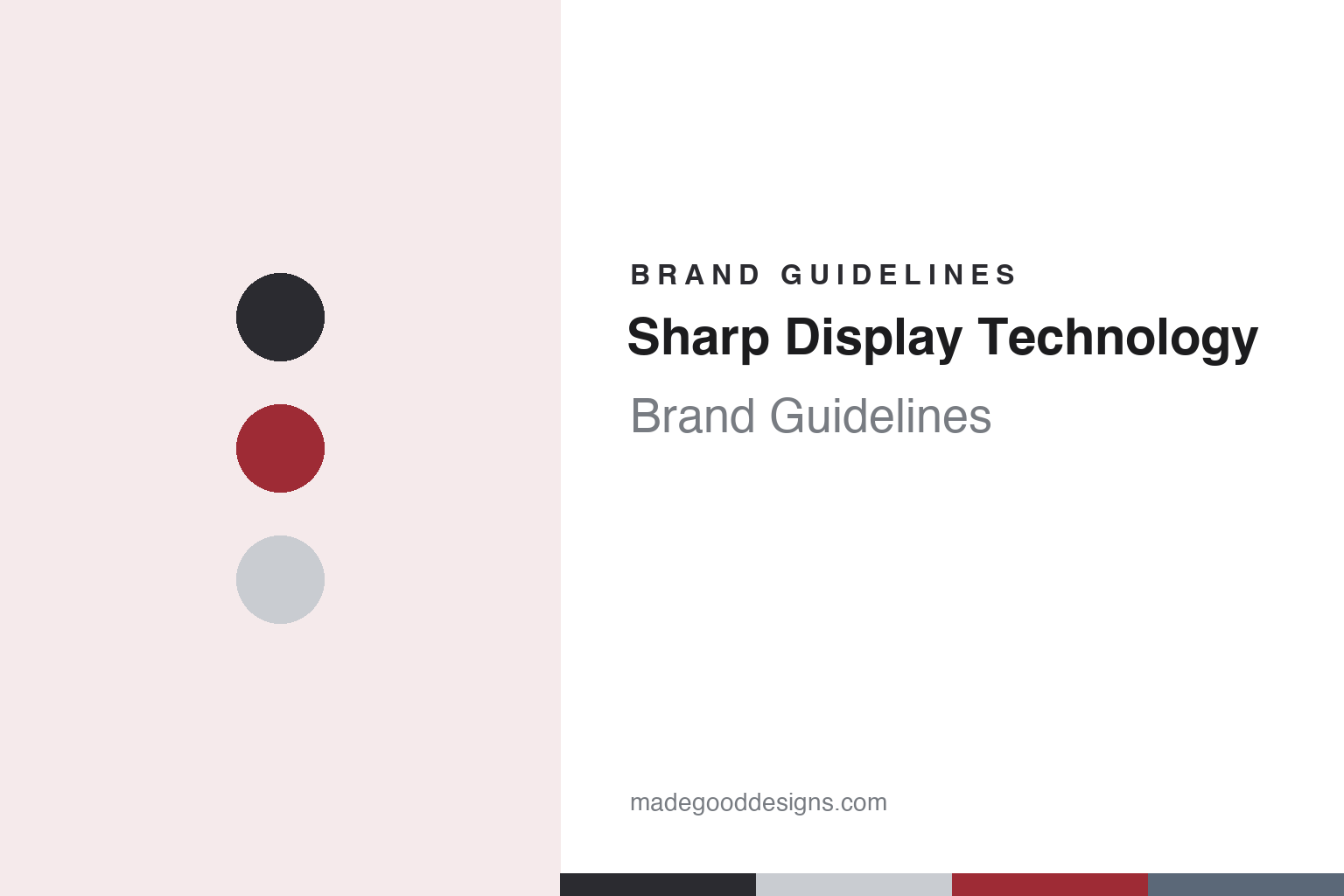
Sharp Display Technology Brand Guidelines
The display arm of an Osaka electronics maker, from calculator LCDs to IGZO.
Aa
Two constants: a graphite, muted crimson and silver palette and a geometric sans register. Abstract homage — not a Sharp Display Technology product or mark; no panel, logo or nameplate is reproduced.
From pencil to panel
A display arm with a 1912 parent.
Sharp Display Technology Corporation, or SDTC, is the display company of Sharp, and its story begins with the parent. Sharp traces its founding to 1912, when Tokuji Hayakawa opened a metal workshop in Tokyo; his Ever-Ready Sharp mechanical pencil of 1915 later gave the company its name, English Wikipedia says. The business was re-established in Osaka in 1924 as Hayakawa Metal Works and began selling crystal radios under the Sharp brand in 1925, Japanese Wikipedia says.
The war years are set out in Sharp’s own 80th-anniversary history of 1992, as cited by Japanese Wikipedia. In 1941 the company became a factory supervised by the Army’s aviation headquarters. In 1942 it was renamed Hayakawa Electric Industry and began making aircraft radios, and in the same year a workshop for war-blinded workers became one of its branch factories. In 1944 it was designated a munitions company and a Navy-supervised factory. After the war it was placed under special accounting rules in 1946, released from them in 1949, and listed on the Osaka exchange that year.
Displays came later. The company took the name Sharp on 1 January 1970, and in 1973 it introduced a calculator with an LCD, which English Wikipedia calls the first LCD calculator and which Sharp treats as the start of its LCD history. Mass production of LCDs began at its Mie plant in 1995, and the first AQUOS LCD televisions followed in 2001.
The 2000s brought very large factories. Sharp opened the Kameyama plant in Mie Prefecture in 2004 and the Sakai plant near Osaka in 2009; English Wikipedia describes Sakai as for a time the only tenth-generation LCD plant in the world. Televisions made with Kameyama panels were sold in Japan as the “Kameyama model,” a label of origin that Japanese Wikipedia says lifted sales sharply.
Colour
Hon Hai, IGZO and a spin-off.
The heavy investment ran into the 2008 financial crisis and falling panel prices. In March 2012 Sharp agreed a capital and business tie-up with Taiwan’s Hon Hai Precision Industry, which trades as Foxconn; in June 2012 Hon Hai’s chairman took a half share in the Sakai plant, English Wikipedia says. In 2016 Hon Hai and related companies bought about two-thirds of Sharp, completing the purchase in August that year, Japanese Wikipedia says. Sharp moved its head office to the Sakai plant in 2016, and in March 2026 to central Osaka.
Sharp’s panel business was among those caught in the international LCD price-fixing investigations. In November 2008 the US Department of Justice announced that Sharp had agreed to plead guilty and pay a criminal fine for taking part in separate conspiracies to fix the prices of TFT-LCD panels sold to Dell, Motorola and Apple between 2001 and 2006. In December 2008 the Japan Fair Trade Commission issued an order against Sharp over LCD modules for the Nintendo DS, English Wikipedia says.
Technology kept moving. In 2012 Sharp began mass-producing LCDs driven by IGZO, an oxide semiconductor of indium, gallium, zinc and oxygen; Sharp says it was the first company in the world to do so, through joint development with Semiconductor Energy Laboratory. Sharp went on to sell an 8K LCD television in 2017.
On 1 October 2020 Sharp spun its display device business off as Sharp Display Technology, with its head office at the Kameyama plant, the Chunichi Shimbun reported that day, as cited by Japanese Wikipedia. The same month Sharp completed its purchase of the land and buildings of the Hakusan plant in Ishikawa from Japan Display, and Sharp now lists Hakusan among SDTC’s bases.
Typography
How display makers present themselves.
Display-panel makers sell to other companies, so most people meet their work under someone else’s name: the screen in a phone, a television, a laptop or a car dashboard. Their own identities are built for customers, investors and engineers, and they come into view most clearly at trade shows such as the Society for Information Display’s Display Week in the United States and CES in Las Vegas, where makers book large stands to show what their panels can do.
The visual language of those stands is the product itself. Huge curved screens, rollable televisions that rise out of a base and transparent panels set in shop windows or furniture sit beside foldable phones photographed mid-fold and car cockpits wrapped in a single sweep of glass. Close-up photography does the rest: macro shots of red, green and blue sub-pixels, flexible films bent between two fingers and wafer-thin edges seen side-on.
Behind the show floor sits the factory. Company films and reports often show clean fab halls, workers in full-body suits and large sheets of glass substrate carried by robot arms, with plants described by “generation,” a measure of the glass size each line handles. Industry awards add another layer of presentation: Display Week’s Display of the Year awards and CES Innovation Awards appear in the makers’ own timelines.
Their histories run through joint ventures, factory sales and regulatory cases as much as through product launches. This guide sets out what can be checked about each one — who founded it, who owns it and where its panels are made — and marks clearly what rests only on the company’s own word.
Aa
A clean geometric sans for an engineering subsidiary. (Specimen set in Manrope, a sans STAND-IN; NOT the Sharp or Sharp Display Technology logo.)
SDTC today
Smaller panels, closed TV fabs.
Sharp’s recruiting site describes SDTC as developing, producing and marketing displays “of all sizes” for smartphones, tablets, PCs, in-vehicle devices and TVs, with bases at Kameyama and Taki in Mie, Tenri in Nara and Hakusan in Ishikawa. It names four areas of work: IGZO, reflective displays that use ambient light instead of a backlight, in-vehicle displays, and research into a next-generation display it calls nano LED.
The large-panel business has largely closed. In May 2024 Sharp announced that it would stop producing LCD panels for televisions within the year, Japanese Wikipedia says. The Sakai plant, run by the Sharp subsidiary Sakai Display Products (SDP), closed on 21 August 2024, Must Share News reported the next day, describing it as the last factory in Japan making LCD panels for televisions. In June 2024 SoftBank agreed with Sharp to turn the Sakai site into an AI data centre, Evertiq reported on 10 June 2024.
Kameyama followed. Sharp announced in 2025 a plan to sell the Kameyama No. 2 plant, which had moved from TV panels to smartphone panels, to Hon Hai. That sale fell through in February 2026: Sharp said LCD panel production at the plant would stop from around August 2026 and that it would look for a buyer after that, The Asia Business Daily reported on 11 February 2026, citing Kyodo News. invidis reported the same on 24 February 2026, adding that a Sharp plant at Yonago in Tottori Prefecture would close in July 2026.
For a design guide, Sharp Display Technology shows how a component maker’s identity sits inside a parent brand: the factories, Kameyama and Sakai, became household names in Japan while the subsidiary itself rarely appears on a product. Compare Sharp, the parent, and Japan Display, which sold Sharp its Hakusan site. For this guide we use graphite, a muted crimson and silver with a sans, an unofficial interpretation; no product or logo is reproduced.
Explore & save
Keep Sharp Display Technology’s identity on hand — save it to a board in the Made Good inspiration library.
Sharp Display Technology identity set
Pin the Sharp Display Technology graphite, crimson and silver palette and the geometric sans register to your own board.