Tianma Brand Guidelines
A Shenzhen display maker from 1983, with a factory in Akita.
Aa
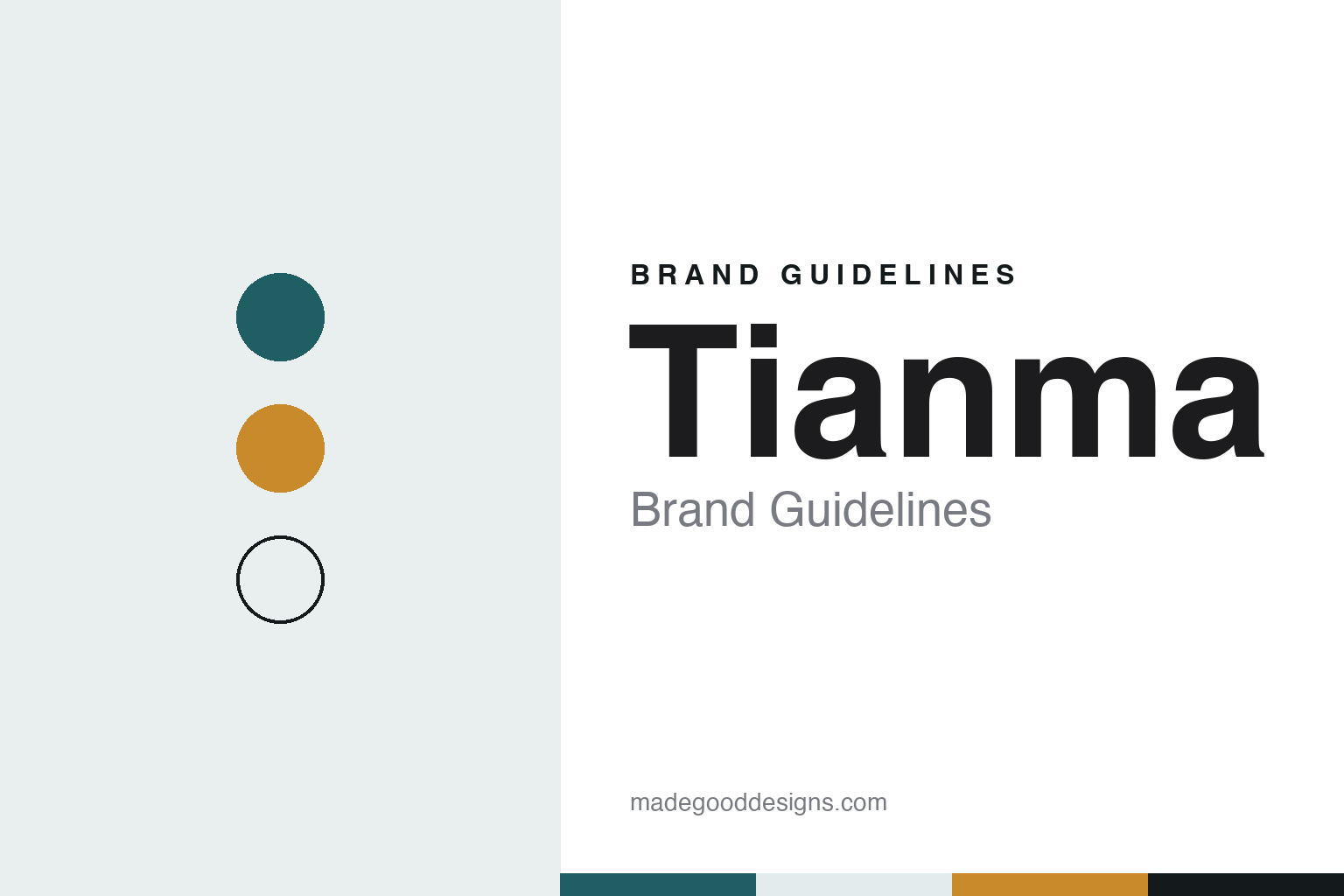
Two constants: a teal, amber and mist palette and a geometric sans register. Abstract homage — not a Tianma product or mark; no display, logo or nameplate is reproduced.
Shenzhen, 1983
An LCD maker that grew into a group.
Tianma — formally Tianma Microelectronics — was established in 1983 in Shenzhen as a maker of LCD displays, OLED-Info wrote in a January 2026 profile. A company profile on China Daily’s government-information portal, dated March 2019, gives the same year and says the company was listed on the Shenzhen Stock Exchange in 1995; Chinese Wikipedia gives its short stock name as Shen Tianma A. The word itself, tianma, is the “heavenly horse” of Chinese folklore, English Wikipedia notes.
OLED-Info traces the move to larger glass: Tianma built its first amorphous-silicon TFT-LCD line in Shanghai in 2006, and by 2009 it had similar fabs in Chengdu and Wuhan.
Tianma belongs to an aviation-industry group. Chinese Wikipedia describes it as part of AVIC International, and reports a March 2017 deal under which Tianma was to buy all of Xiamen Tianma, a flat-panel maker, and 60% of Tianma Organic, its OLED business; after that purchase and a share placement, AVIC International’s direct stake was to fall from 20.81% to 15.16%, the same article says.
The group also reaches into Japan. Japanese Wikipedia traces Tianma Japan to NEC’s colour-LCD development unit, set up in 1989 and spun off as NEC LCD Technologies in April 2003. In July 2011 it became a joint venture of NEC and Shenzhen AVIC Optoelectronics and was renamed NLT Technologies; by March 2013 it had left NEC’s equity accounting, in July 2016 it became a wholly owned Tianma subsidiary, and on 1 July 2017 it took the name Tianma Japan. It is based in Kawasaki and runs a factory in Akita, according to the same article. The business once had a second plant, in Kagoshima; NEC LCD Technologies closed it at the end of December 2009 and moved its production to Akita.
Colour
Small and medium screens, from phones to cockpits.
Tianma has concentrated on small and medium-sized displays. The 2019 China Daily profile lists uses in smartphones, tablets, smart wearables, car instrument clusters, industrial and medical instruments and avionics, and names manufacturing sites in Shenzhen, Shanghai, Chengdu, Wuhan and Xiamen, and Akita in Japan, with sales and technical-support offices in the United States, Germany, Japan, South Korea, Taiwan and Hong Kong.
OLED is now a large part of the business. OLED-Info reported in February 2022 that Tianma had begun producing flexible AMOLED displays on its sixth-generation TM18 line in Xiamen, designed for 48,000 substrates a month, which the company called the largest flexible AMOLED production line in China. In its January 2026 profile, the same publication estimated that Tianma produced almost 60 million OLED displays in 2024 and more than 75 million in 2025.
Cars are the other focus. At CES 2026, a Tianma release carried by LEDinside on 7 January 2026 described a full-scale “Smart Cockpit 7.0” demonstration with a 49.6-inch curved 8K display, called ACRUS, that stretches across a viewing width of 1.25 metres, a slidable AMOLED screen and InvisiVue, a display that looks like brushed metal or wood grain until it is switched on. Its automotive displays span LTPS-LCD, AMOLED and microLED, the release says.
MicroLED is the newest strand. MicroLED-Info reported in August 2025 that Tianma’s full-process microLED pilot line in Xiamen, announced in June 2022, had moved from trial production in 2024 to small-batch output of standard panels, the first a 7-inch automotive display. The same report describes two microLED prototypes Tianma has shown for cars: an 8-inch head-up display and an 8.07-inch octagonal transparent display intended for digital side mirrors inside the vehicle. Chinese Wikipedia says the company stepped up its work on micro-LED and mini-LED supply in 2021.
Research sits alongside the factories. The China Daily profile says Tianma has set up a national R&D laboratory for TFT-LCD key materials and technologies, a national enterprise technology centre and a post-doctoral workstation, and that it has taken on projects for China’s National Development and Reform Commission, its Ministry of Science and Technology and its Ministry of Industry.
Typography
How display makers present themselves.
Display-panel makers sell to other companies, so most people meet their work under someone else’s name: the screen in a phone, a television, a laptop or a car dashboard. Their own identities are built for customers, investors and engineers, and they come into view most clearly at trade shows such as the Society for Information Display’s Display Week in the United States and CES in Las Vegas, where makers book large stands to show what their panels can do.
The visual language of those stands is the product itself. Huge curved screens, rollable televisions that rise out of a base and transparent panels set in shop windows or furniture sit beside foldable phones photographed mid-fold and car cockpits wrapped in a single sweep of glass. Close-up photography does the rest: macro shots of red, green and blue sub-pixels, flexible films bent between two fingers and wafer-thin edges seen side-on.
Behind the show floor sits the factory. Company films and reports often show clean fab halls, workers in full-body suits and large sheets of glass substrate carried by robot arms, with plants described by “generation,” a measure of the glass size each line handles. Industry awards add another layer of presentation: Display Week’s Display of the Year awards and CES Innovation Awards appear in the makers’ own timelines.
Their histories run through joint ventures, factory sales and regulatory cases as much as through product launches. This guide sets out what can be checked about each one — who founded it, who owns it and where its panels are made — and marks clearly what rests only on the company’s own word.
Aa
A geometric sans for a component maker’s plain, technical voice. (Specimen set in Manrope, a sans STAND-IN; NOT the Tianma logo.)
Tianma
One name across China and Japan.
Tianma’s name runs through the group: Xiamen Tianma and Tianma Organic in China and, since 2017, Tianma Japan, which replaced the NLT Technologies name on the former NEC business. The China Daily profile describes the company as supplying display solutions to the consumer and professional display industries, and its public face is a technical one, shown through trade-fair demonstrations such as the CES cockpit.
That keeps the identity close to the product. The 2026 CES release names its technologies — ACRUS, InvisiVue — rather than a consumer range, and the company’s sites, as the 2019 profile lists them, are in China and Japan.
For a design guide, Tianma shows how a panel maker can carry one name across a Chinese group and a Japanese subsidiary with a long history of its own. Compare Japan Display, another maker with roots in Japanese LCD units, and TCL CSOT, a Shenzhen neighbour. For this guide we use a deep teal, an amber and a pale mist with a sans, an unofficial interpretation; no product or logo is reproduced.
Explore & save
Keep Tianma’s identity on hand — save it to a board in the Made Good inspiration library.
Tianma identity set
Pin the Tianma teal, amber and mist palette and the geometric sans register to your own board.