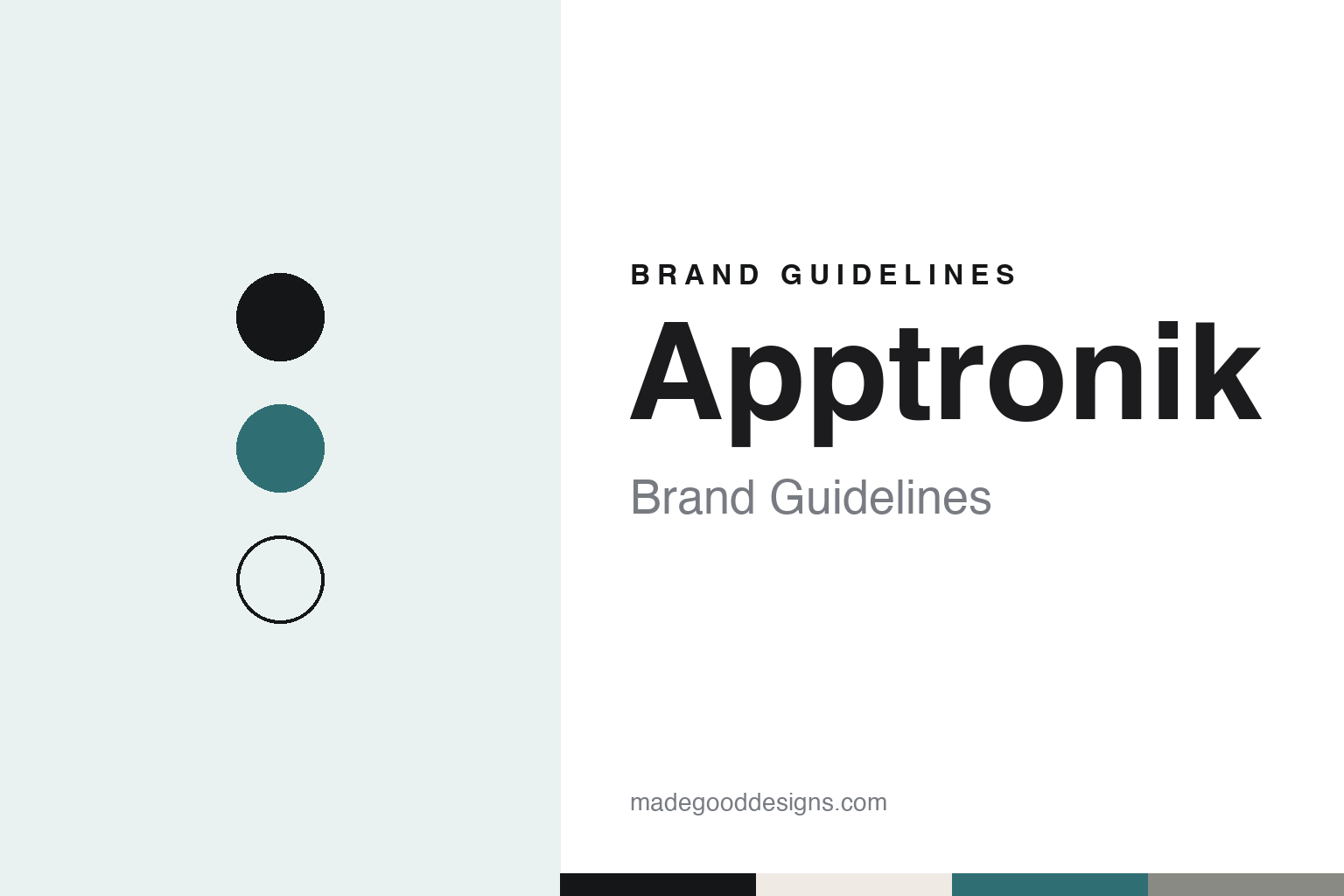
Apptronik Brand Guidelines
Robots for humans, from a university lab in Austin.
Aa
Two constants: a near-black, off-white and teal palette and a grotesque sans register. Abstract homage — not an Apptronik product or mark; no robot, logo or nameplate is reproduced.
Austin, 2016
A spin-out from a University of Texas lab.
Apptronik was founded in Austin, Texas, in 2016. The Daily Texan, the University of Texas at Austin’s student newspaper, reported in September 2018 that it was co-founded by the university’s alumni Jeff Cardenas, Nicholas Paine, Bill Helmsing and Bill Welch together with Luis Sentis, then an associate professor of aerospace engineering, and that it grew out of the university’s Human Centered Robotics Lab. IEEE Spectrum also dated the spin-out to 2016, in January 2023, and traced the team’s robotics history to the 2015 DARPA Robotics Challenge, where Paine, the company’s chief technology officer, was on the Valkyrie team of NASA’s Johnson Space Center. Cardenas is co-founder and chief executive, the company says.
Its early work was on other organisations’ robots. According to IEEE Spectrum, Apptronik’s first contract was for next-generation actuation and controls for NASA. The Daily Texan named NASA’s Valkyrie humanoid as its first project and NASA and Lockheed Martin as clients, and said in 2018 that the company had so far run without investors. The paper added that it had received a UT Innovation Grant in 2016 and had been a finalist in the SXSW Accelerator pitch event in 2018. It described a liquid-cooled humanoid then in development for firefighting and logistics on naval ships, and an exoskeleton for the US Department of Defense, and said the team built its own actuators and controllers in-house.
The company’s own history lists the research platforms that led to its humanoid, among them Draco, its first biped, the Quick Development Biped (QDB), the upper-body humanoid Astra and QDH, which IEEE Spectrum described in 2023 as the prototype for Apollo. Cardenas told the magazine that the company had built more than 30 unique electric actuators.
Colour
Apollo, with a form by argo design.
Apptronik unveiled Apollo in Austin on 23 August 2023. The company’s announcement said the robot drew on more than ten earlier robots, including its work on NASA’s Valkyrie, and was meant first for warehouses and manufacturing plants. It credited the robot’s form to the design firm argo design, which it said set out to balance complexity and approachability, and described digital panels on Apollo’s face and chest for communicating with people. It also said Apollo was modular: a walking biped, a torso on a wheeled base, or a stationary unit.
Partnerships followed, as the company’s press releases record. In March 2024 it announced a commercial agreement with Mercedes-Benz to pilot Apollo in Mercedes-Benz manufacturing, exploring the delivery of kitted parts to the production line, and called it its first publicly announced commercial deployment. Days later it announced work with NVIDIA’s Project GR00T. In June 2024 it announced a proof-of-concept programme with the logistics group GXO, and in December 2024 a strategic partnership with the Google DeepMind robotics team.
The current model is Apollo 2. The company’s website describes it with either a bipedal or a wheeled base, an expressive LED mouth, coordinated lighting and a chest display showing status, battery level and task progress, alongside its Artemis software and Fleet Connect tools for managing fleets of robots. In June 2026 the company described fleets of Apollo 2 robots collecting data at “Robot Park” locations and customer sites, for AI models developed with Google DeepMind.
Typography
Robots that walk out of the lab.
Humanoid and legged-robot makers sell machines that most people have only seen on a screen, so video carries much of their identity. Boston Dynamics built a public following through clips of its robots: a 2017 video of the Spot quadruped opening a door for another robot reached the top of YouTube, “Parkour Atlas” followed in 2018, and in 2025 a troupe of robot dogs danced on America’s Got Talent, according to Wikipedia. When Hyundai Motor Group completed its purchase of the company in 2021, its announcement video showed Atlas dancing beside a child, The Robot Report noted.
The newer story is work. Makers now show their robots in factories and warehouses rather than in labs: Agility’s Digit handling totes for the logistics group GXO, and Boston Dynamics’ electric Atlas being trained to sequence car parts at a Hyundai plant in Georgia, as each company describes it. Press releases lean on customer names, pilot sites and hours of operation, and trade reporters such as The Robot Report and IEEE Spectrum follow those claims from launch to deployment.
Launches happen on stages built for that audience. Agility presented a redesigned Digit at ProMat, the material-handling show, in 2023, and Boston Dynamics unveiled its new Atlas at Hyundai’s media day at CES 2026, the companies say. Research conferences such as ICRA, the IEEE’s robotics and automation meeting, and the World Robot Conference in China play the same part for engineers and the trade.
Identities shift as the companies grow up. In March 2026 Agility Robotics became simply Agility, with a refreshed logo that the company said was inspired by the hardware and software it builds, The Robot Report reported. This guide sets out what can be checked about each company: who founded it, who owns it, where it builds its robots, and which claims rest only on its own word.
Aa
A plain grotesque sans for a company whose line is “Robots for Humans.” (Specimen set in Space Grotesk, a sans STAND-IN; NOT the Apptronik logo.)
Apptronik
Built with Jabil, backed by carmakers.
Where Apollo is made is set out in a February 2025 announcement. Apptronik and the contract manufacturer Jabil, of St. Petersburg, Florida, announced a pilot in which Jabil would build Apollo robots and use them in some of its own manufacturing operations, including the lines that build Apollo, and the release described Jabil as the worldwide manufacturing partner for Apollo. Under the pilot, newly built robots were to carry out tasks such as inspection, sorting, kitting and lineside delivery in Jabil’s factories before going to Apptronik’s customers.
The company is privately held; CNBC named it to its 2025 Disruptor 50 list of private companies, as its website notes. It announced a Series A round in February 2025, co-led by B Capital and Capital Factory with Google taking part, extended it in March 2025, and said in February 2026 that it had closed the round, with investors including Mercedes-Benz, John Deere, AT&T Ventures and QIA. In June 2025 it created Elevate Robotics, a wholly owned subsidiary for industrial tasks beyond the limits of the human form, and it says Apollo won a Fast Company Innovation by Design award in 2025. In April 2026 it announced senior hires from Waymo, Boston Dynamics and Amazon, with Dan Chu as chief product officer.
Its language has stayed consistent. In 2018 Cardenas told The Daily Texan that the idea was “man and machine,” not man versus machine; the company’s mission page today speaks of “Man with Machine” and of robots for dull, dirty and dangerous work, under the line “Robots for Humans.”
For a design guide, Apptronik shows a humanoid maker that credits an outside design studio with its robot’s form, and that uses light and screens on the robot’s face and chest to show what it is doing. Compare Agility Robotics and Figure, two other American humanoid makers. For this guide we use a near-black, a warm off-white and a muted teal with a grotesque sans, an unofficial interpretation; no product or logo is reproduced.
Explore & save
Keep Apptronik’s identity on hand — save it to a board in the Made Good inspiration library.
Apptronik identity set
Pin the Apptronik near-black, off-white and teal palette and the grotesque sans register to your own board.