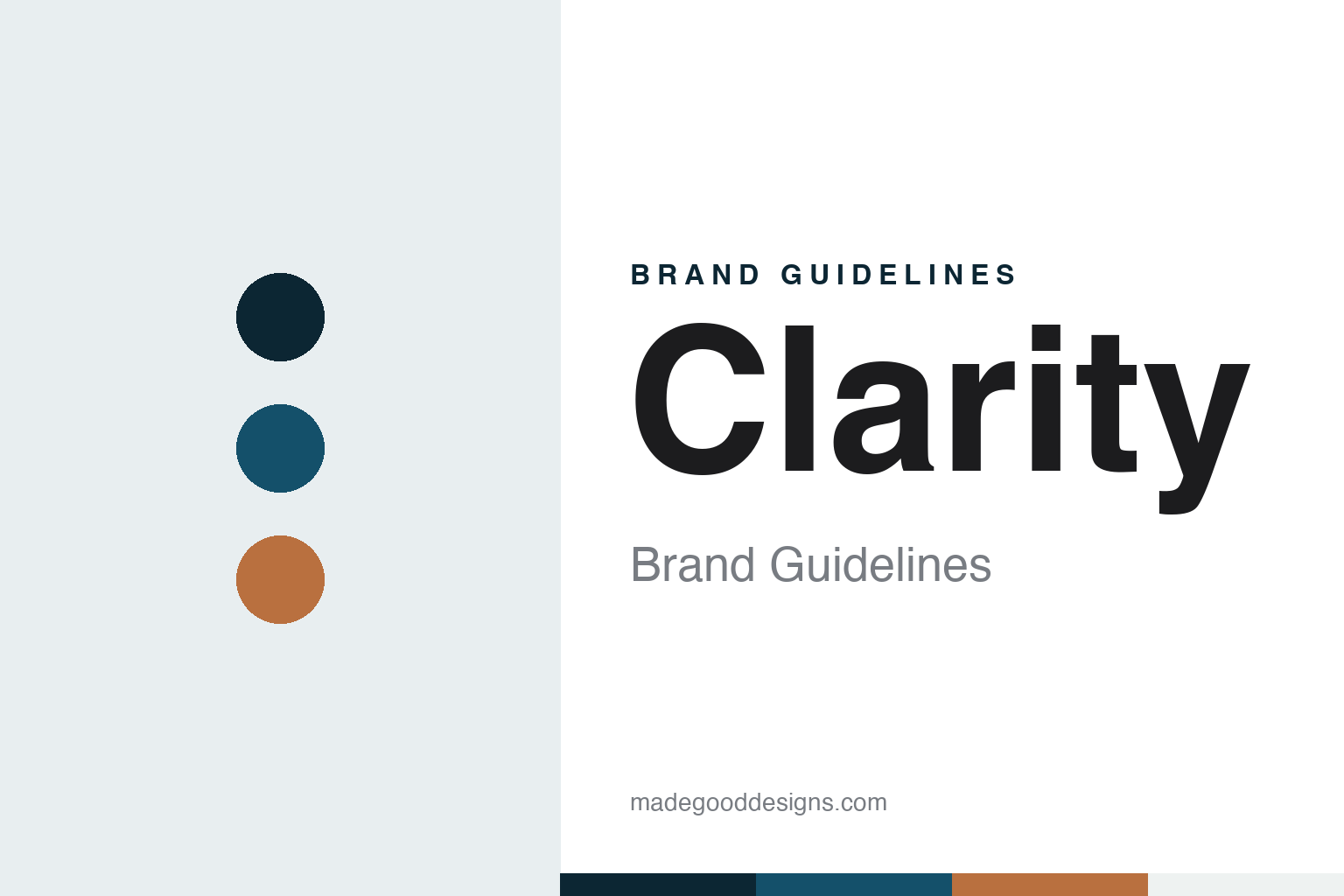
Clarity Brand Guidelines
The Sydney radiopharma built on a copper cage.
Aa
Two constants: a deep teal and copper palette and a clean geometric sans register. Abstract homage — not a Clarity product or mark; no molecule, logo or packaging is reproduced.
A Cage for Copper
Canberra chemistry, a Melbourne lab and a Sydney company.
Clarity Pharmaceuticals was formed in 2010 by TM Ventures, according to a company profile by Tim Boreham in Biotech Daily in August 2025. The same profile says that Dr Matt Harris, who came from TM Ventures, ran the company as chief executive from 2010 to 2018 and later became its chief scientific officer, and that Dr Alan Taylor, a scientist trained at Sydney’s Garvan Institute who had spent years in investment banking, joined as executive chair in late 2013.
The science is older than the company. In a November 2021 interview published by the Australian Securities Exchange, Taylor traced it to Professor Alan Sargeson at the Australian National University, who decades earlier had set out to build molecular cages that could hold copper. The cages are called sarcophagine cages, after the sarcophagus, Taylor explained: what goes in does not come out. Taylor said that work was carried forward by Professor Paul Donnelly at the University of Melbourne, who made the cage “bifunctional,” so that it could hold copper and also carry a peptide, antibody or small molecule aimed at a cancer target. Biotech Daily places Donnelly’s work at the university’s Bio21 Institute.
When Taylor arrived, he told the ASX, Clarity “wasn’t really much”: a shell company holding a couple of provisional patents, one from the University of Melbourne and one from ANSTO, Australia’s nuclear science agency. The company became the vehicle that commercialised the patents, and Taylor said its first studies in people were run at the Peter MacCallum Cancer Centre in Melbourne. Clarity is based in inner Sydney; its website gives an office in the National Innovation Centre at Eveleigh, beside Redfern.
Colour
Copper-64 to see, copper-67 to treat.
Clarity calls its chemistry SAR Technology, after the sarcophagine chelator at its core, and calls its products Targeted Copper Theranostics. “Theranostic” joins therapy and diagnostics: the same targeting molecule carries one isotope for imaging and another for treatment. Clarity uses two isotopes of the same element, copper-64 for PET imaging and copper-67 for therapy, and describes them as a “perfect pairing”. The company says copper-64 has a half-life of about 12.7 hours and gives its products a shelf-life of up to 48 hours, which it says allows central manufacture and wider distribution than shorter-lived imaging isotopes. Those are Clarity’s own descriptions, set out on its technology pages.
Its pipeline is built on three named products. SAR-bisPSMA, the lead, carries two PSMA-targeting agents on one cage and is being developed for prostate cancer, both as a stand-alone diagnostic and as a theranostic. SARTATE is being developed as a diagnostic for neuroendocrine tumours, and SAR-Bombesin is being developed for prostate cancer imaging. The company also runs a Discovery Program for new targets. None of these is an approved medicine: Clarity describes itself in 2026 as a clinical-stage company.
The regulatory steps are dated in the company’s own releases. In February 2025 Clarity said the US Food and Drug Administration had granted Fast Track Designation to copper-67 SAR-bisPSMA for a group of patients with advanced prostate cancer, adding to two earlier Fast Track Designations for the copper-64 imaging version. In September 2025 it said that all of the isotope and drug-product manufacturers for its US trial sites were located in the United States, and that it had five open Investigational New Drug applications with the FDA. It has also announced supply agreements for copper isotopes, among them a copper-67 agreement with Nusano of Utah in October 2025 and a copper-64 agreement with Theragenics, near Atlanta, in March 2026. On 27 October 2026 the company announced that its registrational Phase III CLARIFY trial, run in the United States and Australia, had dosed its target of 383 participants; for a second Phase III trial, AMPLIFY, the company said in March 2026 that more than the planned number of participants had consented.
Typography
How the category presents itself.
Radiopharmaceutical companies sell products that most people never see. A dose leaves a production site as a few millilitres in a small glass vial, travels inside a heavy shielded container and is given in a hospital’s nuclear-medicine department. So the industry’s pictures tend to show the places and machines around the product rather than the product itself.
The factory pictures are the most distinctive. Annual reports and websites in this field often show hot cells, the lead-shielded workstations where technicians handle radioactive material through thick windows and manipulator arms, and robotic dispensing systems that fill vials behind glass. Cyclotrons appear as large circular machines in bare concrete rooms, and research reactors are often photographed from above the pool, where the water glows blue around the core.
The second set of pictures comes from the scan itself. PET and SPECT images, usually shown in bright false colour over a grey outline of the body, are the clearest way to show what a tracer is for, and they recur in product pages, investor slides and congress booths. Alongside them sit images of time: couriers, vans and aircraft, because many isotopes decay within hours. Fluorine-18 has a half-life of about 110 minutes and technetium-99m about six hours, so supply chains are drawn as networks of sites and routes.
The trade meets at a small number of congresses, chiefly the annual meeting of the Society of Nuclear Medicine and Molecular Imaging (SNMMI) in North America and the congress of the European Association of Nuclear Medicine (EANM) in Europe, where booths, posters and product launches set much of the year’s visual language. This guide records what can be checked about each company’s history and ownership, and marks what rests only on its own word.
Aa
A clean geometric sans for a laboratory company. (Specimen set in Manrope, a sans STAND-IN; NOT the Clarity logo.)
Clarity
From a shell company to an ASX listing.
Clarity listed on the Australian Securities Exchange on 24 August 2021 under the code CU6, Biotech Daily reported. In its interview with Taylor that November, the ASX described the float as the largest biotech IPO on the exchange to that date. Taylor said the company chose Australia because its technology and most of its shareholders were Australian, and that listing gave it the means to run trials in the United States and at home.
The company has grown since then. In June 2026 it announced that it had welcomed its 100th team member, with staff mainly in the United States and Australia. Its leadership has also changed: Biotech Daily reported that Dr Colin Biggin followed Harris as chief executive and was succeeded by Michelle Parker, with Biggin remaining as chief operating officer and Taylor as executive chair.
The name is a common one, so the full form matters. Clarity Pharmaceuticals is unrelated to other companies called Clarity, and its own website is claritypharmaceuticals.com. In its releases the company uses the same terms again and again: SAR Technology, Targeted Copper Theranostics, the “perfect pairing”, and product names built on the SAR prefix, such as SAR-bisPSMA and SAR-Bombesin.
For a design guide, Clarity shows how a young research company can build an identity on one piece of chemistry and a consistent naming system. Compare Telix, another Australian radiopharmaceutical company, and Lantheus, a long-established US imaging-agent maker. For this guide we use a deep teal and a copper tone with a sans, an unofficial interpretation; no product or logo is reproduced.
Explore & save
Keep Clarity’s identity on hand — save it to a board in the Made Good inspiration library.
Clarity identity set
Pin the Clarity deep teal and copper palette and the clean geometric sans register to your own board.