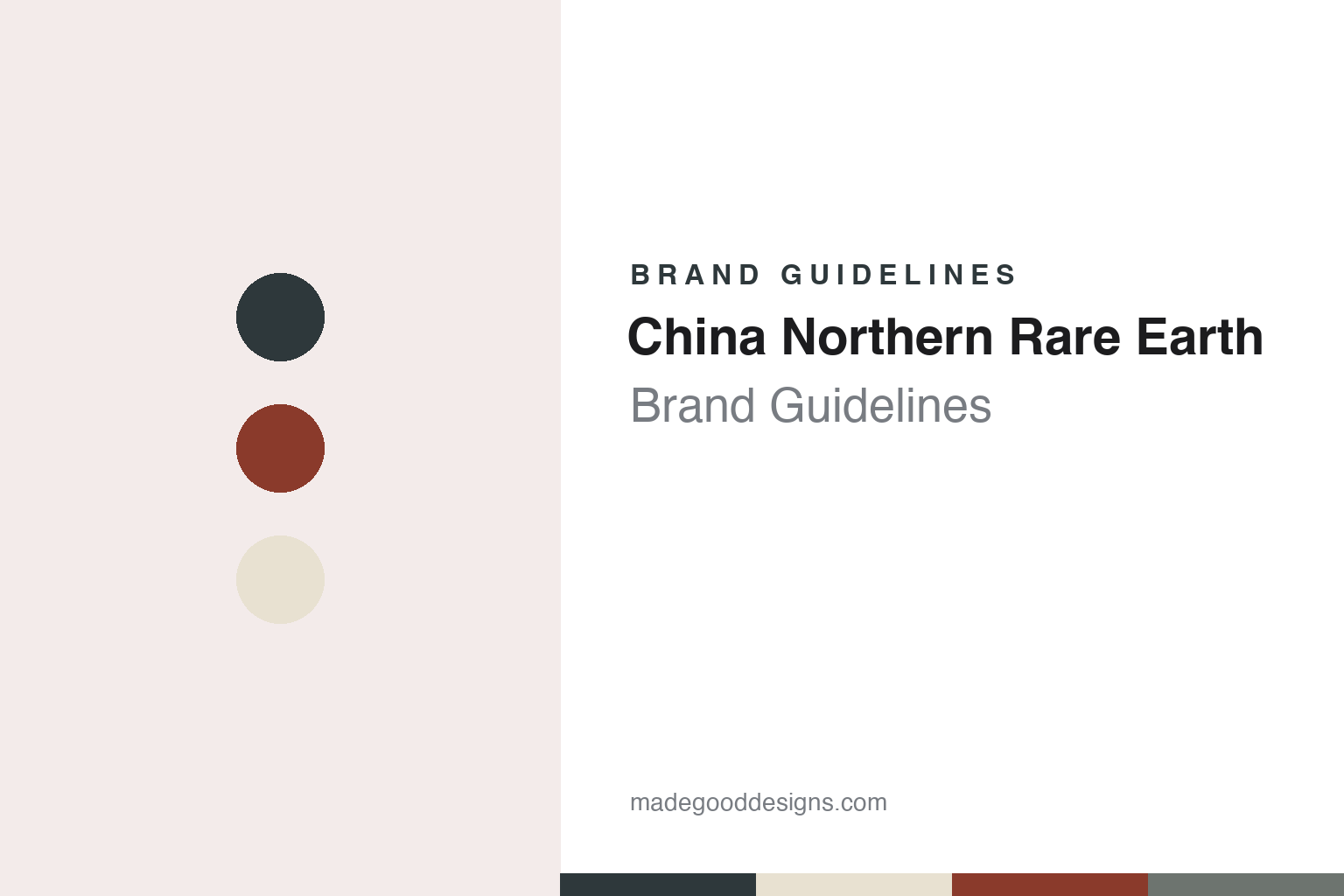
China Northern Rare Earth Brand Guidelines
A Baotou steelworks plant that became a listed rare-earth group.
Aa
Two constants: a slate, ore red and steppe sand palette and an industrial sans register. Abstract homage — not a China Northern Rare Earth product or mark; no logo or trademark is reproduced.
The 8861 plant
A steelworks, a mine and a rare-earth plant.
China Northern Rare Earth traces its industrial origins to 1961. Its company history says construction began that year on the 8861 rare-earth experimental plant in Baotou, Inner Mongolia, the forerunner of the rare-earth smelter of Baotou Iron and Steel, and that by 1970 the plant ran the four basic steps of beneficiation, pre-treatment, extraction and separation. The ore behind it came from Bayan Obo, about 150 kilometres north of Baotou according to the company. It says the Chinese geologist Ding Daoheng found iron ore there in 1927 while travelling with the Sino-Swedish scientific expedition, and that in 1935 the geologist He Zuolin identified two rare-earth minerals in those samples, later shown to be bastnäsite and monazite.
The Guardian, republishing a Le Monde report in August 2012, dated rare-earth production at the state-owned Baotou Iron and Steel company, known as Baogang, to 1958; the company’s own chronology begins with the 1961 plant. Both accounts place the business inside the steelworks for its first decades. In 1963 a metallurgical research institute was formed in Baotou under the metallurgy ministry; the company says it became the Baotou Research Institute of Rare Earths, which now sits within the group. The company also records that in 1975 a gravity-separation workshop at the Baogang concentrator began producing rare-earth concentrate, and that China’s total rare-earth output passed that of the United States in 1986.
The listed company came later. In 1997, the company history says, Baotou Iron and Steel formed Inner Mongolia Baotou Steel Rare-Earth Hi-Tech from its No. 3 rare-earth plant and the rare-earth section of its concentrator, with a Hong Kong partner and a Baogang group company as co-founders. Its shares began trading on the Shanghai Stock Exchange on 24 September 1997, and the company says the stock was called “China’s first rare-earth share.” Its first chairman, the history notes, was the then general manager of Baotou Iron and Steel.
Colour
From Baogang Rare Earth to Northern Rare Earth.
The decade after the listing was one of consolidation. The company says its mixed rare-earth metal and mixed rare-earth carbonate were named Inner Mongolia brand products in 1995, and that it gained ISO 9002 quality certification in 1998. In 2006 it began using its registered trademark Bayan Obo (白云鄂博), which it describes as its calling card at home and abroad, borrowing the name of the mine. In 2007 Baotou Steel moved its other rare-earth assets, including the research institute and a polishing-powder maker, into the listed company, whose short name became Baogang Rare Earth. In 2009 it launched a high-performance magnetic-materials project and organised an Inner Mongolia Baotou Steel Rare Earth group, and by the end of 2013, it says, the consolidation of the region’s upstream rare-earth companies was complete. On 28 March 2014 the Baotou rare-earth product exchange, which the company had helped found with other producers, began trading.
The present name arrived on 13 February 2015, when, by a notice from the Baotou Steel group, the company was renamed China Northern Rare Earth (Group) High-Tech Co., Ltd., shortened in Chinese to 北方稀土 (Beifang Xitu). In May 2016 the chairman of the Baotou Steel group was elected its chairman. On 22 January 2018 it signed a restructuring agreement with the Gansu provincial state-assets commission and became the controlling shareholder of Gansu Rare Earth, which the company describes as bringing the northern light-rare-earth industry under one roof. In December 2021 it set up a joint company, Antai Northern Technology, with AT&M.
Its products run along the chain the company describes: rare-earth concentrate, oxides, metals, polishing powder and hydrogen-storage alloys, and six “new material” lines covering magnetic, hydrogen-storage, alloy, catalytic, polishing and optical materials. It says its subsidiaries make neodymium-iron-boron alloys and permanent-magnet motors, and that rare-earth magnet parts from its research institute have flown on China’s Long March rockets. Its headquarters remain in Baotou’s national rare-earth high-tech zone, and the company describes itself as the world’s largest rare-earth group by scale; that is its own description.
Typography
Design and documentation.
Rare-earth and magnet companies sell materials most people never see, so their pictures do a lot of the explaining. The usual opening image is the mine: an open pit cut in benches into red or ochre desert ground, haul trucks small against the terraces, and a wide sky above. It tells a viewer that the story starts with rock and with a particular place, which matters in a business where origin is part of the product.
The next scenes are inside the plant. Separation is slow chemistry, and companies often show it as long rows of mixer-settler tanks, pipework and walkways, or a rotating kiln seen from its end. The finished goods then appear as oxide powders in small dishes or heaps, often in soft pastel shades of pink, green, grey and cream, a quiet way to show that one ore becomes many separate elements.
Magnets bring the story to the customer. Silver blocks, rings and arcs stacked on a bench, or set into a cutaway of an electric motor or a wind-turbine generator, link the material to the products people know. Investor presentations add the periodic table, usually with the lanthanides picked out in a highlight colour, along with maps that trace the route from mine to separation plant to magnet factory.
The same visual vocabulary appears at trade gatherings, from the events of the Rare Earth Industry Association to the Magnetics conference, where stands and slides lean on the same few motifs: the pit, the plant, the powder and the magnet. For a designer, the category shows how a technical, slow-moving industry can be made legible through a short, repeated sequence of images rather than through slogans.
Aa
An industrial sans for a Baotou producer. (Specimen set in IBM Plex Sans, a sans STAND-IN; NOT the China Northern Rare Earth logo or the Bayan Obo mark.)
Bayan Obo
A mine name on the product, a region in the company name.
Rare-earth processing at Baotou has an environmental record that independent reporters have described. The Guardian’s report of 7 August 2012, first published by Le Monde, described a tailings pond of about ten square kilometres on the city’s outskirts into which nearby processing plants discharged water, and villagers who said their crops began failing towards the end of the 1980s. A study by the municipal environmental agency, the report said, linked their problems to the industry; villagers had been promised compensation that was only partly paid, and new tower blocks had been funded by compensation Baogang paid to the local government. The company now says it has reached “zero discharge” of production wastewater and that the first phase of its green smelting upgrade project has entered production; those are its own statements.
The names tell the story of the business. The listed company carried the Baotou Steel name for eighteen years before taking a regional one, “Northern,” in 2015, while its products have carried the name of the Bayan Obo mine since 2006. The website pairs the full Chinese name with the short form 北方稀土.
For a design guide, China Northern Rare Earth shows a company that names itself after a region and sells under the name of a mine. Compare Lynas and MP Materials, two other rare-earth producers. For this guide we use slate, an ore red and steppe sand with a sans, an unofficial interpretation; no product or logo is reproduced.
Explore & save
Keep China Northern Rare Earth’s identity on hand — save it to a board in the Made Good inspiration library.
China Northern Rare Earth identity set
Pin the slate, ore red and steppe sand palette and the industrial sans register to your own board.