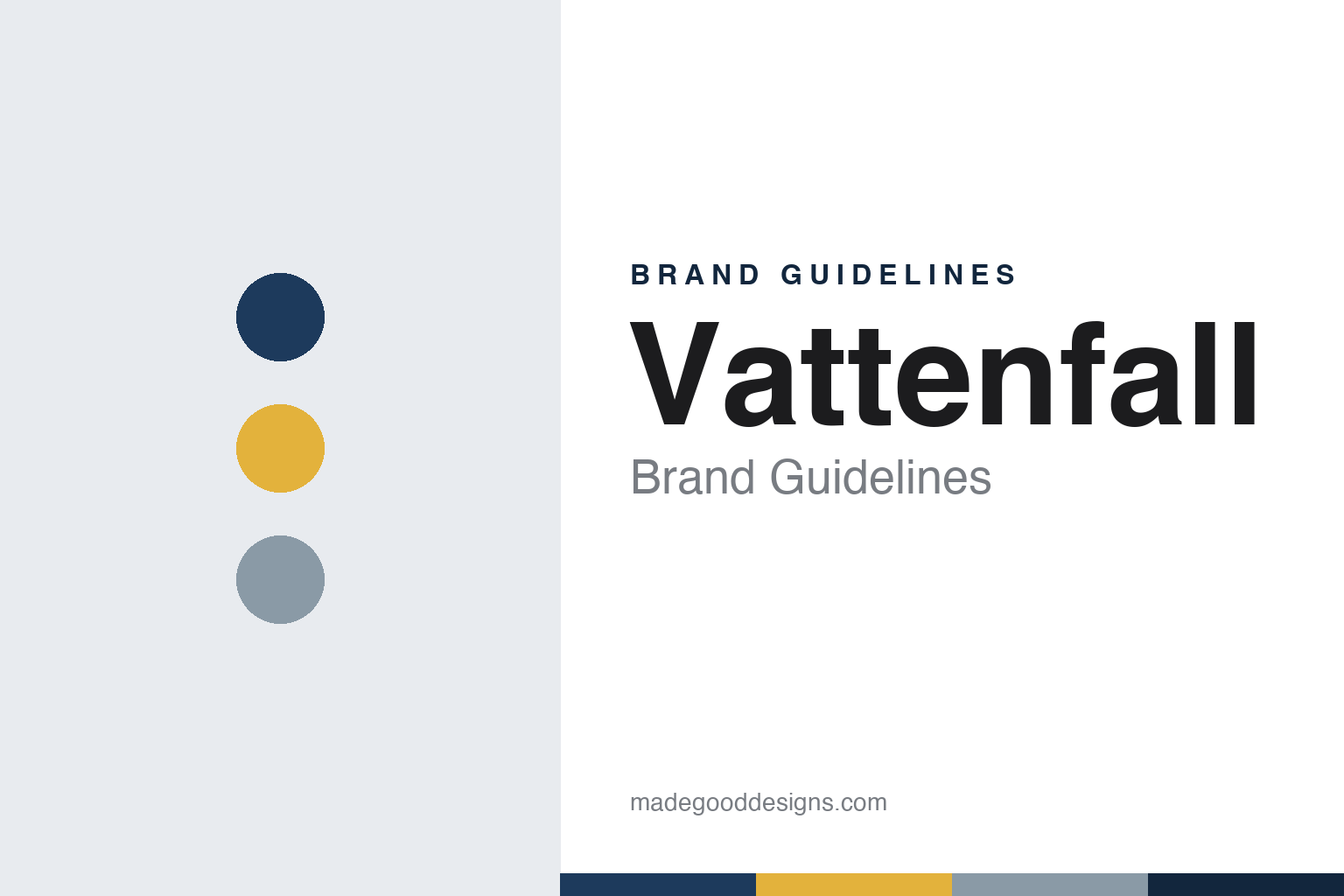
Vattenfall Brand Guidelines
A Swedish state waterfall board that became a European power group.
Aa
Two constants: a lake blue, sun yellow and granite grey palette and a plain geometric sans register. Abstract homage — not a Vattenfall asset or mark; no logo, plant or product is reproduced.
The Royal Waterfall Board
A state power producer born at Trollhättan.
Vattenfall’s name is simply the Swedish word for “waterfall,” and, as English Wikipedia notes, it is a shortening of the original name, Kungliga Vattenfallsstyrelsen, the Royal Waterfall Board. Swedish Wikipedia says the board was formed in 1909 out of the Trollhättan canal and waterworks, after a decision of the Riksdag, the Swedish parliament. The company tells the same story from its side: it dates its birth to the restructuring of the Trollhättan canal and hydro power plant under the state board, says the Swedish state had bought the water rights at Trollhättan a few years earlier, and writes that Vattenfall “is said to have been the world’s first state-owned power producer” — a claim we give as the company’s own.
Its first hydro power stations were Olidan at Trollhättan on the Göta älv, opened in 1910, and Porjus on the Lule älv and Älvkarleby on the Dalälven, both in 1915, according to Swedish Wikipedia. In the early years the board sold power mainly to the railways and to industry; household customers were relatively few because electricity was expensive. From the mid-1930s Swedish consumption rose quickly, and large hydro stations were built in Norrland, the far north, among them Harsprånget on the Lule älv in 1951, while the trunk grid was extended to carry power south to central and southern Sweden.
The company says demand rose dramatically during and after the Second World War and that hydro power had to be expanded “at a furious pace,” which it could do thanks to water rights acquired much earlier.
Nuclear power came next. English Wikipedia says Vattenfall began building its first reactors, Ringhals 1 and 2, in 1974 and eventually owned seven of Sweden’s twelve reactors; Swedish Wikipedia names it today as the main owner of Ringhals in Halland, with four reactors, and Forsmark in Uppland, with three. The company says the Ringhals and Forsmark work sites were the largest in the Nordic region at the time.
One episode from the 1950s sits outside the power business. English Wikipedia records that two Vattenfall engineers, Bengt Odelgard and Per-Olof Weman, developed a diagonal belt for the company’s own cars, known as the “Vattenfall belt,” and presented the work to Volvo in the late 1950s.
Colour
From state agency to Vattenfall AB.
In 1992 the state agency was turned into a joint-stock company, Vattenfall AB, still owned by the state. At the same time the national high-voltage grid passed to a new agency, Svenska kraftnät, English Wikipedia says; Swedish Wikipedia links the change to the deregulation of the Swedish electricity market that followed in 1996. The head office moved too. From 1964 to 2012 it stood at Råcksta in Vällingby, Stockholm, in an office building designed by the architect Sven Danielson; since 2012 it has been in the Arenastaden district of Solna, Swedish Wikipedia says.
The years after deregulation brought rapid growth abroad. English Wikipedia lists a stake in the Finnish utility Hämeen Sähkö in 1996, 25.1 percent of Hamburg’s HEW from the city in 1999, a majority of the Polish heat company EW in 2000 and 35.3 percent of Denmark’s Elsam in 2005; in 2002 the German businesses were brought together as Vattenfall Europe AG. In Berlin, the state government later recalled, the city had sold its shares in the power company Bewag to private investors in 1997, and Bewag was later sold on to the Vattenfall group.
The largest step was the Netherlands. Nuon had been formed in 1994 from four regional utilities in Gelderland and Friesland; Vattenfall bought 49 percent of it on 1 July 2009 and took full control in 2012, according to English Wikipedia. The Dutch business was later renamed Vattenfall Nederland — in 2018 according to English Wikipedia, in 2019 according to Swedish Wikipedia.
Then came a long retreat from fossil fuels and from some markets. Swedish Wikipedia says the Polish business was sold in 2011 and the Danish coal plants by 2015. In 2014 Vattenfall agreed to sell its Hamburg power and district-heating grids to the city, and on 30 September 2016 it completed the sale of its German lignite mines and power stations to the Czech group EPH and its partner PPF Investments, English Wikipedia says. The Hemweg 8 coal plant in Amsterdam closed at the end of 2019 and Moorburg in Hamburg at the end of 2020.
Berlin followed. Vattenfall announced a strategic review of its heat business in May 2022, and on 3 May 2024 the Berlin Senate announced that the state had completed its repurchase of Vattenfall Wärme Berlin AG, renamed BEW Berliner Energie und Wärme AG. Swedish Wikipedia says that with this sale Vattenfall no longer has any coal-fired plants in its portfolio.
Germany’s nuclear phase-out also brought a legal dispute. Brunsbüttel and Krümmel were shut down permanently in 2011 on government order; in October 2016 Vattenfall began proceedings against the German government at the World Bank’s International Centre for Settlement of Investment Disputes, and in March 2021 the government agreed a settlement, according to English Wikipedia.
Typography
Power companies and their public face.
Many of Europe’s big electricity and gas groups began as something narrower: a regional hydro company, a national gas board, a coal-fired generator, a city lighting firm. Many of today’s names were assembled through mergers, nationalisations and privatisations, and their identities often had to stand for several older companies at once. A single short name and a simple symbol became the usual answer.
The pictures these groups choose tell the same story. Offshore wind farms standing in grey northern seas, hydro dams in mountain valleys, solar fields and transmission lines now carry more of the visual weight than power stations and chimneys. Colour often follows: greens and blues, sometimes with a warm accent for the sun, are common in the sector’s newer identities. Iberdrola’s three leaves, introduced in 2002 when it tied its brand to renewable energy, and Engie’s rising sun, adopted with the new name in 2015, are two examples.
Much of the brand now lives on screens rather than letterheads. Customers meet these companies through smart-home energy apps, online accounts and the electric-car charging points that carry their names on streets and motorways. Iberdrola, for example, redrew its logo in 2023 for digital use, with solid colours and a custom typeface shared by the companies it owns in other countries.
The sector also presents itself through long annual sustainability reports, sponsorship and industry gatherings such as Eurelectric’s Power Summit and the WindEurope annual event. This guide sets out what can be checked about each brand — where it came from, who owns it, and how its name and symbol changed — and marks clearly what rests only on the company’s own word.
Aa
A plain geometric sans for a state power company. (Specimen set in Manrope, a sans STAND-IN; NOT the Vattenfall logo.)
Vattenfall
Wholly owned by the Swedish state.
Ownership has not changed since 1909. The company says Vattenfall AB is 100 percent owned by the Swedish state and has its head office in Solna; it describes itself as one of Europe’s largest producers and retailers of electricity and heat, with around 21,000 employees and main markets in Sweden, Germany, the Netherlands, Denmark and the UK. It states its purpose as “to enable the fossil freedom that drives society forward.” Anna Borg has been president and chief executive since 1 November 2020, according to English and Swedish Wikipedia.
Wind is now central to the story the company tells. Its offshore start was Lillgrund in the Öresund, off Malmö — commissioned in 2007 according to English Wikipedia, and dated 2008 by Swedish Wikipedia. Swedish Wikipedia lists its largest wind farms in early 2024 as Hollandse Kust Zuid in the Netherlands, Kriegers Flak and Horns Rev 3 in Denmark, and Thanet in the UK. Vattenfall entered British household energy supply in June 2017, English Wikipedia says.
Its record has drawn criticism as well. English Wikipedia notes that the campaign group Corporate Europe Observatory named Vattenfall the first winner of its Climate Greenwash Awards in May 2009, accusing it of presenting itself as a climate champion while lobbying for business as usual, and that its plans to extend the Clashindarroch wind farm in Scotland drew criticism from the Scottish Wildcat Association. In Berlin, a 2013 referendum on taking energy supply back into public hands narrowly missed its quorum, after which the city set up Berliner Stadtwerke in 2014.
For a design guide, Vattenfall shows how a state agency named after falling water became a company whose public face now leans on wind and on its stated goal of fossil freedom. Compare Ørsted, the Danish group once called DONG Energy, and Fortum, from neighbouring Finland. For this guide we use a lake blue, a sun yellow and a granite grey with a sans, an unofficial interpretation; no product or logo is reproduced.
Explore & save
Keep Vattenfall’s identity on hand — save it to a board in the Made Good inspiration library.
Vattenfall identity set
Pin the Vattenfall lake blue, sun yellow and granite grey palette and the plain geometric sans register to your own board.


