Occidental Brand Guidelines
The 1920 Los Angeles oil company now called Oxy.
Aa
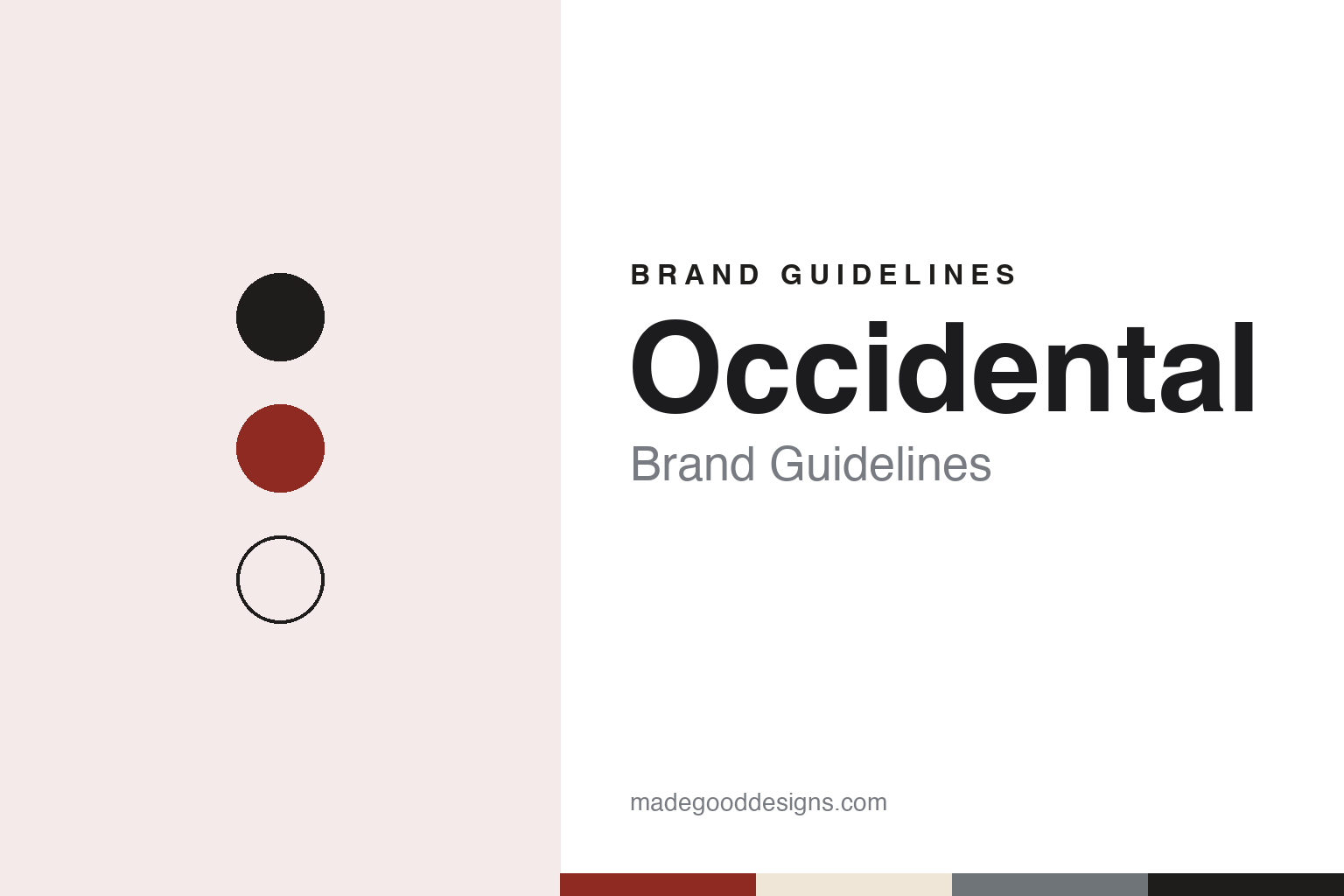
Two constants: an Occidental brick red, charcoal and sand palette and an Industrial sans register. Abstract homage — not an Occidental asset or mark; no logo, platform or product is reproduced.
Los Angeles, 1920
A Californian start and a long reshaping.
Occidental Petroleum was founded in Los Angeles in 1920, English Wikipedia says. The company now calls itself Oxy, a short form that Wikipedia links to its stock-market ticker and its logo, and its website says that over “100 years” it has built assets, infrastructure, expertise and technology. It is incorporated in Delaware and has its headquarters in Houston, where it moved in September 2014.
The company’s modern shape dates from 1957, when Armand Hammer acquired a controlling stake and became president and chief executive. Under him Occidental spread abroad in the 1960s, into Peru, Venezuela, Bolivia, Trinidad and the United Kingdom. It discovered the Lathrop gas field in California in 1961 and won exploration rights in Libya in 1965, where it worked until United States sanctions halted its activities there in 1986. In 1968 it moved into chemicals by buying the Hooker Chemical Company, the root of the business later called OxyChem. In 1983, with the Colombian state company Ecopetrol, it discovered the Caño Limón oilfield in Arauca. Ray R. Irani became chairman and chief executive in 1990.
Hooker brought a difficult history with it. From 1942 to 1952 Hooker disposed of chemical waste at Love Canal in Niagara Falls, New York, and in 1947 became the sole owner and user of the land, English Wikipedia records. The company leased the filled site to the local school board in 1953, and the area was later built on; in 1980 a federal emergency was declared in the area, residents were relocated, and the company paid restitution. The dumping took place before Occidental bought Hooker in 1968.
Colour
From a conglomerate to an oil and gas company.
Occidental’s North Sea history includes the Piper Alpha disaster. On 6 July 1988 the company’s production platform in the Scottish North Sea was destroyed by a gas leak, explosion and fire. The public inquiry that followed blamed inadequate maintenance and safety procedures by Occidental, English Wikipedia says; no charges were brought.
From the 1990s the company narrowed its focus. It sold its stake in the meatpacker IBP in 1991 and its remaining coal operations in 1993, and in the late 1990s bought the Elk Hills oil field in California from the United States government. Wikipedia says that under Irani the company grew “from a collection of unrelated businesses to one that focuses on oil and gas.” It spun off California Resources Corporation to shareholders from December 2014. Vicki Hollub, who had worked at Occidental since 1981, became chief executive in May 2016; Wikipedia describes her as the first woman to lead a major American oil and gas company.
Large purchases followed. Occidental completed its acquisition of Anadarko Petroleum on 8 August 2019, after Anadarko’s shareholders approved the deal at a special meeting that day, World Oil reported; Anadarko’s shares stopped trading on the New York Stock Exchange the same evening. In August 2023 it bought Carbon Engineering, a direct-air-capture technology company, and on 1 August 2024 it closed its purchase of CrownRock, a Permian producer, the company announced. Wikipedia adds that it bought the carbon-removal start-up Holocene in April 2025 and sold its Permian natural gas gathering affiliate to Enterprise Products in August 2025.
The business is concentrated in two regions. As of 2020, English Wikipedia says, the United States supplied about 77% of its production, with the Permian Basin its largest area and the Denver Basin next; part of that output comes from enhanced oil recovery, in which carbon dioxide and water are injected underground. In the Middle East it works in Oman, Qatar and the United Arab Emirates under production sharing agreements; since 2011 it has partnered with Abu Dhabi’s state oil company on the Shah gas field through Al Hosn Gas, which began operating in 2015, and it holds a share in the Dolphin Gas Project.
Typography
How oil and gas producers present themselves.
Oil and gas producers sell crude, gas and liquids to refiners, traders and utilities rather than to shoppers, so most of their visual identity lives in places investors, partners, regulators and job seekers look. The pictures are familiar across the sector: drilling pads on open plains photographed from the air, with straight gravel roads running between them; offshore platforms and floating production, storage and offloading vessels, the FPSOs, standing in grey water; and geologists holding core samples cut from the rock they hope to produce.
The second register is the investor presentation. Producers set out their story in investor-day slides and quarterly decks built around acreage maps, with basins shaded in company colours, wells marked as dots and figures for inventory and reserves given in the units the industry uses. Names of basins and plays, such as the Permian, the Eagle Ford or the North Sea, often carry as much weight on these pages as the company’s own mark.
The third is reporting. Annual reports and sustainability reports sit beside each other on company websites, and the sustainability documents return to the same subjects year after year: methane, flaring, water and land use. Community-investment pages show schools, clinics and local programmes in the areas where a company drills, usually with photographs of the people involved rather than of the equipment.
Behind those formats, upstream companies often carry long histories of mergers, spin-offs and renamings, and their names can outlast the businesses that first used them. The guides in this group follow that record company by company, from the origins of each name to its current owner, and treat the colours and type shown here as our own interpretation rather than any company’s official system.
Aa
An industrial sans — the plain register of an oil company that calls itself Oxy. (Specimen set in Archivo, a sans STAND-IN; NOT the Occidental logo.)
Oxy
An oil company without its chemicals.
The latest big change came on 2 January 2026, when Occidental completed the sale of its chemical business, OxyChem, to Berkshire Hathaway, the company announced. Berkshire is also a large Occidental shareholder, holding about 28% of its stock according to English Wikipedia. Occidental kept OxyChem’s legacy tort claims and environmental liabilities in a subsidiary, Environmental Resource Holdings, while Glenn Springs Holdings continues to manage clean-up work at environmental sites; the company says it expects to spend on remediation for many years. Hollub said the sale would let Occidental focus on its “deep and diverse oil and gas portfolio.”
Leadership and the map shifted again in 2026. In May, Wikipedia says, Oxy took a 10% stake in an ExxonMobil deepwater exploration block off Trinidad and Tobago, and from June Richard Jackson, previously chief operating officer, succeeded Hollub as chief executive; the company’s leadership page now lists him as president and chief executive officer. Wikipedia also records that in January 2018 Occidental was found partly responsible, with two other companies, for the Bayou Corne sinkhole in Louisiana.
Oxy’s own language is direct. Its stated mission is “We dare to do what others won’t,” its vision is to “lead the industry by reaching for the impossible, then achieving it,” and its values run from “Lead with passion” to “Commit to good.” The website frames the business as providing “reliable energy while reducing greenhouse gas emissions” and describes plans for carbon management and net zero; those are the company’s own aims. Its 2024 announcements also named a subsidiary, Oxy Low Carbon Ventures, which the company says is advancing new technologies to reduce emissions.
For a design guide, Occidental shows how a century-old name can be shortened to three letters and a mission line while the business beneath it is rebuilt. Compare ConocoPhillips, another Houston producer, and Diamondback Energy, a Permian Basin specialist. For this guide we use a brick red, a charcoal and a sand with a sans, an unofficial interpretation; no product or logo is reproduced.
Explore & save
Keep Occidental’s identity on hand — save it to a board in the Made Good inspiration library.
Occidental identity set
Pin the Occidental brick red, charcoal and sand palette and the Industrial sans register to your own board.