Golub Capital Brand Guidelines
A 1994 New York lender, unitranche loans and the GBDC funds.
Aa
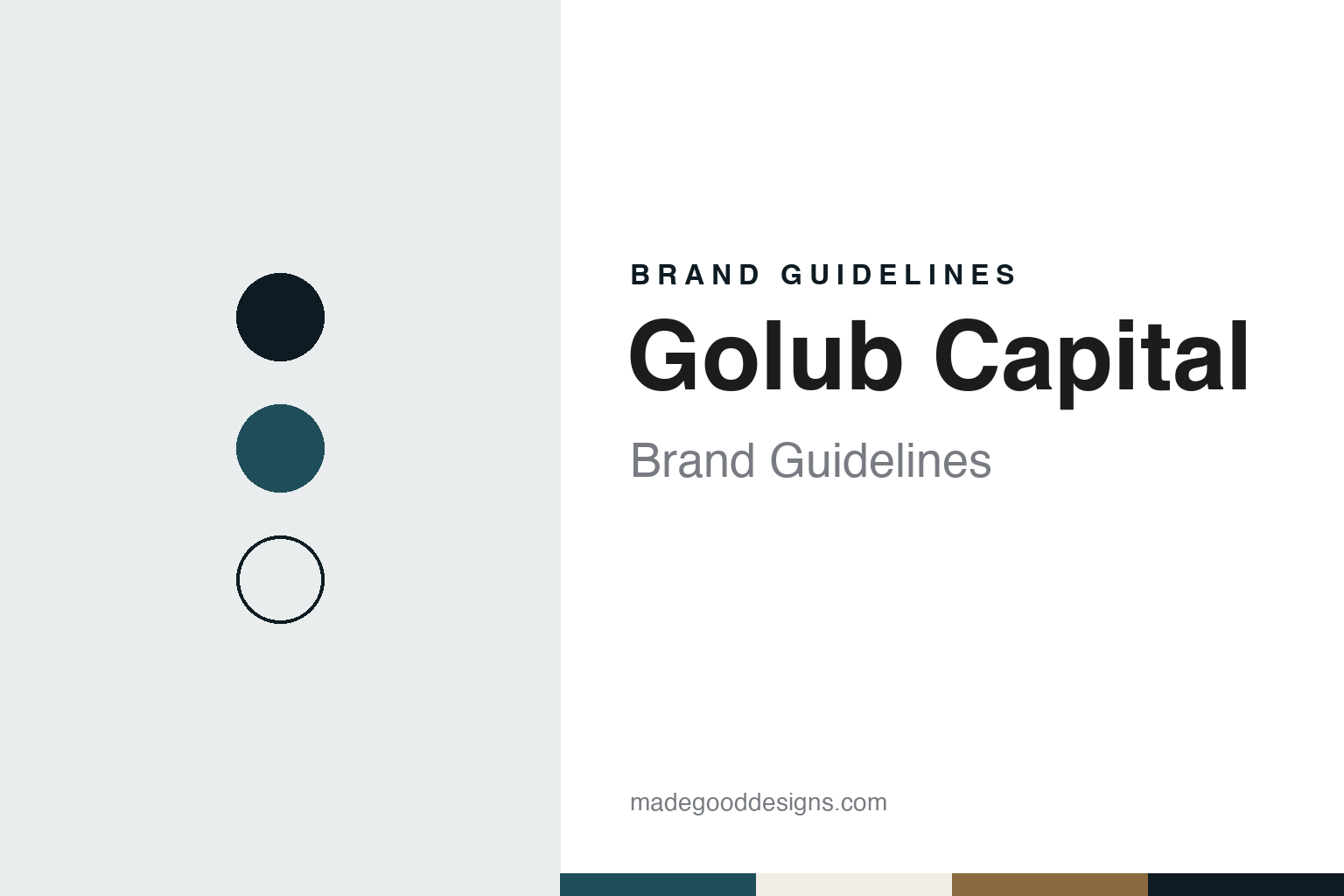
Two constants: a deep teal, slate and warm paper palette and a plain corporate sans register. Abstract homage — not a Golub Capital document or mark; no logo or fund material is reproduced.
New York, 1994
A lender built around private equity sponsors.
Golub Capital was founded in New York City in 1994 by Lawrence Golub, English Wikipedia says, after a career that had taken him through Allen & Company, Wasserstein Perella and Bankers Trust, with a spell as a White House Fellow. The company gives the same founding year on its website, and in January 2024 it marked the start of its 30th anniversary year in a press release datelined New York. According to Wikipedia, the firm began with a small pool of equity capital and, at first, with Golub and one assistant as its only staff; the anchor investors in its first fund included Mellon Bank.
The early business changed direction more than once. In 2000, Wikipedia says, Golub Capital began to specialise in mezzanine loans to companies owned by private equity firms, and it stopped making controlling private equity investments of its own so that it would not compete with those clients. In 2003 Lawrence Golub’s brother David Golub joined as president, with Lawrence Golub remaining chief executive. In 2004 the firm began offering senior and “one-stop” loans, the single-facility structure the industry calls unitranche, and by 2007 it was acting as a lead lender and arranger of senior loans.
The company now calls itself a “pioneer of the unitranche loan,” its own description in its 2024 anniversary release. Wikipedia says the firm kept growing through the 2008 financial crisis and by 2011 had offices in New York, Chicago and Atlanta. In 2014 it opened a San Francisco office for lending to fast-growing, venture-backed technology companies, a line of business the firm now presents under the name Golub Growth.
Colour
Listed and non-traded lending vehicles.
Much of Golub Capital’s public profile comes from its business development companies, the US fund structure that lends to mid-sized companies and can be listed on a stock exchange. Golub Capital BDC, Inc. was formed in 2009, Wikipedia says, and priced its initial public offering in April 2010, according to its own press release of 15 April that year. It trades on the Nasdaq under the ticker GBDC and is managed by GC Advisors LLC, an affiliate of Golub Capital, its website says. David Golub is its chief executive.
GBDC has grown partly by absorbing sister funds. It closed a merger with Golub Capital Investment Corporation in September 2019, and another with Golub Capital BDC 3 on 3 June 2024, after a merger agreement announced that January, according to GBDC’s press releases. In 2023 the firm launched Golub Capital Private Credit Fund, known as GCRED, for private wealth investors, the company said in January 2024; it opened offices in Seoul and Hong Kong in the same year.
The company describes its work in a few strands: sponsor finance for companies owned by private equity firms, broadly syndicated loans and credit opportunities, alongside the collateralised loan obligations it issues. It says it was again the largest issuer of middle market CLOs by volume in 2025, for the thirteenth year running, and that in 2025 it marked five years of operations in London, from where it lends to borrowers in the UK, Germany, France and the Nordics. In October 2025 it announced a strategy for investing in continuation vehicles alongside private equity firms, which it calls GP-led secondaries.
Typography
Design and documentation.
Private credit firms lend to companies directly rather than through banks or public bond markets, and they present themselves mainly to the investors whose money they manage rather than to consumers. Their websites tend to be restrained: a few corporate colours, plain sans or serif type, photographs of offices and people, and pages organised by investment strategy and by the kinds of client they serve. Blue Owl, for example, sorts its site by audience — asset managers, financial advisors, institutional investors and insurance companies — while Oaktree groups its work into credit, equity and real estate.
Writing carries much of the identity. Managers publish insight pieces, market outlooks and explanatory charts on how direct lending works, where loans sit in a company’s capital structure and how risk is shared. Oaktree’s co-founder Howard Marks has posted his memos publicly on the firm’s website for years, and its pages set out its investment philosophy as a short list of tenets. Team pages, dated timelines and accounts of past deals and portfolio companies do the work that advertising does for a consumer brand.
Listed vehicles add another layer. Many firms run business development companies, American funds that lend to private companies, some traded on a stock exchange and some not. Each needs its own investor-relations pages, with filings, results and shareholder letters; non-traded funds typically offer quarterly tender offers of up to 5% of shares, Reuters explained in July 2026, so their letters on withdrawal requests are public documents in their own right.
Ownership changes often. Many of the firms in this group were formed by merger, spun out of a bank or another manager, or bought by a larger asset manager, and their names, sites and visual identities are adjusted as they move. This guide sets out what can be checked about each firm — who founded it, who owns it and how it describes its business — and marks clearly what rests only on its own word.
Aa
A plain corporate sans, in the register of a lender’s reports. (Specimen set in Manrope, a sans STAND-IN; NOT the Golub Capital logo.)
Golub Capital
A family name, minority partners and “good boring.”
Outside investors have taken minority positions in Golub Capital over the years. In August 2018 it sold a passive, non-voting minority stake in its management companies to Dyal Capital Partners, then a unit of Neuberger Berman, and in December 2022 Korea Investment Corporation made a direct investment of less than five per cent, English Wikipedia says. Lawrence Golub is chief executive of the firm and David Golub its president.
The company’s website lists offices in New York and Chicago first, followed by others including San Francisco, London, Seoul and Abu Dhabi. It says it had more than 1,100 employees at the start of 2026, and it also publishes a figure for the capital it manages, a gross measure that includes leverage. Its awards page lists recognitions from the trade title Private Debt Investor, among them “Lender of the Decade, Americas” in 2023, and notes that Golub Capital has paid small fees to award-givers for the right to use those recognitions in its materials.
The firm’s voice is deliberately plain. Its annual results releases for 2024 and 2025 describe “good boring” results, and David Golub is quoted in January 2026 saying the firm has long believed that specialisation is a key source of competitive advantage. The website is built around sponsor finance, recent transactions and a recurring Middle Market Report on the earnings of mid-sized US companies, and the firm runs a Nonprofit Board Fellows programme that it says now reaches 17 of the top 25 US business schools.
For a design guide, Golub Capital shows how a lender with almost no consumer audience builds a brand from a family name, a plain-spoken slogan and a long run of trade recognition. Compare Antares, another lender to private-equity-backed companies, and Blue Owl, another private credit manager with listed lending vehicles. For this guide we use a deep teal, slate and warm paper with a sans, an unofficial interpretation; no product or logo is reproduced.
Explore & save
Keep Golub Capital’s identity on hand — save it to a board in the Made Good inspiration library.
Golub Capital identity set
Pin the Golub Capital deep teal, slate and warm paper palette and the plain corporate sans register to your own board.