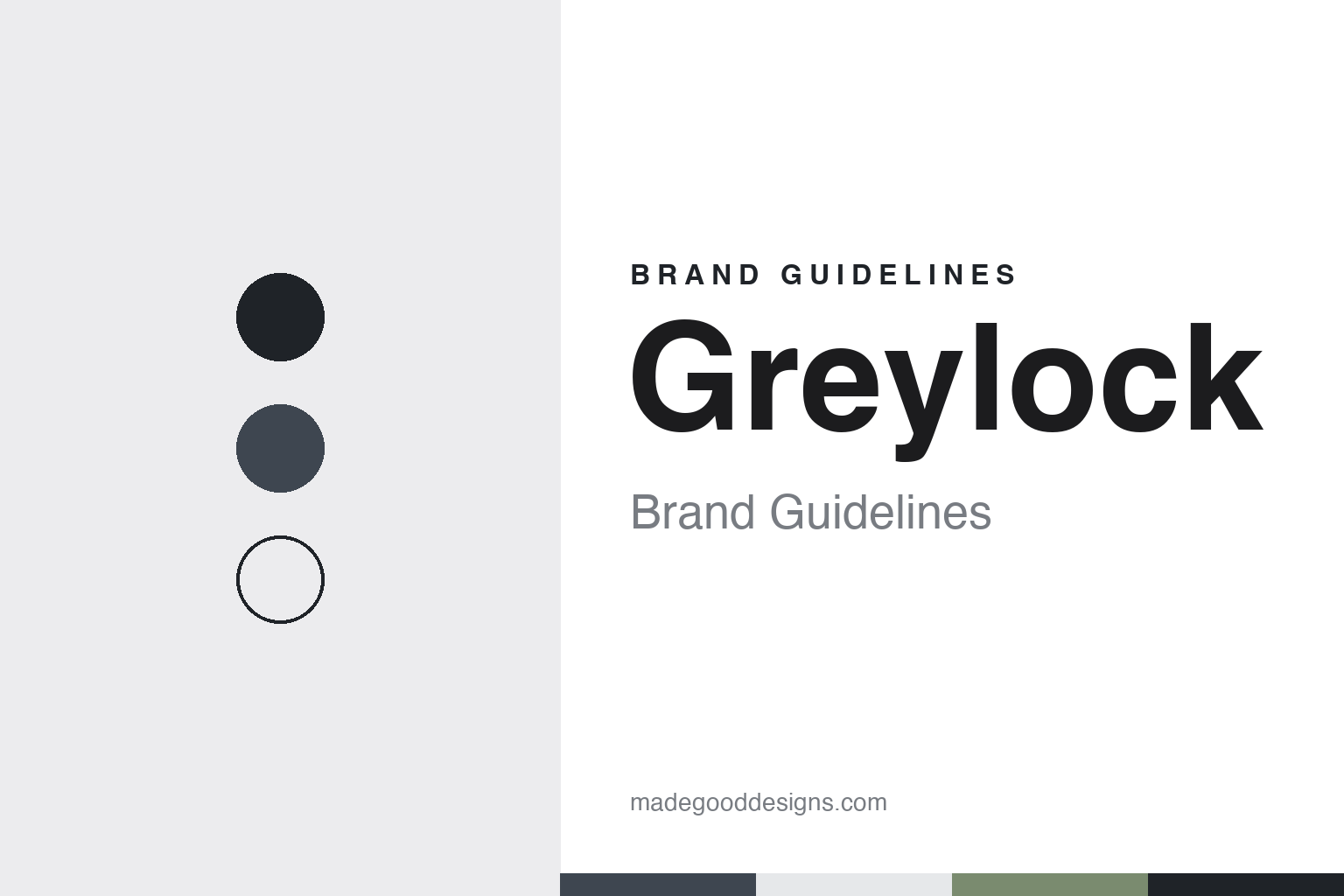
Greylock Brand Guidelines
A 1965 Cambridge partnership that moved to Sand Hill Road.
Aa
Two constants: a Greylock slate, granite and lichen palette and a Narrow grotesque register. Abstract homage — not a Greylock asset or mark; no logo or wordmark is reproduced.
Out of ARD
A Massachusetts partnership, 1965.
Greylock dates from 1965. English Wikipedia says the firm was founded that year in Cambridge, Massachusetts, by Bill Elfers and Dan Gregory, who were joined soon afterwards by Charlie Waite; Wikipedia’s articles on the early history of venture capital name Elfers and Waite as the founders. Both men had worked at American Research and Development Corporation, the Boston investment company led by Georges Doriot.
Wikipedia’s article on Doriot describes Elfers as a fifteen-year veteran of that company who left in 1965 to set up the new firm, first called Greylock Capital, as a limited partnership, a structure that could share investment gains with its partners. Several other American Research and Development alumni later left to form partnerships of their own, among them the founders of Fidelity Ventures and Palmer Partners, the same article says.
The early money came from families. English Wikipedia says the original capital was committed by a group of six families, and that the firm opened a second fund in 1973. Its article on American Research and Development adds that from 1972 Greylock introduced the practice of raising a series of separate funds rather than adding capital to existing partnerships, a habit that made each fund easier to value.
The numbering still runs. In July 2026 TechCrunch reported that Greylock had announced its 18th fund and described it as a “61-year-old firm,” a figure that matches the 1965 founding; in October 2016 the same publication put the firm’s record at “50 years of investing.” The firm’s own page about itself says it has kept to the same approach “for more than five decades.”
Colour
From Massachusetts to Sand Hill Road.
For most of its history Greylock was a Boston-area firm. English Wikipedia says it opened its first office in Silicon Valley in 1999 and moved its headquarters there from Boston in 2009. Forbes reported in September 2013 that the firm’s 14th fund was its first since it had moved its headquarters to Silicon Valley from Massachusetts. Today its website lists two offices: one in Menlo Park, on Sand Hill Road, and one in San Francisco.
The firm also had an Israeli branch. Wikipedia, citing The Wall Street Journal, says the arm known as Greylock IL was renamed 83North in January 2015.
Its focus is early. In October 2023 TechCrunch reported that Greylock’s 17th fund would target pre-seed, seed and Series A founders in enterprise and consumer software, and that more than 80 percent of the previous fund had been invested at those stages. At the same time the firm launched Greylock Edge, a programme for a handful of founders still at the idea, pre-seed or seed stage. In July 2026 the publication reported that the firm’s 10 partners each make one or two new investments a year and that the new fund would back about 25 companies. Greylock’s website makes the same point in its own words: “Each Greylock partner makes only one or two new investments a year because the work demands depth.”
Some companies began inside its offices. TechCrunch reported in 2026 that Palo Alto Networks launched inside Greylock’s offices and that the email-security company Abnormal was incubated there in 2018, and in 2023 that Inflection AI had started there. The firm’s own list of early partnerships includes Airbnb, Discord and LinkedIn, and TechCrunch has named Meta, Workday, Coinbase and Roblox among its investments.
People matter as much as funds in its account of itself. In 2013 Forbes wrote that Greylock was known for investors with operating backgrounds, and noted that it had formalised a talent team to recruit executives, engineers, product managers and designers for its companies; in 2016 TechCrunch described the same in-house talent group. Its partners have included the LinkedIn co-founder Reid Hoffman and David Sze, English Wikipedia says.
Typography
Design and documentation.
Venture capital firms sell no products, so their identities rest on a name, a few lines of copy and the companies they back. Their websites can be strikingly spare. Sequoia Capital’s homepage opens on a single sentence, “We help the daring build legendary companies,” and Andreessen Horowitz uses its motto, “Software Is Eating the World,” as the tagline that runs across its site.
The founder is usually the hero. Sequoia describes the people it wants to back rather than the money it manages, and its ethos page lists “the creative spirits” and “the underdogs,” and both firms give over large parts of their sites to founder stories and to portfolio pages that gather the names and marks of the start-ups they have funded. Wikipedia noted in November 2025 that the a16z website listed more than a thousand portfolio companies.
Publishing has become part of the job. Andreessen Horowitz runs a podcast network of about a dozen shows, newsletters, a books list and a New Media team that, in its own words, offers “go-direct as a service” to founders; Tech Times wrote in June 2026 that its thesis urges founders to speak through their own channels. Sequoia’s site mixes partner essays and videos with its Training Data podcast. Essays matter too: Marc Andreessen’s 2011 piece “Why Software Is Eating the World” gave his firm a motto.
Place and name do the rest. Sand Hill Road in Menlo Park, where Andreessen Horowitz lists its headquarters office, has given its name to a book by one of the firm’s partners, Secrets of Sand Hill Road. Names are chosen with care: Sequoia says its founder picked a long-lived tree rather than his own name, while Andreessen Horowitz compressed two surnames into a16z, a short handle it now uses across its website address, podcasts and social accounts.
Aa
A narrow grotesque, after the plain type of the firm’s website. (Specimen set in Archivo Narrow, a sans STAND-IN; NOT the Greylock logo.)
Greylock
An Oscar for the supporting actor.
Greylock’s public voice is restrained. Its website carries the line “Your first believer in what doesn’t exist yet,” and quotes Henry McCance, its chairman emeritus, as saying that a Greylock partner should aspire to win the Oscar for supporting actor, a line that casts the founder as the lead. Its homepage tells founders’ stories in single sentences: Palo Alto Networks started “from a desk inside Greylock’s office,” and Facebook was “still only for college students” when the firm invested. The style sheet of the website names Trade Gothic, an American sans-serif family, for its text.
Its backers are long-standing. In October 2023 the Greylock partner Saam Motamedi told TechCrunch that the firm’s limited partners were mainly university endowments and nonprofit foundations, most of which had been with it for decades. In July 2026 he told the publication that the partnership had chosen to keep its new fund smaller than it could have raised, because it can give close support only to a small number of companies. The firm says on its own page that the majority of its investments go to entrepreneurs “creating their first enterprise.”
For a design guide, Greylock shows how a firm can build an identity on continuity: one name since 1965, numbered funds and a stated preference for staying small. Compare Index Ventures, another early-stage investor, and Kleiner Perkins, another Silicon Valley venture partnership. For this guide we use a slate, a granite and a lichen green with a sans, an unofficial interpretation; no product or logo is reproduced.
Explore & save
Keep Greylock’s identity on hand — save it to a board in the Made Good inspiration library.
Greylock identity set
Pin the Greylock slate, granite and lichen palette and the Narrow grotesque register to your own board.


