Hafnia Brand Guidelines
A Latin name for Copenhagen, a Singapore base and a 2019 BW merger.
Aa
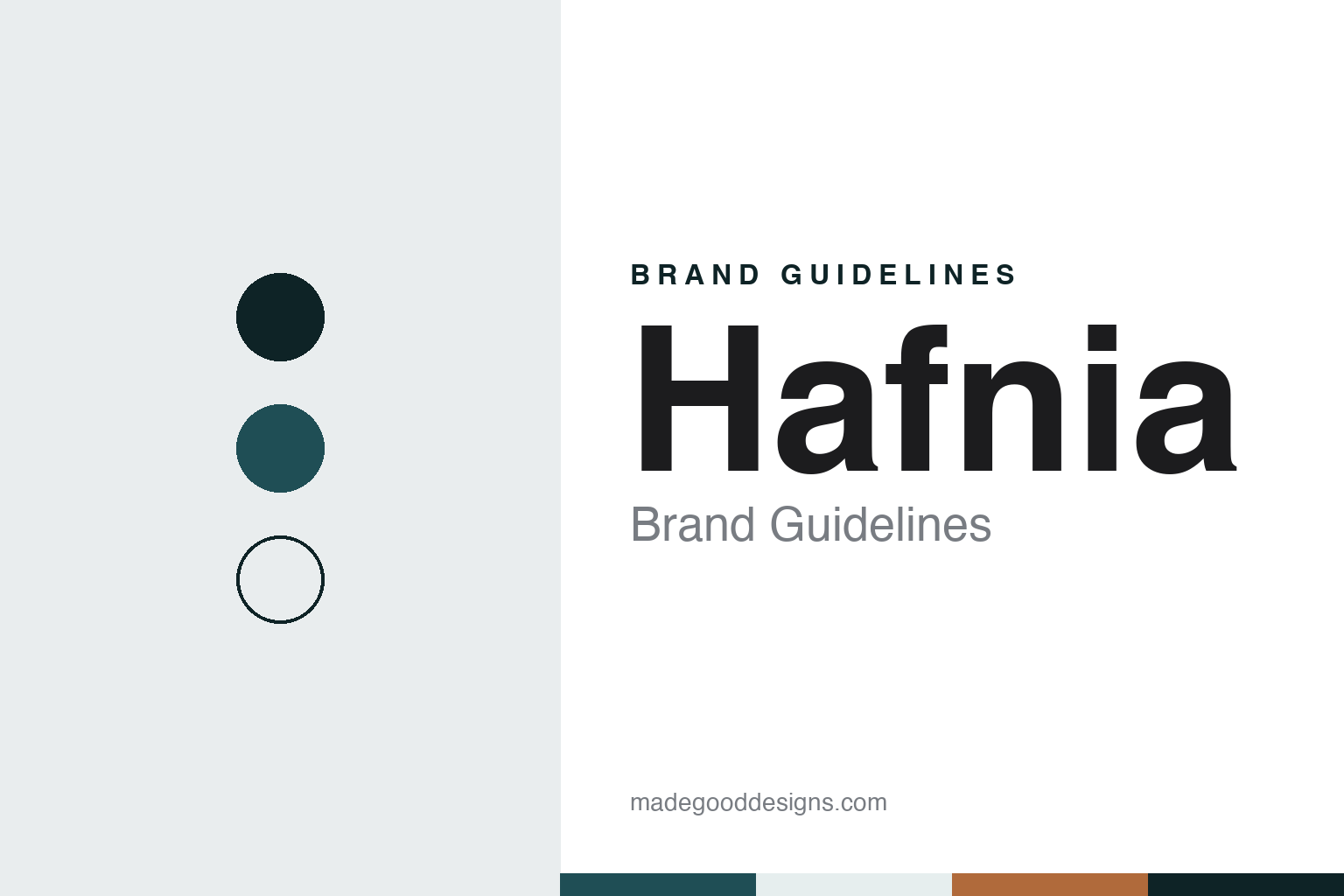
Two constants: a Hafnia teal, sea grey and copper palette and a Rounded sans register. Abstract homage — not a Hafnia vessel or mark; no funnel mark, logo or house flag is reproduced.
Hafnia
A Latin name for Copenhagen.
Hafnia takes its name from the Latin name for Copenhagen, as English Wikipedia notes, although the company is now headquartered in Singapore. It is a younger business than most of its peers. Its own timeline begins in 2010, when Tankers Inc. and Hafnia Management were founded and an MR pool was formed — a commercial pool for medium-range product tankers — followed in 2011 by an LR pool with Straits Tankers. The company’s June 2026 announcement of a change of chief executive says Mikael Skov had led Hafnia “since its establishment in 2010”; the Danish trade paper Maritime Danmark reported that he stepped down after 16 years.
The Copenhagen name had a Copenhagen base at first. The company says Hafnia Tankers was established in Copenhagen in 2012–13 through a three-way merger of Tankers Inc., a Blackstone and Tufton vehicle and the Danish shipowner J. Lauritzen. It dates a joint venture with Vista Shipping and CSSC to 2017–18, after a Handy pool in 2015 and a bunker alliance in 2016.
The decisive step came in 2019, when Hafnia Tankers merged with BW Tankers, part of the BW Group. The Danish political and business outlet Altinget recorded that merger in 2026, noting that Skov stayed in charge after it; the company says the deal also brought in all the pool companies, and that Hafnia was listed in Oslo the same year.
Colour
A BW company, listed twice.
The BW Group has a long history of its own. English Wikipedia says it was founded in Hong Kong in 1955 by Y.K. Pao as World-Wide Shipping, bought the Norwegian shipowner Bergesen d.y. in 2003 and took the single brand BW in 2005; it gives the group’s headquarters as Singapore and Oslo. The Maritime Executive reported in December 2025 that BW held a controlling interest of 44 per cent in Hafnia, and Hafnia’s chairman is Andreas Sohmen-Pao, BW’s chairman, according to Hafnia’s 2026 announcement and English Wikipedia.
Hafnia added a second listing in April 2024. In a BW Group release dated 9 April 2024, Hafnia announced that its shares had begun trading that day on the New York Stock Exchange under the ticker HAFN, while staying listed on the Oslo Stock Exchange as HAFNI. Its own timeline records 2024 as the year it became “a publicly listed company in both Norway and the USA.”
The business is more than a fleet. Hafnia describes “a fully integrated shipping platform” offering technical management, commercial and chartering services, pool management and a large bunker-buying desk. Its pools, it says, cover MR, LR1, Panamax and chemical tankers; it formed a Panamax pool with the trader Mercuria in 2024, and in 2025 launched Seascale Energy, a joint venture with Cargill that it says buys fuel for more than 3,000 vessels. English Wikipedia lists offices in Copenhagen, Houston and Dubai besides Singapore, with a presence in Manila, Mumbai and Monaco.
On size, the company speaks for itself. Its home page describes Hafnia as the largest tanker company anywhere, while its About page says it is “one of the largest operators of product and chemical tankers,” operating close to 200 vessels. Maritime Danmark has described it as one of the largest product tanker owners anywhere.
Typography
Design and documentation.
A tanker or dry-bulk owner sells a service rather than a product, so its identity has to live on its ships and in its paperwork. The oldest signs are the funnel mark and the house flag, painted or flown on every vessel the company operates; today the same hull in company livery is more often seen in an aerial photograph taken from a drone, the ship shown loaded and under way, filling the first screen of a corporate website.
Behind that picture sits the fleet list. Owners publish their ships by class and by name, from the very large crude carriers and Suezmax tankers of the crude trade to Capesize and smaller bulk carriers. Frontline’s home page, for example, counts its VLCCs, Suezmaxes and LR2/Aframax tankers, while CMB.TECH groups its ships under division names such as Euronav for oil tankers and Bocimar for dry bulk. Vessel names can run in a family too: Bocimar’s ships usually carry the prefix Mineral, English Wikipedia says.
Most owners also give space to crew welfare and safety, to environmental reporting and to the next generation of ships. Newbuilding and fuel announcements carry much of the story: CMB.TECH, for one, uses the slogan “Decarbonise Today, Navigate Tomorrow” and in 2026 presented a dry-bulk ship it describes as ammonia-powered, while Frontline’s 2026 fleet-renewal deal was framed around scrubber-fitted “ECO” newbuildings.
Because so many of these companies are listed in New York, Oslo or Brussels, the investor-relations section often does the heaviest lifting: quarterly results, presentations, dividend histories and charts of freight rates. This guide sets out what can be checked about each company — where it was founded, who controls it and what became of its name — and marks clearly what rests only on the company’s own word.
Aa
A rounded sans — “The Forward-Thinking Tanker Company.” (Specimen set in Manrope, a sans STAND-IN; NOT the Hafnia logo.)
Hafnia
“The Forward-Thinking Tanker Company.”
Hafnia’s leadership changed in 2026. Mikael Skov stepped down as chief executive on 1 September 2026 and was succeeded by Søren Steenberg Jensen, previously head of asset management, according to the company’s June 2026 announcement and Maritime Danmark; Skov was nominated to join the board, subject to shareholder approval.
The company has also moved into a fellow product tanker owner. The Maritime Executive reported on 23 December 2025 that Hafnia had completed the purchase of about 14 per cent of the Danish company TORM from Oaktree Capital Management, and that Hafnia planned to discuss merger possibilities with TORM’s board; after further purchases, Euroinvestor reported in September 2026 that Hafnia held about 19.85 per cent. No merger between the two had been agreed at the time of writing, in November 2026.
Hafnia presents itself in words more than in emblems. It calls itself “The Forward-Thinking Tanker Company,” names a short vision statement and its purpose “People First,” and spells out its values as CARE: Collaboration, Ambition, Reliability and Endurance. Its fleet list shows several naming families: gemstones, as with Hafnia Amethyst and Hafnia Tourmaline; cities, as with Hafnia Shenzhen and Hafnia Shanghai; rivers, as with Hafnia Loire and Hafnia Tagus; and others, such as Hafnia Triton and Hafnia Galatea, named after figures from Greek myth. Other ships it operates in its pools keep their owners’ names.
For a design guide, Hafnia shows how a company can borrow an old city name and carry it into a new base and a new group. Compare TORM, the 1889 Danish product tanker owner in which Hafnia now holds a large stake, and Scorpio Tankers, another product tanker owner. For this guide we use a deep teal, a sea grey and a copper with a sans, an unofficial interpretation; no product or logo is reproduced.
Explore & save
Keep Hafnia’s identity on hand — save it to a board in the Made Good inspiration library.
Hafnia identity set
Pin the Hafnia teal, sea grey and copper palette and the Rounded sans register to your own board.