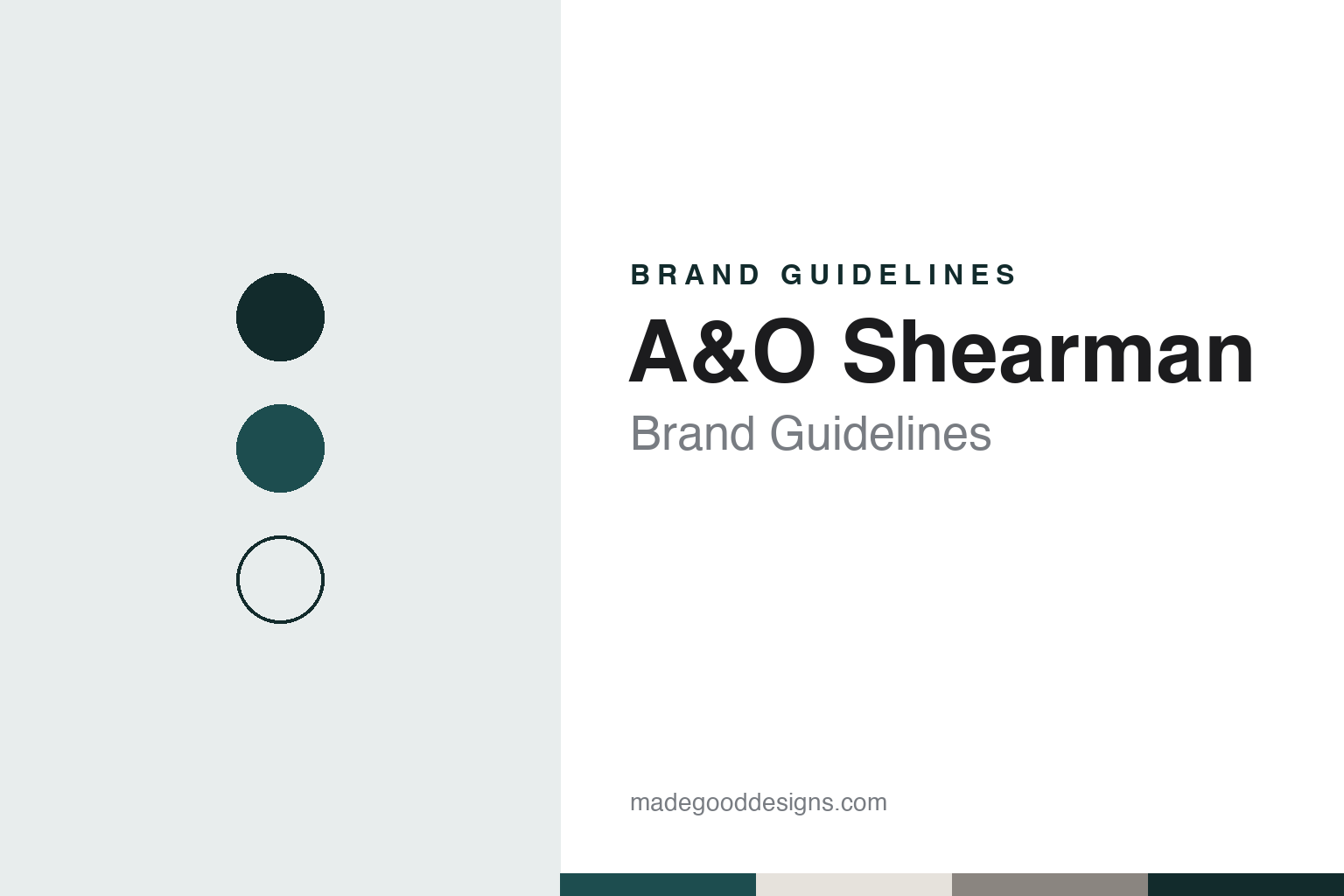
A&O Shearman Brand Guidelines
Two founding firms, one shortened name.
Aa
Two constants: a deep teal, ink and warm grey palette and a clean geometric sans register. Abstract homage — not an A&O Shearman asset; no logo or mark is reproduced.
Two founding firms
London in 1930, New York in 1873.
A&O Shearman, formally Allen Overy Shearman Sterling LLP, was formed on 1 May 2024 by the merger of two older firms: Allen & Overy of London and Shearman & Sterling of New York. The firm calls them “two historic firms” on its website.
Allen & Overy was founded in London on 1 January 1930 by George Allen and Thomas Overy, who had left the firm Roney & Co. and brought several clients with them, Wikipedia says. Allen became private solicitor to the future Edward VIII in 1935 and advised him during the abdication crisis of 1936, work that brought the young firm wider recognition. Later milestones listed by Wikipedia include the 1958–59 contest for British Aluminium, in which it acted for Reynolds Metals, and the Italian motorway company Autostrade’s 1963 bond issue, which Wikipedia says is widely regarded as the first modern Eurobond. International finance became a larger part of its work, and it opened offices in Dubai in 1978, New York in 1985, and Hong Kong and Tokyo in 1988. After the fall of the Berlin Wall it recruited locally qualified lawyers for privatisation work in Central and Eastern Europe, merged with Italy’s Brosio, Casati e Associati in 1998 and took in substantial parts of Loeff Claeys Verbeke in the Benelux countries in 2000–2001. It was drafting counsel on the 2002 ISDA Master Agreement, the standard terms for derivatives transactions.
Shearman & Sterling was founded in New York in November 1873 by Thomas G. Shearman and John William Sterling, who had both worked in David Dudley Field’s practice; Shearman specialised in litigation and Sterling in corporate work. National City Bank of New York, a predecessor of Citibank, retained the firm in 1891 and stayed a client for more than a century. It opened its first overseas office in Paris in 1963, built a permanent presence in Abu Dhabi after advising on the establishment of the Abu Dhabi National Oil Company in 1971, and opened in London in 1972 and Hong Kong in 1978. Its securities work included Ford Motor Company’s initial public offering in 1956, and an international arbitration practice was established in its European offices in 1987.
Colour
From announcement to one firm.
Both firms had looked for partners before. Allen & Overy’s talks with O’Melveny & Myers failed in 2019, and Shearman & Sterling’s negotiations with Hogan Lovells ended in March 2023, according to Wikipedia. The two firms announced their proposed combination on 21 May 2023; in October that year more than 99 per cent of votes cast by partners at each firm supported it, and the merger took effect on 1 May 2024. The stated aim was to combine Shearman’s US corporate client base with A&O’s wider international network, so that one firm could advise on English, US and local law.
Integration brought restructuring. In September 2024 the firm announced plans to reduce its partnership by about ten per cent, close its Johannesburg office and discontinue its consulting business, and in October 2024 it moved to an all-equity partnership. On 11 April 2025 its US practice reached an agreement with the US administration to avoid potential executive action against the firm; it committed to pro bono work, and the administration withdrew an Equal Employment Opportunity Commission inquiry into the firm, Wikipedia says.
Technology is part of the firm’s public profile. Its predecessors launched the online service aosphere in 2002, the Peerpoint contract-lawyer service in 2013 and MarginMatrix, built with Deloitte, in 2016. In February 2023 Allen & Overy announced the use of the generative AI platform Harvey by its lawyers, and that December it launched ContractMatrix with Harvey and Microsoft. In November 2026 Legal Cheek reported a five-year AI plan under which lawyers in every practice would set aside at least three per cent of their billable time to help build AI tools.
Typography
How the firms present themselves.
Large UK and global law firms sell advice rather than objects, so their identities rest on names, words and a small number of visual constants. Many trade under founders’ surnames that have been shortened or combined through mergers, and the wordmark is usually set plainly, in one weight, with the colour doing quiet work: often a single accent, used sparingly against white, grey or a dark neutral.
The firm website carries most of the brand. A typical site is organised around expertise and sectors, with practice pages for areas such as finance, disputes or competition, and an office list or map that shows how many cities and countries the firm covers. Partner profiles, with photographs, practice areas and contact details, sit at the centre of the client-facing pages, because clients often choose a lawyer as much as a firm.
Firms also publish a steady stream of thought leadership: insights, briefings, blogs, webinars and seminars on regulation, markets and technology. Alongside these sit annual reports or results pages, statements on responsible business, inclusion and sustainability, and pro bono reports that describe unpaid work for charities and community groups. Graduate-recruitment pages, sometimes run as separate microsites, address law students with a different, warmer voice, while alumni networks keep former lawyers in touch.
The firms in this guide, many of them with long roots in London, share that vocabulary, but their histories differ: some go back to the eighteenth or nineteenth century, others are the products of mergers this century, and several now operate as international partnerships spanning dozens of countries. This guide sets out what can be checked about each one, from founding and mergers to how it presents itself today, and marks clearly what rests on the firm’s own word.
Aa
A clean geometric sans for a merged firm. (Specimen set in Manrope, a sans STAND-IN; NOT the A&O Shearman logo.)
A&O Shearman
Four surnames, one short name.
A&O Shearman is counted among the London firms known as the Magic Circle, the informal label that Wikipedia says was coined by legal reporters in the 1990s; Allen & Overy was one of the five firms it first described. Legal Cheek still called the merged firm a Magic Circle player in November 2026.
The firm operates through Allen Overy Shearman Sterling LLP, registered in England and Wales and regulated by the Solicitors Regulation Authority, with affiliated entities in other jurisdictions, Wikipedia says; in 2026 it reported nearly 4,000 lawyers across 48 offices in 29 countries. Its website says those lawyers are “equally fluent in English law, U.S. law and the laws of the world’s most dynamic markets.” The site groups its pages around expertise, insights and global seminars, annual reports and results, and responsible business, including pro bono, inclusion and sustainability, with an alumni network alongside.
The name carries the history. The legal name keeps all four founding surnames, while the trading name shortens Allen & Overy to A&O, the abbreviation Wikipedia also uses for the older firm, and keeps Shearman in full.
For a design guide, A&O Shearman shows how a merger can be expressed in a name that compresses one heritage and keeps the other whole. Compare Clifford Chance, which worked with Allen & Overy on the 1999 loan documents, and Freshfields, another Magic Circle firm. For this guide we use a deep teal, an ink and a warm grey with a sans, an unofficial interpretation; no product or logo is reproduced.
Explore & save
Keep A&O Shearman’s identity on hand — save it to a board in the Made Good inspiration library.
A&O Shearman identity set
Save the A&O Shearman teal, ink and warm grey palette and the clean geometric sans register to your own board.