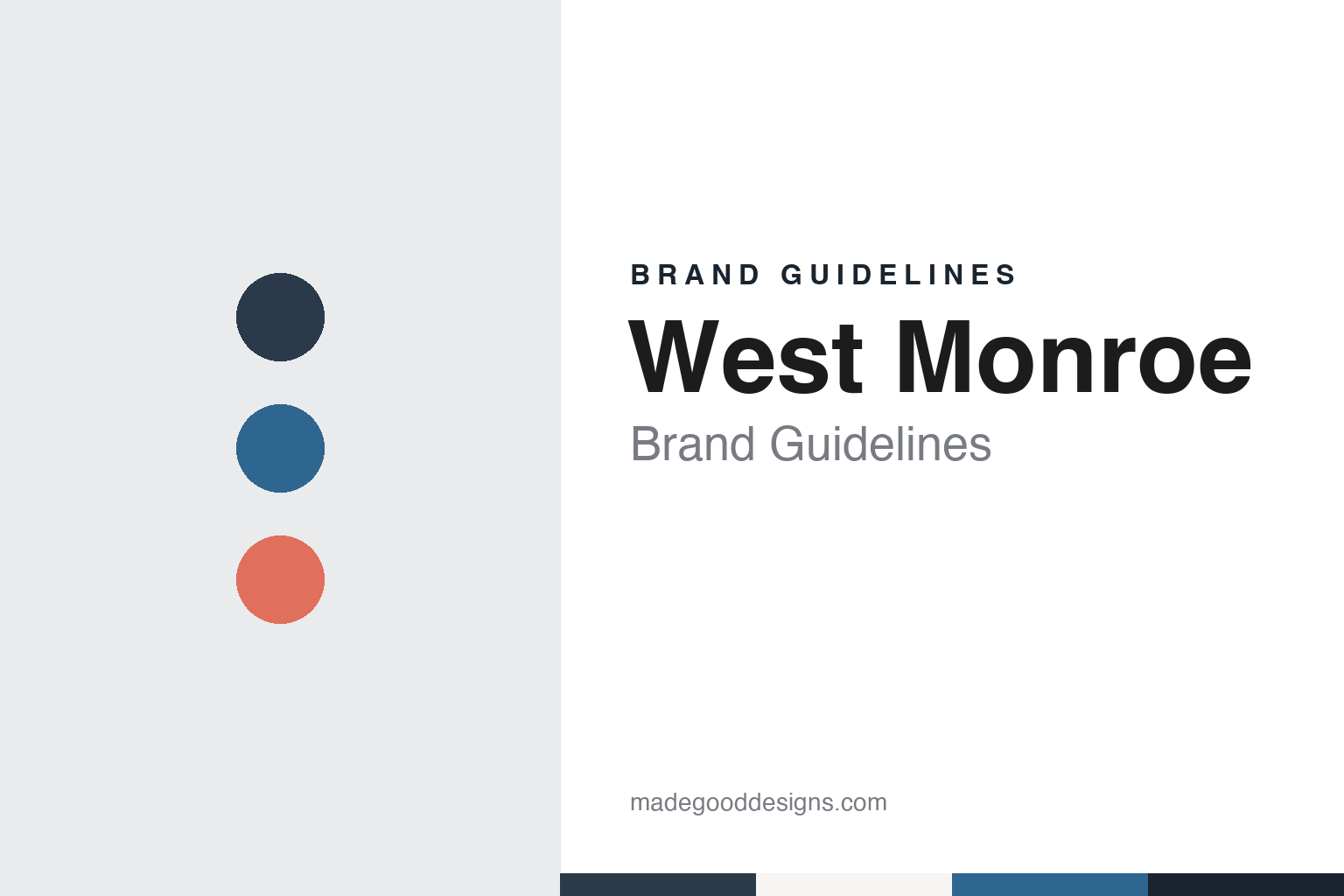
West Monroe Brand Guidelines
A Chicago consultancy named after the street it came from.
Aa
Two constants: a slate, lake blue and coral palette and a grid sans register. Abstract homage — not a West Monroe asset or mark; no logo or wordmark is reproduced.
Four Andersen consultants
A Chicago start named after a street.
West Monroe was founded in Chicago in April 2002 by four former Arthur Andersen consultants, among them Dean Fischer and Kevin McCarty, according to English Wikipedia; the trade site Consultancy.uk told the same founding story in October 2014. Wikipedia says the four met at Miller’s Pub in the city, that the firm was set up as West Monroe Partners LLC, and that the name came from Arthur Andersen’s former address on West Monroe Street. Its first client, in June 2002, was Equity Marketing Services, and its early work was business and technology consulting for mostly Midwestern companies.
The firm spread beyond Chicago within a few years, opening offices in Seattle and New York in 2005, Wikipedia says. At the end of 2012 it reorganised as an employee stock ownership plan, and in 2013 it made its first acquisition, the Minneapolis merger-integration specialist On Point Consulting, which became its Minneapolis office. The same year it set up the Fischer Fellowship, named after its co-founder, which lets employees take paid leave of three to six months to work on philanthropic and humanitarian projects, Wikipedia says. Fischer led the firm as chief executive from its founding until October 2014, when McCarty, then president, took over and Fischer became executive chairman, Consultancy.uk reported; by then the firm had more than 500 employees and was 37th in the 2014 Vault Consulting 50 ranking, the site said.
The street name later went on a building. In 2019 West Monroe announced a 12-year lease, running from 2020 to 2032, as anchor tenant of a 15-storey office building on West Monroe Street in Chicago’s Loop, with naming rights that made it “West Monroe Partners HQ.” The company said at the time that it had 1,450 employees, up from 850 in August 2017.
Colour
Acquisitions and a 50/50 owner.
Growth came largely through buying specialists. Wikipedia lists Madrona Solutions Group of Seattle in 2014, the Salesforce partner Etherios in 2015, the Chicago healthcare consultancy Invoyent in 2016 and CAST Management Consultants of Los Angeles in 2017. In 2019 came Waterstone Management Group, an adviser to private-equity firms, and the Minneapolis digital product studio GoKart Labs; in 2020 the strategy and outsourcing firm Pace Harmon, which gave West Monroe its Washington office, and Two Six Capital, a San Francisco data-science consultancy for private equity whose purchase closed on November 30, 2020, Consulting.us reported. The software firms Verys and Carbon Five followed in 2021, according to Wikipedia.
The ownership model changed in 2021. In a release dated November 10, 2021, West Monroe said it had finalised an investment from MSD Partners, an investment adviser founded in 2009 by the partners of MSD Capital, Michael Dell’s family investment office. The deal left MSD Partners with a 50% stake and the firm’s employees with the other half, under a board split equally between the two. The firm gave its headcount then as 2,000 and said the investment would fund acquisitions, training and its Intellio suite of software assets; the same release described West Monroe as a digital consulting firm “born in technology but built for business.” In 2022 it opened a London office to serve private-equity clients and bought 71 & Change, a change-management consultancy in the Pacific Northwest, Wikipedia says.
Leadership changed hands again in 2025. West Monroe announced on May 5, 2025, that Gil Mermelstein, its president and a 15-year veteran of the firm, would become chief executive on July 1, 2025 — only the third since its founding — with McCarty moving to executive chairman. In September 2025 it bought 2050 Partners, a Bay Area energy-efficiency and clean-energy regulatory consultancy founded in 2015, for its energy and utilities practice.
Typography
How consultancies present themselves.
Management consultancies sell advice, so their brands have to stand in for something a client cannot hold. Most begin with a name — often a founder’s surname, a set of initials or a coined word — set as a confident wordmark, and pair it with one signature colour that runs from the website to the cover of every report. The visual system is usually restrained, leaving the work itself to carry the message.
Much of that work is published. Firms put out thought-leadership articles, surveys and recurring indexes, along with yearly outlooks on trends in a sector; many also run podcasts and newsletters. Their websites are organised around industry pages and capability pages, so that a hospital chief, a utility executive or a private-equity partner can find the team that speaks to them.
Case studies are a staple, but clients are often anonymised: a “global insurer” or a “regional health system” rather than a named company, with the results stated as outcomes. Alongside them sit the signals of scale and standing that firms like to show — office maps, rankings and awards from business magazines, and partnerships with technology companies.
The people side is just as visible. Large consultancies keep alumni networks for former staff, many of whom go on to become clients, and their careers pages explain the hiring process in detail, often with guides to the case interview. Many also publish annual impact or responsibility reports. The guides that follow look at how individual firms handle these conventions, and where their own stories — origins, owners and names — set them apart.
Aa
A grid sans for a firm named after a Chicago street. (Specimen set in Work Sans, a sans STAND-IN; NOT the West Monroe logo.)
West Monroe
From “Be Digital” to “AI-native.”
The firm’s slogans track its strategy. Wikipedia records an earlier tagline, “Don’t Do Digital. Be Digital.”, and a podcast, This is Digital, launched in 2022. Today the website calls West Monroe an “AI-native global business and technology consulting firm” and opens its about page with a line aimed at the rest of the trade: “Other consultancies advise from the sidelines. We create impact side by side.” Its industry pages run from consumer and industrial products to healthcare, insurance and private equity, and it lists offices in eleven locations, from Boston and Seattle to London and Costa Rica, with Chicago as headquarters.
Its newest products push that message further. In June 2026 the company launched WestMonroe.ai, a public platform of AI agents on questions such as growth strategy, talent strategy and AI policy, with six agents at launch, and said it would be available at no cost. Its website also lists Clonal and Intellio among its own platforms.
For a design guide, West Monroe shows how a firm’s origin story can become its identity: a street address turned into a company name, and then into the name on a building. Compare Accenture, which began as Arthur Andersen’s consulting division, and Huron, another Chicago consultancy founded in 2002 by former Arthur Andersen staff. For this guide we use a slate, a lake blue and a coral with a sans, an unofficial interpretation; no product or logo is reproduced.
Explore & save
Keep West Monroe’s identity on hand — save it to a board in the Made Good inspiration library.
West Monroe identity set
Save the West Monroe slate, lake blue and coral palette and the grid sans register to your own board.