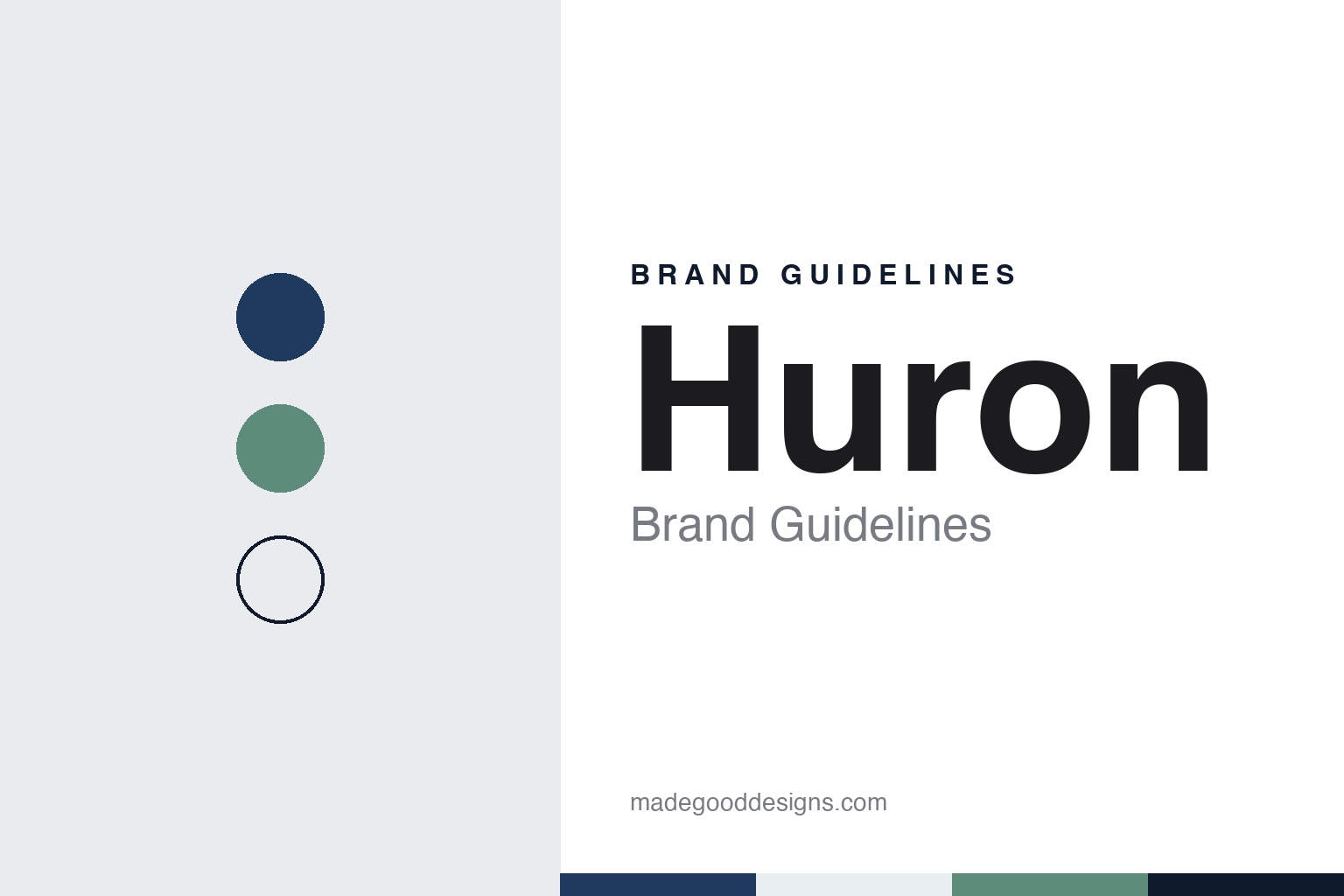
Huron Brand Guidelines
The Chicago consultancy that former Andersen consultants built in 2002.
Aa
Two constants: a lake blue, mist and shoreline green palette and a plain modern sans register. Abstract homage — not a Huron asset or mark; no logo or campaign artwork is reproduced.
After Andersen
A firm born from a collapse.
Huron was founded in the wreckage of another firm. In 2002, as the accounting firm Arthur Andersen unravelled after the collapse of its client Enron, its professionals began to leave. One group of financial and operational consultants, led by Gary Holdren, a partner and Andersen’s Midwest director of global client services, founded Huron Consulting Group in March 2002, according to the International Directory of Company Histories. They set it up in Chicago, the city where Andersen had its own headquarters.
The firm opened for business in May 2002 with 213 consultants, the Directory says. Its start-up backing came from Lake Capital Management, an investment firm for which Huron was the first investment. Holdren became chairman, chief executive and president.
The timing shaped the business model. The Directory explains that Huron was set up as a consultancy unaffiliated with any public accounting firm, so it was not bound by the new rules that stopped auditors from selling certain non-audit services to their audit clients. It organised itself into two segments: financial consulting, covering disputes, investigations, economic analysis, valuation and help for companies in financial distress, and operational consulting, covering higher education, healthcare, legal business consulting, strategic sourcing and performance improvement.
Colour
From turnarounds to hospitals.
Huron’s first months leaned on distress. Turnaround contracts, including work on the bankruptcy of UAL Corp., the parent of United Airlines, fuelled its early growth, the Directory says. When that demand began to ease at the end of 2003, the firm turned to its operational side, and above all to healthcare: it launched a healthcare practice in 2003 and, that autumn, four senior consultants from Cap Gemini Ernst & Young’s healthcare practice joined its Chicago office. The Directory adds that Consulting Magazine named Holdren among the most influential consultants of 2003.
The company went public in October 2004, listing on NASDAQ under the ticker HURN. Acquisitions followed quickly. According to the Directory, Huron bought Speltz & Weis, a firm that ran interim management for distressed hospitals, in May 2005; MSGalt & Company in April 2006; Document Review Consulting Services and Aaxis Technologies in July 2006; and Glass & Associates and Wellspring Partners in January 2007. The Directory says the Wellspring purchase expanded Huron’s healthcare practice fourfold.
Higher education was there from the start. The Directory describes an early practice serving colleges, universities, hospitals and academic medical centres on research administration, regulatory compliance, clinical research and financial management. That pairing of hospitals and universities, both large, regulated and research-heavy institutions, remains at the centre of how the firm describes itself today.
The firm also grew in headcount and reach. By the end of 2006, the Directory says, its revenue-generating professionals had nearly quadrupled, from 213 at the start to 842, split between 344 in financial consulting and 498 in operational consulting. Besides its Chicago head office it then had offices in Boston, Charlotte, Houston, Los Angeles, New York, San Francisco and Washington, D.C., and document review centres in Florida and the Carolinas that served its legal business consulting practice.
Typography
Design and documentation.
Management consultancies sell advice, so their brands have to stand in for something a client cannot hold. Most begin with a name — often a founder’s surname, a set of initials or a coined word — set as a confident wordmark, and pair it with one signature colour that runs from the website to the cover of every report. The visual system is usually restrained, leaving the work itself to carry the message.
Much of that work is published. Firms put out thought-leadership articles, surveys and recurring indexes, along with yearly outlooks on trends in a sector; many also run podcasts and newsletters. Their websites are organised around industry pages and capability pages, so that a hospital chief, a utility executive or a private-equity partner can find the team that speaks to them.
Case studies are a staple, but clients are often anonymised: a “global insurer” or a “regional health system” rather than a named company, with the results stated as outcomes. Alongside them sit the signals of scale and standing that firms like to show — office maps, rankings and awards from business magazines, and partnerships with technology companies.
The people side is just as visible. Large consultancies keep alumni networks for former staff, many of whom go on to become clients, and their careers pages explain the hiring process in detail, often with guides to the case interview. Many also publish annual impact or responsibility reports. The guides that follow look at how individual firms handle these conventions, and where their own stories — origins, owners and names — set them apart.
Aa
A plain modern sans — for a firm that now calls itself simply Huron. (Specimen set in Inter Tight, a sans STAND-IN; NOT the Huron logo.)
Huron
One name, three industries.
The legal name is still Huron Consulting Group, but the firm presents itself simply as Huron. Its website calls it “a global professional services firm” working across the private and public sectors, and says it works across healthcare, education and commercial industries, with capabilities in strategy, operations, technology and human capital. Its brand page says it works with more than 700 higher education institutions around the world and with all of the 100 largest hospitals and health systems in the United States. Those are the company’s own descriptions and figures.
Its strategy arm keeps a separate name. The website presents Innosight as “Innosight by Huron” and says the team’s expertise is rooted in the work of its cofounder Clay Christensen on disruptive innovation. In September 2025 Huron announced the acquisition of Wilson Perumal & Company, a strategy and operations consultancy known for work on managing complexity, Pulse 2.0 reported; about 30 of its professionals joined Huron, and the firm’s chief executive and president, Mark Hussey, described the deal as the next step for the Innosight team. Innosight’s page lists growth strategy, innovation strategy, complexity management and portfolio strategy among its capabilities.
The identity has been refreshed again. A page titled “Introducing the new Huron” on the company’s website carries the line “Meet the moment. Own the future.” and says the firm is “showing up with a fresh look that reflects our momentum.” The campaign page leads with client case studies from hospitals, universities and companies rather than with the firm’s history. The website names Chicago as Huron’s global headquarters, one of 26 locations it lists worldwide.
For a design guide, Huron shows how a firm born in 2002 can build an identity on its industries rather than its heritage. Compare Accenture, the former Andersen Consulting, and FTI Consulting, which the Directory lists among Huron’s principal competitors. For this guide we use lake blue, mist and shoreline green with a sans, an unofficial interpretation; no product or logo is reproduced.
Explore & save
Keep Huron’s identity on hand — save it to a board in the Made Good inspiration library.
Huron identity set
Pin the Huron lake blue, mist and shoreline green palette and the plain modern sans register to your own board.