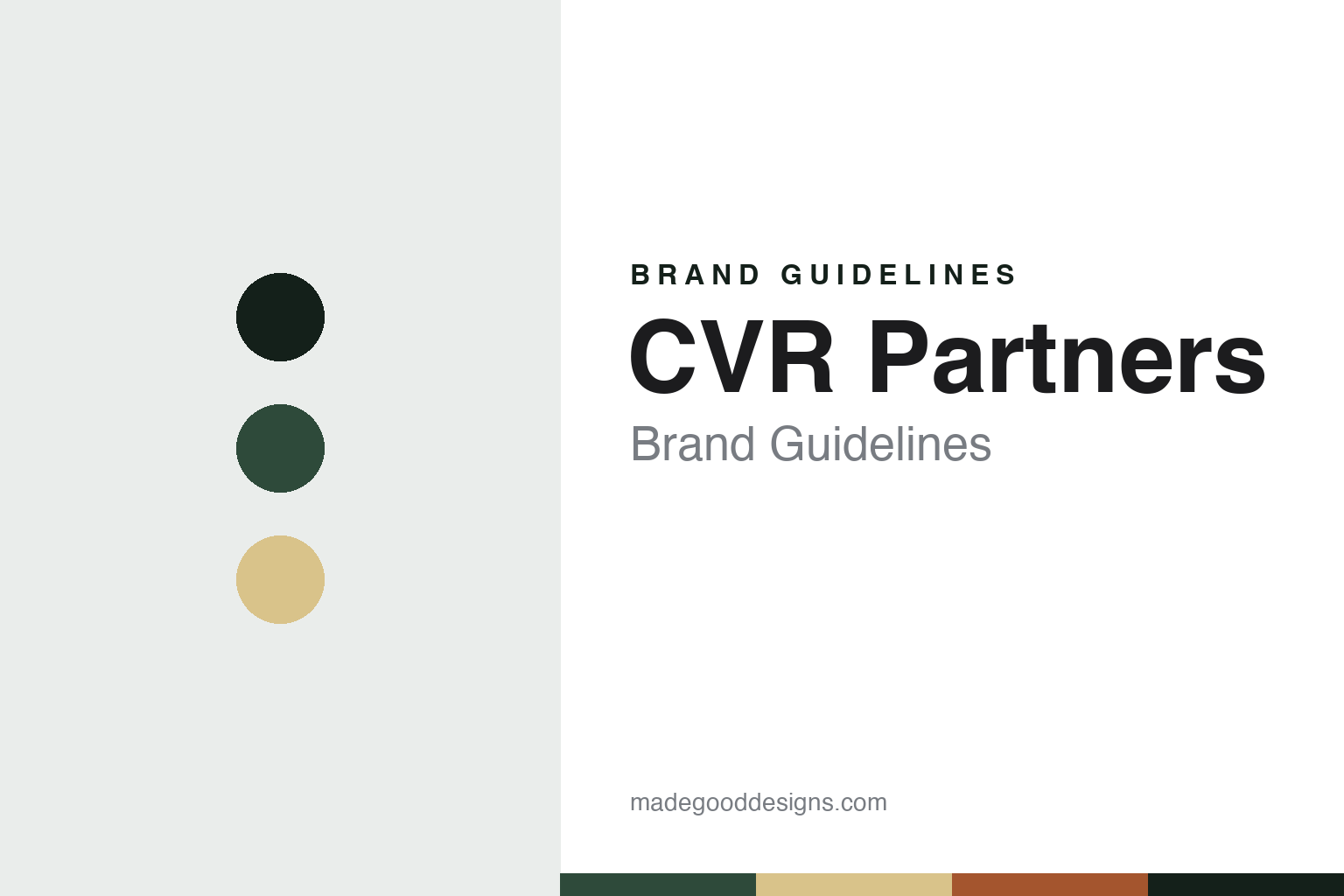
CVR Partners Brand Guidelines
Pet-coke nitrogen at Coffeyville and ammonia at East Dubuque.
Aa
Two constants: a prairie green, wheat and rust palette and a condensed industrial sans register. Abstract homage — not a CVR Partners product or mark; no plant, logo or label is reproduced.
A gasifier in Kansas
A coal plant from California, rebuilt to run on petroleum coke.
CVR Partners is a fertilizer business with an unusual starting point: a refinery town in south-east Kansas. English Wikipedia’s history of Coffeyville Resources traces the site to an oil refinery built in 1906 by the National Refining Company. In 1944 the refinery was sold to the Cooperative Refinery Association, which gave it the nickname “COOP,” and in 1982 that association merged with Farmland Industries, the Kansas City farm cooperative. The refinery was later bought by Coffeyville Resources, the article says.
The neighbour is the plant that matters here. Construction of a nitrogen fertilizer plant next to the refinery began in 1998, according to the same article, and the way it was built is the most distinctive fact in the company’s story. A Texaco coal-gasification plant from Cool Water, near Daggett in California, was taken apart, refurbished, shipped to Kansas and converted to gasify petroleum coke instead of coal. Reassembled, it became the heart of the fertilizer works, which began production in late 2000.
That choice of feedstock still defines the site. At Coffeyville the gasifier turns petroleum coke, most of it supplied by the refinery next door, into a hydrogen-rich synthesis gas, which is converted into ammonia and then upgraded into urea ammonium nitrate. English Wikipedia describes it as one of only two fertilizer plants in North America that does not rely on natural gas as a raw material. The refinery itself now belongs to CVR Energy, also of Sugar Land, and the fertilizer business sits in CVR Partners, whose general partner is a CVR Energy subsidiary.
Colour
UAN, ammonia and two Corn Belt plants.
CVR Partners describes itself as a Delaware limited partnership “focused on the production, marketing and distribution of nitrogen fertilizer products,” headquartered in Sugar Land, Texas. Its company description in a June 2026 Business Wire release names two products: urea ammonium nitrate, the liquid fertilizer known as UAN, and ammonia, which it says are mostly used by farmers to improve the yield and quality of their crops.
The same release gives the size of each site in the company’s own terms. At Coffeyville it lists a 1,300 ton-per-day ammonia unit, a 3,100 ton-per-day UAN unit and a dual-train gasifier complex with a capacity of 89 million standard cubic feet of hydrogen a day. At East Dubuque, Illinois, on the Mississippi in the north-west corner of the state, it lists a 1,075 ton-per-day ammonia unit and a 950 ton-per-day UAN unit.
East Dubuque came from outside. English Wikipedia’s article on Rentech, the Los Angeles company, says Rentech entered the fertilizer business in 2006 by buying the East Dubuque ammonia plant from Agrium, and in 2011 put it into a listed subsidiary, Rentech Nitrogen Partners. In August 2015 Chemical & Engineering News reported that CVR Partners would acquire a facility from Rentech Nitrogen, in a summer of fertilizer consolidation; the plant now appears in CVR Partners’ own description of its operations.
The two plants run on different feedstocks, and the company is working to loosen that split. On its third-quarter call in November 2026, as summarised by The Motley Fool, management said a 41-day planned maintenance turnaround at East Dubuque had ended in mid-October, that it intended to test running at a capacity about five per cent higher after an ammonia expansion there, and that a feedstock optionality project at Coffeyville, meant to allow a flexible mix of natural gas and petroleum coke, was in the final phases of engineering, with construction expected to begin in 2027.
Typography
Plants, products and agronomy.
Fertiliser makers sell to two very different audiences at once: farmers and dealers on one side, and industrial buyers, investors and governments on the other. Their public material tends to reflect that split. Green fields, ripening crops and harvest scenes sit beside photographs of mines, process plants, storage domes and port terminals, so that the farm and the factory appear under the same name.
Much of what these companies publish is practical. Crop-nutrition guides, product-grade explainers and nutrient ratios printed as plain numbers, such as an NPK grade written out in full, do a good deal of the identity work. Many makers add agronomy tools, soil-testing services, call centres or field demonstrations for growers, and present them as part of the brand rather than as an extra.
The investor side has its own documents. Annual reports, quarterly statements, sustainability and emissions reports and filings to stock exchanges give these companies a steady, formal voice, often with maps of plants and shipping routes. Capacity figures, new plant projects and joint ventures appear there first, usually dated and attributed, and they are the most reliable record of how a maker has grown.
Distribution is the last layer. Fertiliser reaches farms through dealer networks, cooperatives, regional offices and state channels, and the bag, the dealer sign and the product name are often what a grower actually sees. The guides that follow look at each company through what can be checked: who founded it, who owns it, where it makes its products, how it presents itself and, where it matters, how its name and ownership have changed over the decades.
Aa
A condensed industrial sans for a plant-and-pipeline business. (Specimen set in IBM Plex Sans Condensed, a sans STAND-IN; NOT the CVR Partners logo.)
CVR Partners
A partnership inside a refining group.
CVR Partners is not a stand-alone company in the usual sense. In the June 2026 release, CVR Energy describes itself as a diversified holding company engaged mainly in petroleum refining and marketing, and in nitrogen fertilizer through its interest in the partnership; its subsidiaries serve as the general partner and own about 37 per cent of the common units, the release says. The remaining units trade on the New York Stock Exchange under the ticker UAN, named after the product. English Wikipedia’s article on Icahn Enterprises lists CVR, covering petroleum refining and nitrogen fertilizer, among that group’s businesses.
The name is the parent’s. The partnership shares the CVR name with CVR Energy, and the two issue joint releases when they announce leadership changes, as they did in June 2026. Its public material centres on quarterly results, utilization figures for its ammonia plants and cash distributions to unitholders.
That makes the business’s visual world industrial and agricultural at once: a gasifier and storage tanks beside a refinery in Kansas, an ammonia plant above the Mississippi in Illinois, and the farm country that buys its UAN. The company’s own description is written in tons per day and crop yields.
For a design guide, CVR Partners shows how an industrial fertilizer brand can be defined by its plants and its feedstock rather than by a pack. Compare LSB Industries, another American nitrogen maker with plants in the South and Midwest, and CF Industries. For this guide we use prairie green, wheat straw and a rust with a condensed sans, an unofficial interpretation; no product or logo is reproduced.
Explore & save
Keep CVR Partners’s identity on hand — save it to a board in the Made Good inspiration library.
CVR Partners identity set
Save the CVR Partners prairie green, wheat and rust palette and the condensed industrial sans register to your own board.


