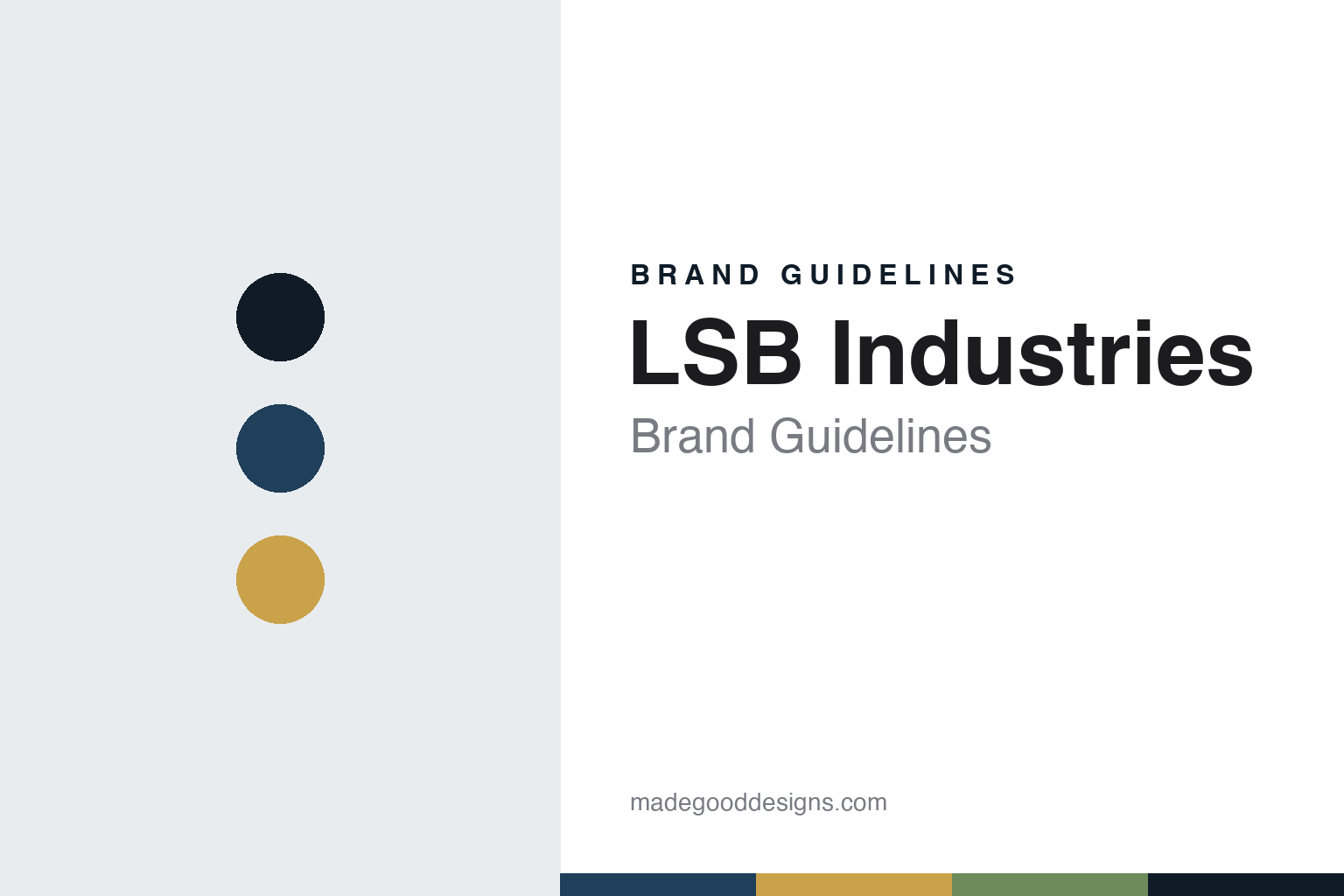
LSB Industries Brand Guidelines
Jack Golsen’s 1968 firm and its three ammonia plants.
Aa
Two constants: a delta blue, amber and pine palette and a grotesque industrial sans register. Abstract homage — not an LSB Industries product or mark; no plant, logo or label is reproduced.
A conglomerate in Oklahoma
From industrial products and climate control to chemicals.
LSB Industries says it was founded in 1968 by Jack Golsen, and that it grew as an industrial conglomerate focused on industrial products and climate-control systems. Its headquarters are in Oklahoma City, according to the company’s own description and the boilerplate of its 2026 press releases.
The chemical business that defines it today was bought rather than built. The company’s timeline says it acquired the chemical manufacturing facility at El Dorado, Arkansas, from Monsanto in 1983. In 1999 it acquired a second plant, at Cherokee, Alabama, from La Roche Industries. English Wikipedia’s article on the town of Cherokee gives that plant a longer past: it says Cherokee Nitrogen was built in 1962 by Armour Agri-Chemicals and was owned by USS Agri-Chemicals, a division of United States Steel, and by LaRoche Industries before LSB bought it.
The third site took longer to bring into use. LSB says it acquired a chemical plant at Pryor, Oklahoma, in 2000 and restarted production there in 2010. A fourth operation is not its own: at Baytown, Texas, the company says it runs a nitric acid facility for Covestro.
Through the 2010s the El Dorado site was rebuilt. The timeline records a major expansion beginning in 2013, new nitric acid plants starting production in 2015 and a new ammonia plant in 2016 — the same year, the company says, that it divested its climate-control business, leaving LSB as a chemical maker.
Colour
Ammonia and what is made from it.
LSB’s product list starts with ammonia and works outward. For industry, the company lists industrial, refrigerant-grade, commercial-grade and aqua ammonia, used, it says, as a chemical feedstock and in water treatment and refrigeration. It also makes nitric acid, in strengths from 57 to 70 per cent and as mixed and concentrated acids, which it says go into semiconductors, nylon and polyurethane intermediates, as well as sulfuric acid and carbon dioxide for food refrigeration and dry ice.
Mining is a market of its own. LSB says it supplies industrial-grade, prilled low-density ammonium nitrate and ammonium nitrate solutions to customers extracting coal, copper, gold and other minerals, and to quarries and construction sites, where the products are altered for blasting at the point of use.
For farms, the range narrows to two products: UAN, a liquid fertilizer for corn and other crops, and ammonia as a high-nitrogen fertilizer used mainly for corn. The company says its agricultural products are used on corn, cotton, wheat, alfalfa, vegetables and citrus across North America. It describes its plants as placed near their markets: Cherokee to supply the Eastern Corn Belt, Pryor to supply the Southern Plains with direct rail access to the Corn Belt, and El Dorado on a 1,400-acre site in southern Arkansas.
The plants have been running harder. On its third-quarter call in October 2026, as summarised by The Motley Fool, management said each of its three facilities had set new monthly production records in the first nine months of the year, and that El Dorado was running at about 1,350 to 1,370 tons a day after a turnaround, against an original nameplate of 1,150 tons. It also described a possible ammonia expansion at El Dorado that would add about 100,000 tons a year of capacity, with completion in 2029 if the project goes ahead.
Typography
Plants, products and agronomy.
Fertiliser makers sell to two very different audiences at once: farmers and dealers on one side, and industrial buyers, investors and governments on the other. Their public material tends to reflect that split. Green fields, ripening crops and harvest scenes sit beside photographs of mines, process plants, storage domes and port terminals, so that the farm and the factory appear under the same name.
Much of what these companies publish is practical. Crop-nutrition guides, product-grade explainers and nutrient ratios printed as plain numbers, such as an NPK grade written out in full, do a good deal of the identity work. Many makers add agronomy tools, soil-testing services, call centres or field demonstrations for growers, and present them as part of the brand rather than as an extra.
The investor side has its own documents. Annual reports, quarterly statements, sustainability and emissions reports and filings to stock exchanges give these companies a steady, formal voice, often with maps of plants and shipping routes. Capacity figures, new plant projects and joint ventures appear there first, usually dated and attributed, and they are the most reliable record of how a maker has grown.
Distribution is the last layer. Fertiliser reaches farms through dealer networks, cooperatives, regional offices and state channels, and the bag, the dealer sign and the product name are often what a grower actually sees. The guides that follow look at each company through what can be checked: who founded it, who owns it, where it makes its products, how it presents itself and, where it matters, how its name and ownership have changed over the decades.
Aa
A grotesque industrial sans for a plant-based chemicals business. (Specimen set in Archivo, a sans STAND-IN; NOT the LSB Industries logo.)
LSB Industries
Project Blue at El Dorado.
The company’s newest story is about carbon. In April 2022 LSB announced a project to capture carbon dioxide produced by its ammonia making at El Dorado and inject it into deep rock formations under the plant site, which it describes as low-carbon or “blue” ammonia. The project was developed with Lapis Carbon Solutions, a Dallas carbon-capture developer, and on 19 May 2026 LSB announced, in a release through Business Wire, an agreement giving it a pathway to full ownership of the project, which it calls Project Blue, through payments tied to milestones.
By October 2026, the company said, that deal had closed. On the third-quarter call, as transcribed by The Motley Fool, LSB’s chief executive said the company had assumed full ownership of the El Dorado project from Lapis in the previous quarter, that construction of the capture facility was “in full swing,” and that LSB was still working with the U.S. Environmental Protection Agency to secure the Class VI permit the injection wells need. That permit was pending at the time of the call.
The same ambition runs through the company’s own pages, which describe a “Low Carbon Vision,” a collaboration announced with the ammonia-fuel developer Amogy in 2023 and a five-year agreement in 2024 to supply low-carbon ammonium nitrate solution to Freeport Minerals; those are the company’s accounts. Its core values, it says, are “Protect What Matters, Make it Better, Practice Integrity and Be One Team.” LSB is listed on the New York Stock Exchange under the ticker LXU.
For a design guide, LSB Industries shows how a chemical maker can present itself through its plants and the markets they serve — farms, mines and industry — rather than through a consumer pack. Compare CVR Partners, another American nitrogen maker built around a few large plants, and CF Industries. For this guide we use a delta blue, an amber and a pine green with a grotesque sans, an unofficial interpretation; no product or logo is reproduced.
Explore & save
Keep LSB Industries’s identity on hand — save it to a board in the Made Good inspiration library.
LSB Industries identity set
Save the LSB Industries delta blue, amber and pine palette and the grotesque industrial sans register to your own board.