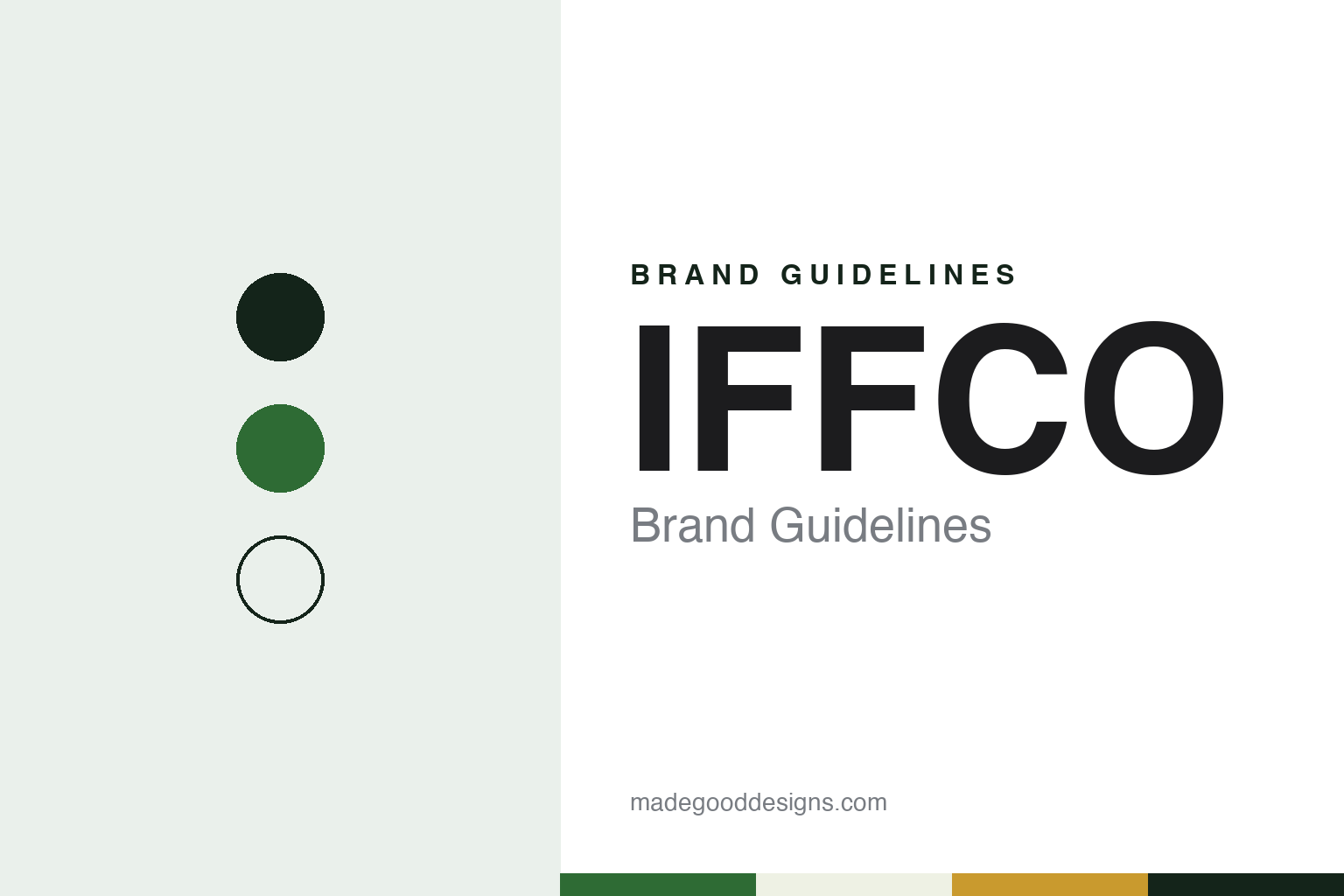
IFFCO Brand Guidelines
India’s farmers’ fertiliser cooperative, from Kalol to nano urea.
Aa
Two constants: a field green and harvest gold palette and a plain cooperative sans register. Abstract homage — not an IFFCO product or mark; no bag, bottle or logo is reproduced.
A cooperative that makes its own
Fifty-seven cooperatives and an American offer.
IFFCO, the Indian Farmers Fertiliser Cooperative, was registered on 3 November 1967 as a multi-unit cooperative society, the cooperative says on its website, and English Wikipedia gives the same date. Its headquarters are in New Delhi. As a cooperative society its members are other cooperatives, and IFFCO says it began building its marketing network in 1968 with a modest 57 cooperatives. English Wikipedia, which carries a 2024 warning about promotional wording, puts today’s membership at around 35,000 member cooperatives.
The reason for its founding is set out in English Wikipedia’s history. In the 1960s India’s cooperative sector distributed a large share of the country’s chemical fertiliser, but it had no plants of its own. When the government opened distribution to several agencies in 1967, private makers began to favour private traders, and cooperatives received less supply. In 1964 the Cooperative League of the USA had told the Indian government that American cooperatives wanted to help Indian cooperatives build fertiliser capacity. That offer led to IFFCO, and American cooperatives, through a body called Cooperative Fertilizer International, provided finance and technical know-how, English Wikipedia says.
IFFCO’s own milestones page fills in the early years. Talks between the government and the Cooperative League began in 1966, and Paul Pothen became the first managing director in 1967. Work on two plants started together in 1968: one at Kalol, near Ahmedabad, and one at Kandla, near Kandla port, both in Gujarat. The cooperative says the Kalol plant was dedicated to the nation in 1974 and that Kandla started production the same year; English Wikipedia gives 1975 as the commissioning year for both. In 1977 Pothen received the Padma Shri, one of India’s civilian honours, for his work in the fertiliser sector, the cooperative says.
Colour
Five plants, two ports and a bottle.
The plant list grew in Uttar Pradesh next. IFFCO says planning for Phulpur, near Prayagraj, began in 1976 and that the plant was inaugurated in 1981, the year it also set up a farmer-training trust there. A plant at Aonla, near Bareilly, followed: the cooperative says it was inaugurated in 1989, while English Wikipedia gives 1988 for its commissioning. Through the 1990s the four plants were expanded, with Kandla’s second expansion completed in 1999, according to the milestones page.
Today the cooperative describes five production units, sited near shipping docks and raw materials. Three of them, at Kalol, Phulpur and Aonla, make urea; Kandla makes NPK and DAP grades; and Paradeep, on the Odisha coast, makes NPK, DAP and phosphoric acid. IFFCO acquired Paradeep from the Oswal Group in 2005, the cooperative says, and English Wikipedia also records the takeover in 2005. The product range on IFFCO’s site runs from primary nutrients such as urea and DAP to secondary nutrients, micronutrients, water-soluble fertilisers and organic and bio-fertilisers.
The newest line is liquid. IFFCO’s Kalol plant page says the cooperative launched Nano Urea in 2021, sold in 500 ml bottles, and followed it with Nano DAP, which it says was added to India’s Fertiliser Control Order in March 2023, with commercial production from April 2023. The cooperative says its nano plant at Aonla was commissioned on 21 December 2022 and its nano plant at Phulpur on 23 December 2022, each able to fill around two lakh bottles a day, and that both were dedicated to the nation on 14 February 2023. A corporate-news item in Gulf News in April 2026 said IFFCO had opened a nationwide awareness campaign for its nano range, by then including Nano Urea Plus, Nano DAP, Nano NPK, Nano Zinc and Nano Copper, run through the cooperative network.
Typography
How fertiliser makers present themselves.
Fertiliser makers sell to two very different audiences at once: farmers and dealers on one side, and industrial buyers, investors and governments on the other. Their public material tends to reflect that split. Green fields, ripening crops and harvest scenes sit beside photographs of mines, process plants, storage domes and port terminals, so that the farm and the factory appear under the same name.
Much of what these companies publish is practical. Crop-nutrition guides, product-grade explainers and nutrient ratios printed as plain numbers, such as an NPK grade written out in full, do a good deal of the identity work. Many makers add agronomy tools, soil-testing services, call centres or field demonstrations for growers, and present them as part of the brand rather than as an extra.
The investor side has its own documents. Annual reports, quarterly statements, sustainability and emissions reports and filings to stock exchanges give these companies a steady, formal voice, often with maps of plants and shipping routes. Capacity figures, new plant projects and joint ventures appear there first, usually dated and attributed, and they are the most reliable record of how a maker has grown.
Distribution is the last layer. Fertiliser reaches farms through dealer networks, cooperatives, regional offices and state channels, and the bag, the dealer sign and the product name are often what a grower actually sees. The guides that follow look at each company through what can be checked: who founded it, who owns it, where it makes its products, how it presents itself and, where it matters, how its name and ownership have changed over the decades.
Aa
A plain, sturdy sans for a cooperative’s name. (Specimen set in Mukta, a sans STAND-IN; NOT the IFFCO logo.)
IFFCO
From fertiliser to insurance and abroad.
IFFCO did not stay inside fertiliser. In 2000 it formed IFFCO Tokio General Insurance with Japan’s Tokio Marine group, according to both the cooperative and English Wikipedia. In 2001, after the Bhuj earthquake in Gujarat, it and its employees set up the IFFCO Kisan Sewa Trust to support farmers, the cooperative says. Later ventures listed on its milestones page include IFFCO Kisan Sanchar, a rural mobile venture formed in 2012 with Bharti Airtel and Star Global, and IFFCO eBazar, a rural retail and e-commerce business formed in 2016.
A dated outside report covers the move into crop protection. The Times of India reported on 26 August 2015 that IFFCO had formally launched a joint venture with Japan’s Mitsubishi Corporation to make agrochemicals in India, called IFFCO-MC Crop Science, with IFFCO holding 51 per cent and Mitsubishi the rest. The paper said operations would begin with that year’s rabi, or winter, season.
Abroad, IFFCO works through joint ventures. English Wikipedia lists the Oman India Fertiliser Company at Sur, in which IFFCO holds 25 per cent and which the cooperative says began operating in 2005, and the Jordan India Fertilizer Company at Eshidiya, a phosphoric acid venture with Jordan Phosphate Mines in which IFFCO holds 27 per cent. The cooperative says the Jordan plant was inaugurated in 2016. It also set up Kisan International Trading in Dubai in 2005 to handle imports, exports and logistics, and English Wikipedia records a stake in Industries Chimiques du Sénégal. Its website also carries a notice that it has not invited dealership or franchise requests, and warns people not to trust anyone offering one in its name.
For a design guide, IFFCO shows how a cooperative presents a farmers’ ownership story alongside large plants and a new bottled product. Compare Coromandel International, an Indian fertiliser venture of 1961, and Chambal Fertilisers, another Indian fertiliser maker. For this guide we use a paddy green, a deep field green and a harvest gold with a sans, an unofficial interpretation; no product or logo is reproduced.
Explore & save
Keep IFFCO’s identity on hand — save it to a board in the Made Good inspiration library.
IFFCO identity set
Save the IFFCO field green and harvest gold palette and the cooperative sans register to your own board.