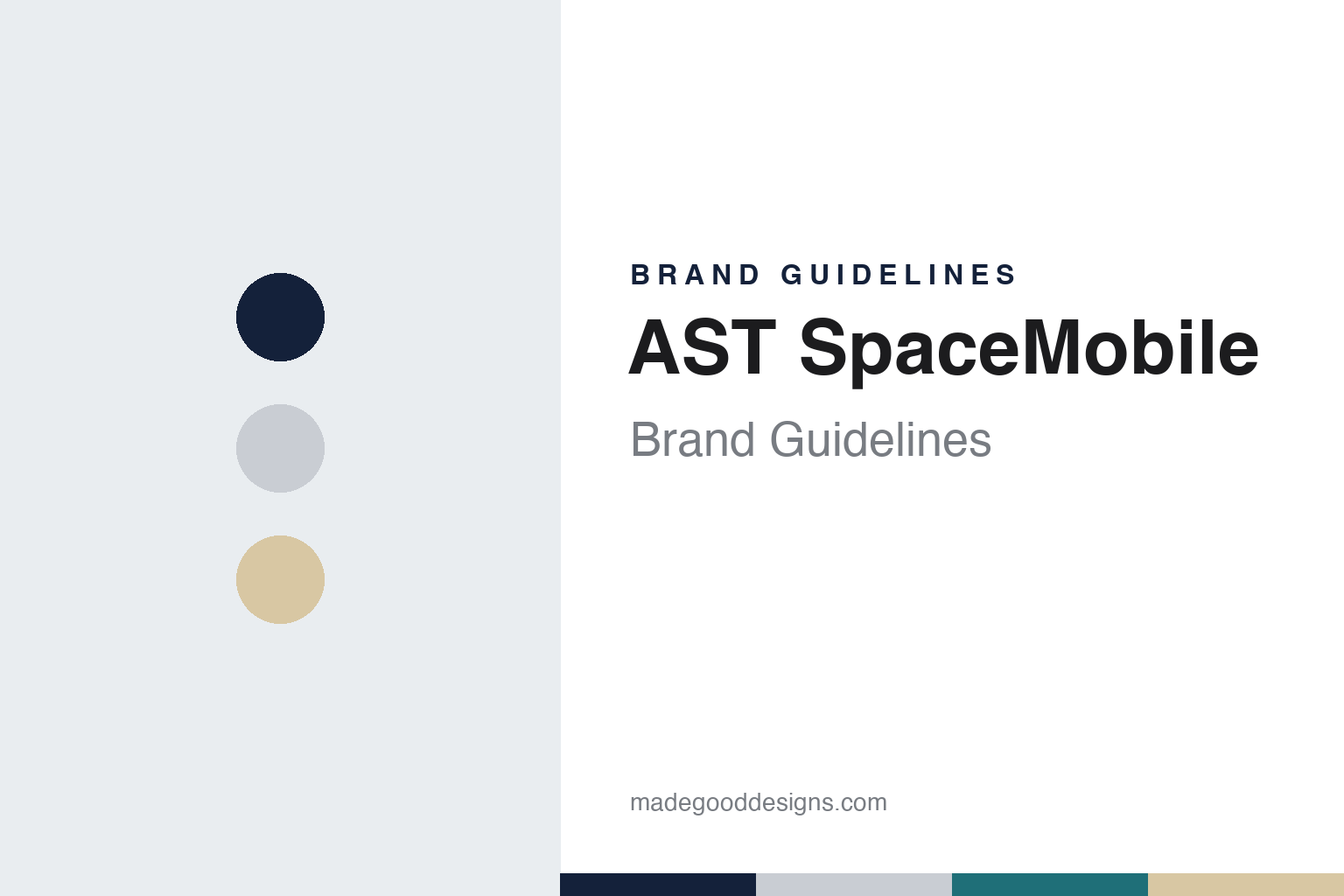
AST SpaceMobile Brand Guidelines
The Midland satellite maker building a network for ordinary phones.
Aa
Two constants: a night blue, silver and sand palette and a technical grotesk register. Abstract homage — not an AST SpaceMobile product or mark; no satellite, logo or nameplate is reproduced.
A 2017 start-up
An engineer’s plan to reach ordinary phones from orbit.
AST SpaceMobile is a satellite designer and manufacturer based in Midland, Texas. English Wikipedia says it was founded in May 2017 by Abel Avellan as AST & Science LLC, and that Avellan remains its chairman and chief executive. Before that, according to the same article, he had worked for Ericsson and in 1999 founded Emerging Markets Communications, a satellite services provider to maritime and other mobility markets, which was sold in 2016.
The company’s plan is unusual among satellite operators. Rather than selling its own handsets or dishes, it is building the SpaceMobile constellation, a space-based cellular broadband network intended to connect directly to standard, unmodified smartphones through the mobile operators that already serve them. English Wikipedia describes the goal as 4G and 5G coverage worldwide, particularly in remote and underserved regions.
Early growth came through stakes and investors. AST & Science bought a controlling interest in the Lithuanian small-satellite maker NanoAvionics in March 2018 and sold its majority stake to Kongsberg Defence & Aerospace in September 2022, English Wikipedia says. A Series B round announced in March 2020 was led by Vodafone and Rakuten, with Samsung Next, American Tower and Cisneros also taking part. In April 2021 the business was combined with New Providence, a special-purpose acquisition company, and began trading on the Nasdaq as AST SpaceMobile.
Colour
BlueWalker to BlueBird.
The first test satellite, BlueWalker 1, was built by NanoAvionics and launched from India on a PSLV rocket on 1 April 2019, according to English Wikipedia. The much larger prototype, BlueWalker 3, followed on a SpaceX Falcon 9 on 10 September 2022; its antenna array of about 693 square feet was fully unfolded that November. On 25 April 2023, English Wikipedia says, the company used it for a two-way voice call between unmodified smartphones, from Midland to Japan, and it later demonstrated 4G and 5G connections from the satellite directly to phones.
The commercial satellites are called BlueBird. Five first-generation “Block 1” BlueBirds were launched together on a Falcon 9 on 12 September 2024, and the company said all five had unfolded by late October. The larger Block 2 design carries an array of about 2,400 square feet. BlueBird 6, the first of them, was launched on India’s LVM3 rocket in December 2025; ISRO called it the heaviest payload the LVM3 had placed in low Earth orbit, English Wikipedia reports.
Not every launch went to plan. Advanced Television reported on 20 April 2026 that BlueBird 7, launched the previous day on a Blue Origin New Glenn, had been left in a low, non-nominal orbit after a problem with the rocket’s upper stage; English Wikipedia says it was de-orbited on 20 April. Launches continued on Falcon 9: BlueBirds 8, 9 and 10 were scheduled for 17 June 2026 from Cape Canaveral, the same publication reported, and on 31 August 2026 it reported that the arrays of BlueBirds 12 and 13 had been deployed and that production was advancing through BlueBird 48.
The size of the satellites has drawn attention beyond the industry. The fully deployed BlueWalker 3 is very bright in the night sky, according to observations cited by English Wikipedia, and astronomers have criticised the constellation’s potential effect on their work; the company entered a coordination agreement with the US National Science Foundation and has said it will use surface coatings and orientation changes to reduce reflections. In December 2024 SpaceNews named it “Emerging Space Company of the Year,” and Time put the BlueBird design on its Best Inventions list in 2025, English Wikipedia says.
Typography
Design and documentation.
Satellite operators sell something nobody can see. The product is capacity on a spacecraft tens of thousands of kilometres away, so the pictures have to stand in for it, and over six decades the industry has settled on a small, recognisable set of images.
The first is the satellite itself, usually a render rather than a photograph: a box wrapped in gold-coloured foil, solar panels spread wide, hanging against the black of space with the blue curve of the Earth below. The second is the ground. Dishes at a teleport, often shot at dusk with the sky turning orange behind them, show that the network has a physical home, and control rooms full of screens show the people who run it.
The third is the map. Coverage maps, beam footprints and orbital diagrams turn an abstract service into something a buyer can point at, and many operators use them as decoration as much as information, with glowing arcs and honeycomb spot beams laid over a darkened globe. Launch-day photographs supply the drama: a rocket on the pad, then a column of flame, then a mission patch.
Finally there are the users. Because so much of the business now serves people on the move, operators show cruise ships and cargo vessels at sea, airliners above the clouds and passengers with laptops in the cabin, alongside soldiers, broadcasters and remote villages. The same visual vocabulary fills the stands at trade shows such as SATELLITE in Washington, DC, and CABSAT in Dubai, where operators compete for attention with models of their spacecraft, wall-sized coverage maps and screens of live footage. Within that shared language, colour, type and naming do most of the work of telling one operator from another.
Aa
A technical grotesk for an engineering-led brand. (Specimen set in Space Grotesk, a sans STAND-IN; NOT the AST SpaceMobile logo.)
AST SpaceMobile
Built in west Texas, launched on several rockets.
Manufacturing is concentrated in Texas. The company says it is headquartered in Midland and has more than 500,000 square feet of manufacturing facilities “in the U.S. and beyond,” listing several sites in Midland and one in Odessa, alongside offices in Florida, Maryland, Spain, Scotland, India and Israel. English Wikipedia says the company has stated it plans to make up to six BlueBirds a month at two Midland sites, and Advanced Television reported in October 2026 that BlueBirds were shipping from the company’s Midland factory.
The service depends on partners. English Wikipedia lists agreements with AT&T and Verizon in the United States, including use of part of their 850 MHz spectrum, a commercial contract with Vodafone for Europe and Africa announced in December 2024, and a ten-year agreement with stc group announced in October 2025. Regulators grant access country by country: the US Federal Communications Commission authorised the BlueBird 1–5 operations in August 2024 and further satellites in August 2025, English Wikipedia says, and in November 2026 Advanced Television reported a 30-year S-band concession in Chile from the regulator SUBTEL, following an allocation in Brazil.
The constellation is still being built. In October 2026 Advanced Television reported an unconfirmed schedule aiming for 46 satellites in orbit by early 2027, enough for a core “beta” service in some markets, and a longer-term target of 243 satellites by the end of 2028. In November 2026, English Wikipedia says, the company announced plans with Firefly Aerospace for a partially reusable launch vehicle called Blacklift.
For a design guide, AST SpaceMobile shows a satellite brand built to work through other companies’ mobile networks rather than through its own handsets. Compare Globalstar and Iridium, two earlier low-orbit satellite phone networks. For this guide we use a deep night blue, a pale silver and a sand tone with a sans, an unofficial interpretation; no product or logo is reproduced.
Explore & save
Keep AST SpaceMobile’s identity on hand — save it to a board in the Made Good inspiration library.
AST SpaceMobile identity set
Pin the AST SpaceMobile night blue, silver and sand palette and the technical grotesk register to your own board.