Bank Pekao Brand Guidelines
The emigrant savings bank of 1929 that brought its bison back.
Aa
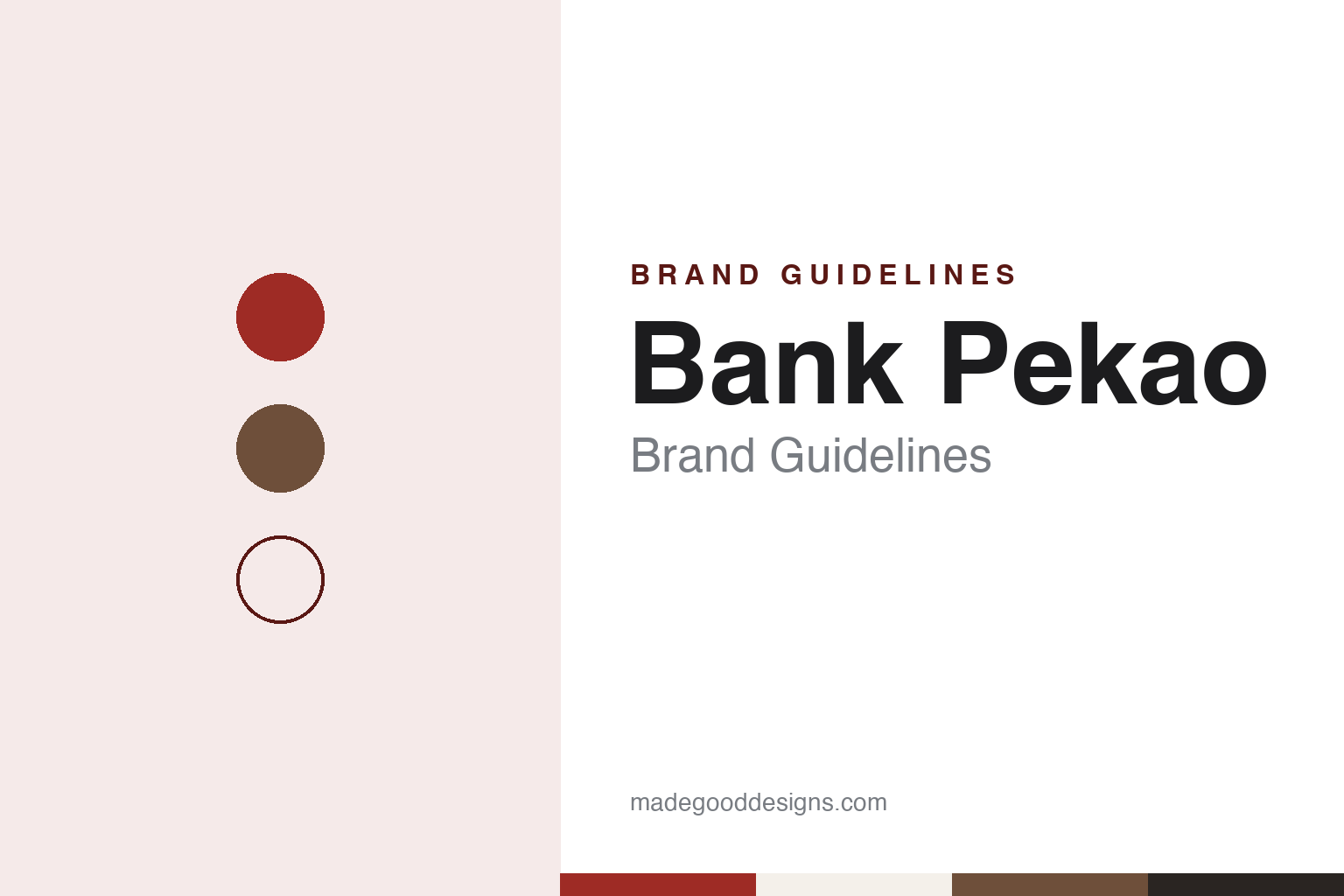
Two constants: a red, brown and paper palette and a grotesque sans register. Abstract homage — not a Bank Pekao product or mark; no bison, logo or card is reproduced.
Polska Kasa Opieki
A bank for Poles abroad.
Bank Pekao began on 17 March 1929, when a decision of Poland’s Ministry of the Treasury set up Bank Polska Kasa Opieki Spółka Akcyjna, the bank says in its published history. Money sent home by emigrants was an important source of income for the young state, and the new bank was meant to serve the largest communities of Poles abroad. Its first president was Henryk Gruber, and its head office stood on a Warsaw corner of Marszałkowska and Świętokrzyska streets.
The bank grew outward rather than inward. Between 1929 and September 1939 it opened 25 offices in France, Argentina, the United States and Palestine, its history says, and plans for Brazil and other countries were cut short by the war. As the economy changed in the 1930s it moved beyond collecting and forwarding savings into lending and the settlement of trade, for example between Poland and Argentina.
The war divided the bank. After the German invasion of September 1939, work stopped at the Warsaw head office and contact with the branches was cut; the bank was placed under German administration and its activity was reduced to administering property, according to Pekao’s account. Its leaders left Poland and the head office moved to France, where the aim was to keep money in the bank’s foreign accounts out of German hands; staff there also helped Polish emigrants, and an underground printing press worked in the bank’s rooms. The Warsaw head-office building was destroyed. In mid-April 1945 a Treasury order allowed the bank to resume work.
Colour
Parcels, foreign currency and a bison.
After the war the bank found a new role in what was called “internal export.” Until 1956 only the state could buy and sell foreign currency, and Pekao handled hard-currency business with Poles abroad. The Pekao parcels followed: relatives abroad paid for a set package of goods, and the recipient in Poland collected it, the bank’s history explains. A first domestic branch opened in 1957, and in 1958 a Kraków branch on the Main Market Square that, the bank says, worked for decades much like an exclusive department store.
In 1969 the State Treasury took a majority of the shares, while PKO, the savings bank that continued the prewar Postal Savings Bank, kept a minority stake. In the early 1970s the shop business was split off into a new company, Pewex, and from 1971 to 1989, when Poles were allowed to hold foreign currency in accounts, Pekao specialised in currency services for the public, the bank says.
The 1990s brought a broader bank. Pekao says it opened Poland’s first postwar brokerage office on 1 March 1991, which took the first privatised companies to the stock exchange, and that its Eurokonto was the first modern package of products on the market. In 1996 the government formed a banking group around Pekao with regional banks in Lublin, Szczecin and Łódź, and in 1997 the żubr, the European bison, became the shared logo of the new Pekao group. The bank also says it was the first in Poland to launch a cash machine and to issue a credit card.
Typography
Banks of Central and Eastern Europe.
Banks in Central and Eastern Europe often carry long national-language names with diacritics, such as Powszechna Kasa Oszczędności, Česká spořitelna or Komerční banka, and shorten them to initials or a single word for everyday use. Many of today’s large banks also descend from state institutions of the communist period, so their identities can show several layers of history: a mark kept for decades, a new owner’s colours, or a symbol brought back. PKO Bank Polski still uses a logo drawn in the late 1960s, English Wikipedia says, while Bank Pekao made a bison its group logo in 1997, moved to its parent UniCredit’s style in 2012 and restored the bison after its change of owners in 2017.
Colour does much of the work. Blue, green, red and yellow appear again and again on the region’s bank signs, cards and apps, usually in a bold wordmark or a simple symbol that has to read clearly on a branch fascia, a cash machine and a phone screen. Ownership by international groups adds another layer, when a local bank takes on a parent’s colours or a shared mark, and sometimes sheds them again.
The banks’ websites follow a familiar pattern: pages on everyday accounts and cards, mortgages, savings and business banking, with prominent space for mobile apps and for the industry awards those apps win. Photography tends to show cities, branches and customers rather than abstract imagery, and sponsorship, from national football leagues to international championships, gives several of these brands a large public stage.
Annual reports, investor pages and a growing number of sustainability reports, often published in the home language and in English, complete the public record. This guide sets out what can be checked about each bank — when it was founded, who owns it and how its identity has changed — and marks clearly what rests only on the bank’s own word.
Aa
A grotesque sans — for a bank whose symbol is a bison. (Specimen set in Libre Franklin, a sans STAND-IN; NOT the Bank Pekao logo.)
Bank Pekao
From UniCredit red to a returning bison.
Privatisation began in June 1998, when the State Treasury sold 15 per cent of the shares in a public offer, and the bank made its debut on the Warsaw Stock Exchange on 30 June 1998. On 3 August 1999 it joined the UniCredit group, after a consortium of UniCredito Italiano and Allianz won the Treasury’s tender for 52.09 per cent of the shares, the bank says. A larger Pekao followed on 30 November 2007, with the legal merger of Pekao and a separated part of Bank BPH.
The identity followed the owners. In June 2012, as official bank and national sponsor of the UEFA EURO 2012 football championship, Pekao changed its logo and colours to signal its place in UniCredit, GazetaPrawna.pl reported; the bank describes the result as new white and red colours with a logotype in line with the UniCredit mark, keeping the name Bank Pekao. The bison stayed in retail products, marketing and social work, the bank’s president said at the time.
On 7 June 2017 the insurer PZU (20 per cent) and the Polish Development Fund, PFR (12.8 per cent), completed their purchase of shares from UniCredit, and with the change of ownership the logo changed, the bank says. Forsal, reporting in June 2017, explained that UniCredit kept the rights to its own logo, so a rebrand was needed, and that the historic bison would return. On 2 June 2025 PZU and Bank Pekao signed a memorandum on a reorganisation that would merge PZU into the bank, The Digital Banker reported; in December 2025 the two set 31 December 2027 as the intended completion date, dependent on legislation, Bankier.pl wrote. It is not completed at the time of writing. In October 2026 Wirtualnemedia.pl reported that the bank was weighing a new name and symbol because many customers confuse Pekao with PKO Bank Polski; the bank said no decision had been taken and that the Polbank trademark was held only as an option.
For a design guide, Bank Pekao shows how a symbol can leave the front of a brand and come back with a change of owner, and how a name close to a rival’s shapes every later choice. Compare it with PKO Bank Polski and Santander Bank Polska. For this guide we use Pekao red, bison brown and parcel paper with a grotesque sans, an unofficial interpretation; no product or logo is reproduced.
Explore & save
Keep Bank Pekao’s identity on hand — save it to a board in the Made Good inspiration library.
Bank Pekao identity set
Pin the Bank Pekao red, brown and paper palette and the grotesque sans register to your own board.