PKO Bank Polski Brand Guidelines
The postal savings bank of 1919 that kept its 1960s mark.
Aa
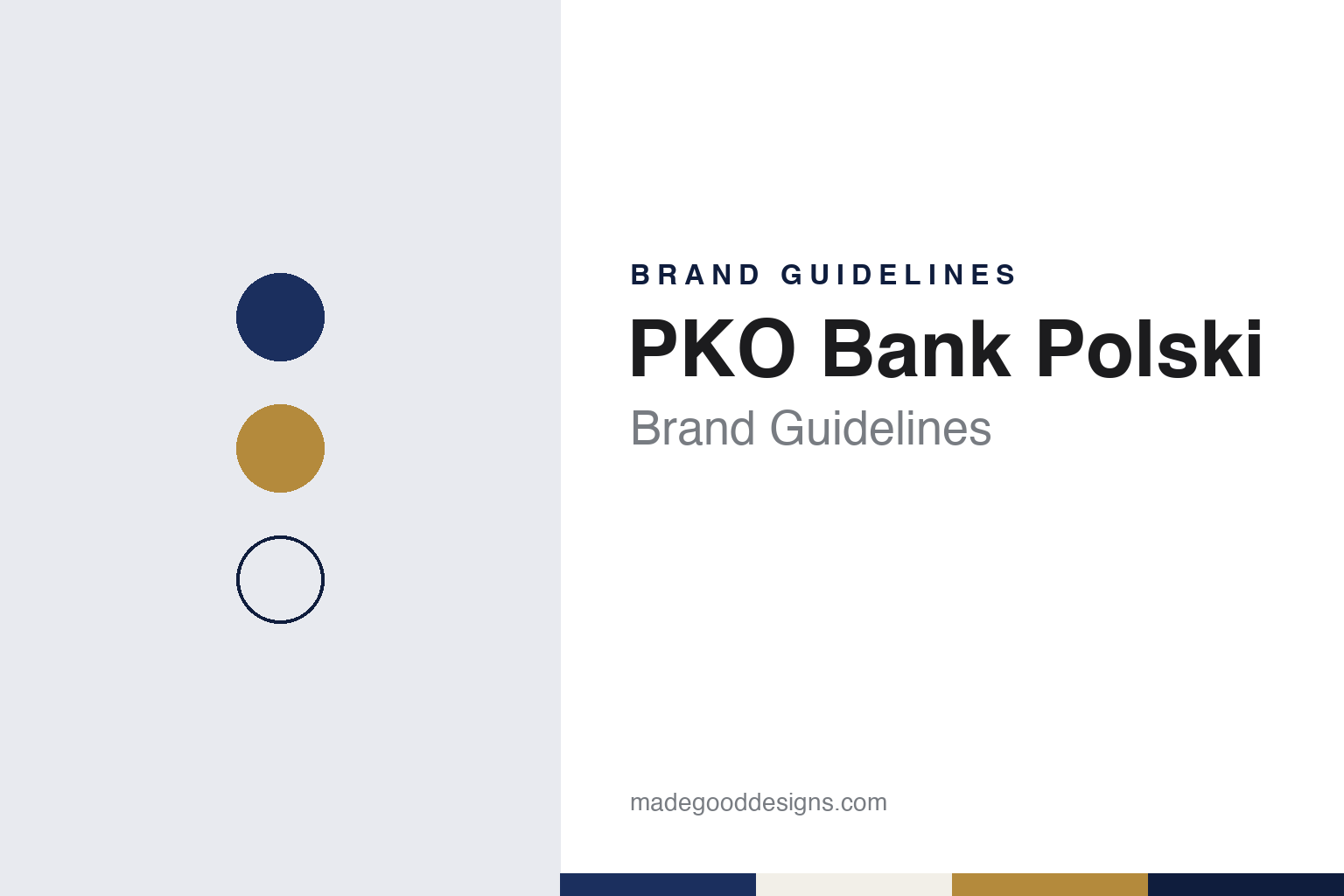
Two constants: a navy, gold and paper palette and a geometric sans register. Abstract homage — not a PKO Bank Polski product or mark; no logo, card or app screen is reproduced.
Pocztowa Kasa Oszczędności
A postal savings bank for a new currency.
PKO Bank Polski traces its history to 7 February 1919, when a state decree created the Pocztowa Kasa Oszczędności, the Postal Savings Bank, according to English Wikipedia. Its first director, Hubert Linde, was appointed at the end of that year. The head office was set up in Warsaw, with early branches in Kraków, Lwów, Łódź, Poznań and Katowice, and one of the bank’s first jobs, Wikipedia says, was to help bring the new Polish złoty into circulation in place of the Polish mark.
Saving for children became part of the story early. In 1935 the school savings clubs, the Szkolne Kasy Oszczędności or SKO, came under PKO’s care, and by the outbreak of the Second World War they ran in about 14,000 schools, Bankier.pl wrote in 2019. The bank still calls the SKO programme its main pillar of support for young pupils and schools.
During the German occupation of Poland in the Second World War, the bank operated under German administration, English Wikipedia says, and its operations resumed in 1945. Bankier.pl credits the staff with starting the rebuilding themselves after the war, repairing buildings and securing damaged vaults.
The postwar state then reshaped it. A banking decree of 25 October 1948 dissolved the Postal Savings Bank and created a new state bank with the same initials, Powszechna Kasa Oszczędności, the General Savings Bank, which began work on 1 January 1950 and took over its predecessor’s branches, assets and liabilities. From 1 July 1975 it was folded into the National Bank of Poland; on 1 November 1987 it became an independent state bank again, as Powszechna Kasa Oszczędności Bank Państwowy, Wikipedia records.
Colour
Passbooks, a car and an app.
For many Polish households PKO was the bank of everyday saving and paying. In 1974 it added a combined savings and current account for private customers, known by its initials as the ROR, according to English Wikipedia, and in 1972, Bankier.pl noted, it was authorised to take advance payments for the Fiat 126p car.
The symbol that ties these decades together is older than most of the products. English Wikipedia credits the designer Karol Śliwka with the PKO logo in the late 1960s and says it remains in use. The same mark has therefore stayed with the bank through the 1975 merger into the National Bank of Poland, the return to independence in 1987, the change to a joint-stock company in 2000 and the stock-market listing in 2004.
Everyday banking has moved to screens. Bankier.pl describes the online service iPKO and the mobile app IKO, which customers use to manage accounts, take loans, authorise payments, buy insurance and pay for public-transport tickets and parking.
Football is a large part of the bank’s public face. PKO Bank Polski was announced in 2019 as the title sponsor of the Ekstraklasa, Poland’s top football league, Wikipedia says, and in November 2026 NowyMarketing reported that the partnership was in its ninth season. That report described a new collection of payment cards for clubs including Lech Poznań, Cracovia, Wisła Kraków and Śląsk Wrocław, plus a special card for the league’s hundredth year. The card details sit on the back, so the front is given over entirely to the club’s colours and crest, and the club cards are also offered with the bank’s account for young people.
Typography
Banks of Central and Eastern Europe.
Banks in Central and Eastern Europe often carry long national-language names with diacritics, such as Powszechna Kasa Oszczędności, Česká spořitelna or Komerční banka, and shorten them to initials or a single word for everyday use. Many of today’s large banks also descend from state institutions of the communist period, so their identities can show several layers of history: a mark kept for decades, a new owner’s colours, or a symbol brought back. PKO Bank Polski still uses a logo drawn in the late 1960s, English Wikipedia says, while Bank Pekao made a bison its group logo in 1997, moved to its parent UniCredit’s style in 2012 and restored the bison after its change of owners in 2017.
Colour does much of the work. Blue, green, red and yellow appear again and again on the region’s bank signs, cards and apps, usually in a bold wordmark or a simple symbol that has to read clearly on a branch fascia, a cash machine and a phone screen. Ownership by international groups adds another layer, when a local bank takes on a parent’s colours or a shared mark, and sometimes sheds them again.
The banks’ websites follow a familiar pattern: pages on everyday accounts and cards, mortgages, savings and business banking, with prominent space for mobile apps and for the industry awards those apps win. Photography tends to show cities, branches and customers rather than abstract imagery, and sponsorship, from national football leagues to international championships, gives several of these brands a large public stage.
Annual reports, investor pages and a growing number of sustainability reports, often published in the home language and in English, complete the public record. This guide sets out what can be checked about each bank — when it was founded, who owns it and how its identity has changed — and marks clearly what rests only on the bank’s own word.
Aa
A geometric sans — for a bank whose mark dates from the late 1960s. (Specimen set in Manrope, a sans STAND-IN; NOT the PKO Bank Polski logo.)
PKO Bank Polski
A state-founded bank on the stock exchange.
The modern company took shape at the turn of the century. Under a government regulation of January 2000, the bank became a joint-stock company on 12 April 2000, wholly owned by the State Treasury and using its current name, and it made its debut on the Warsaw Stock Exchange on 10 November 2004, English Wikipedia says. The Treasury remains the largest shareholder, with 29.43 per cent as of May 2026 according to the same article, ahead of two open pension funds.
Today PKO Bank Polski calls itself the largest universal bank in Poland, with more than a hundred years of history. Its group includes a mortgage bank, PKO Bank Hipoteczny, a leasing business, insurance and fund-management companies and KredoBank in Lviv, and the bank has branches in Germany, the Czech Republic, Slovakia and Romania, Wikipedia lists. The Banker named it Bank of the Year in Poland seven times between 2007 and 2022, according to the same source.
Its name is also its design problem. The initials PKO and the name Pekao sound alike, and the two banks share a long history: when the State Treasury took a majority in Bank Pekao in 1969, PKO stayed on as a minority shareholder, Pekao’s own history says. In October 2026 Wirtualnemedia.pl reported that Pekao’s chief executive had cited research suggesting more than 40 per cent of customers confuse the two institutions.
For a design guide, PKO Bank Polski shows how a state-founded savings bank can keep one mark through a century of change while its products move from passbooks to an app and to club-branded cards. Compare it with Bank Pekao, the other Warsaw bank with a similar name, and with ING Bank Śląski. For this guide we use savings navy, old gold and passbook paper with a geometric sans, an unofficial interpretation; no product or logo is reproduced.
Explore & save
Keep PKO Bank Polski’s identity on hand — save it to a board in the Made Good inspiration library.
PKO Bank Polski identity set
Pin the PKO Bank Polski navy, gold and paper palette and the geometric sans register to your own board.