BRAC Bank Brand Guidelines
The Dhaka bank built for small and medium entrepreneurs.
Aa
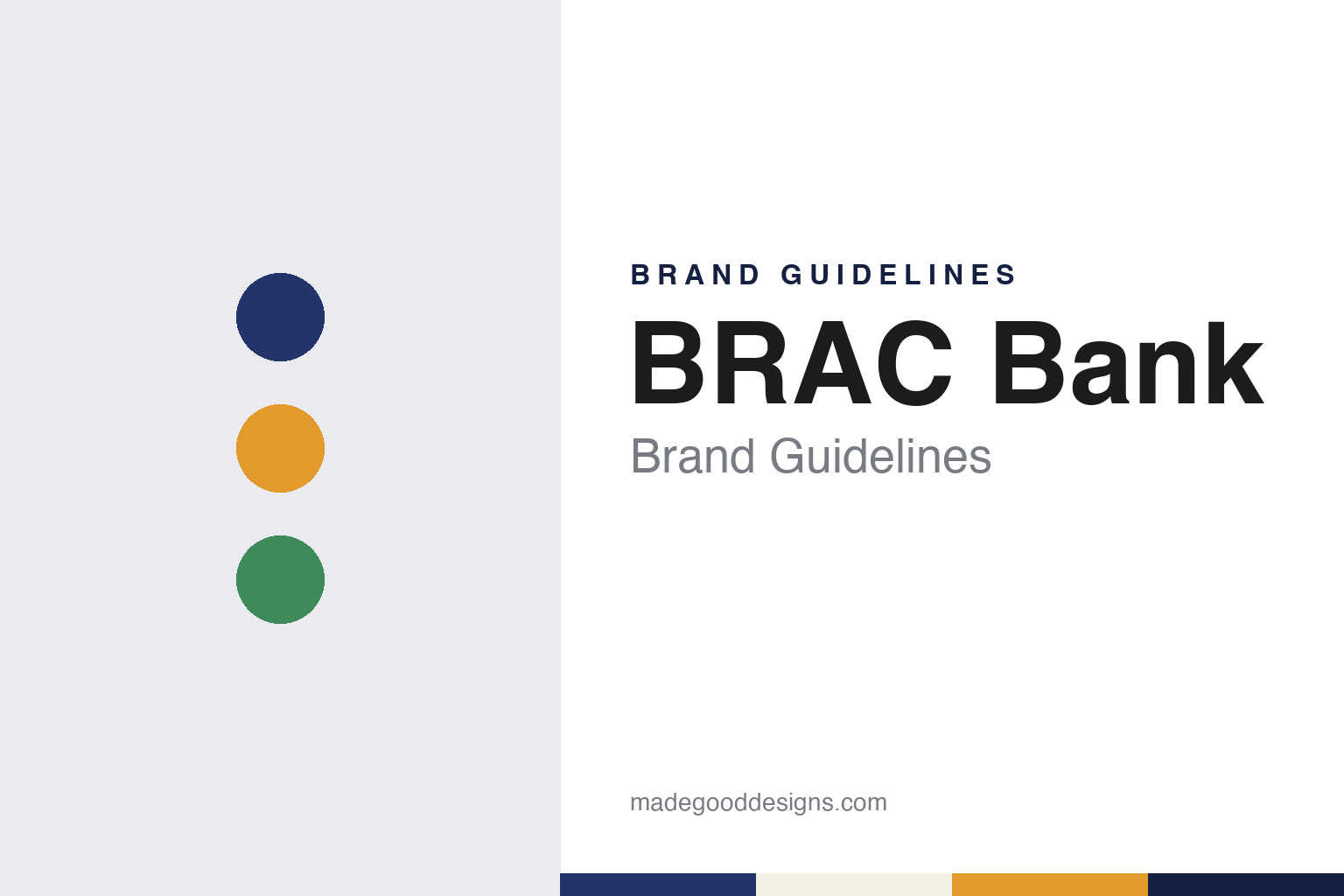
Two constants: a BRAC Bank indigo, marigold and paddy green palette and a Humanist sans register. Abstract homage — not a BRAC Bank product or mark; no card, logo or signage is reproduced.
The Missing Middle
A bank for the entrepreneurs other banks skipped.
BRAC Bank opened for business in Dhaka on 4 July 2001, the date its own company profile gives for the inauguration of banking operations. English Wikipedia names its founder as Sir Fazle Hasan Abed, who also founded BRAC, the Bangladeshi development organisation that remains the bank’s parent. When the bank marked its silver jubilee in July 2026, The Business Standard reported that the celebrations were framed around values “inspired by its founder.”
The idea was narrow by design. The bank says it was set up to serve “unbanked” small and medium entrepreneurs, and that it pioneered small-ticket loans for that segment at a time when such finance was hard to obtain in Bangladesh. It says close to half of its lending portfolio still goes to small and medium enterprises. At the jubilee, its chairperson, Meheriar M Hasan, described the next phase as a move from serving the “Missing Middle” to reaching the “Missing Majority,” The Business Standard reported.
The bank describes itself as values-based. It uses a “3P” philosophy — People, Planet and Prosperity — and gives its mission as “Empowering Entrepreneurs, Enabling Financial Inclusion.” It also says it is the only Bangladeshi member of the Global Alliance for Banking on Values, an international network of banks.
Colour
A small group, and a mobile wallet.
BRAC Bank grew into a small financial group. English Wikipedia records that in August 2009 it bought 51 per cent of Equity Partners Limited and Equity Partners Securities Limited, later renamed BRAC EPL Investments and BRAC EPL Stock Brokerage, and that BRAC Saajan Exchange was formed in 2011 through the purchase of a British money-transfer company, Saajan Worldwide Money Transfer. Its listed subsidiaries also include BRAC IT Services.
The group’s mobile money arm is bKash. It began as a joint venture between BRAC Bank and Money in Motion LLC, a company whose founders included Kamal Quadir and Iqbal Quadir, according to English Wikipedia. Talks with Abed began in 2008, the venture was agreed in 2010, and bKash launched on 21 July 2011 with three basic services: cash in, cash out and send money. Wikipedia describes it today as a mobile financial service operating under the authority of Bangladesh Bank as a subsidiary of BRAC Bank PLC.
Other investors followed: the International Finance Corporation in April 2013, the Gates Foundation in March 2014, Ant International, the operator of Alipay, in April 2018 — a date BRAC Bank also lists in its own timeline — and SoftBank Vision Fund II in November 2021, Wikipedia says. When BRAC Bank marked its 25th anniversary by naming “25 Most Impactful Institutions in Bangladesh,” chosen by a jury formed and supervised by The Business Standard, bKash Limited was on the list, alongside BRAC itself.
The bank’s own range has widened from SME loans. Its timeline lists the Planet Card in October 2010, an e-commerce service that December, agent banking from October 2018, a Freelancer Account in November 2021, Borenno, a premium banking segment for SME customers, in January 2023, and a bancassurance licence from Bangladesh Bank in January 2024. Its mobile app is called Astha, which the bank said had passed 500,000 users in December 2023. English Wikipedia notes that the bank was kit sponsor of the Bangladesh national cricket team from 2016 to 2020.
Typography
Banks of Pakistan, Bangladesh and Sri Lanka.
Banks in Pakistan, Bangladesh and Sri Lanka present themselves to customers who may read in more than one script. A bank’s name can appear in English on one line and in Urdu, Bengali or Sinhala on another, on branch signs, cards, forms and apps. Short initials such as HBL or MCB travel well across those scripts, and several of the banks in this group have turned long founding names into letters that work on a cash machine, a cricket broadcast or a phone screen.
Colour does a lot of the work. Green, red and blue wordmarks are common across the region’s banking signage, and each colour has to hold up in strong sunlight on a shopfront, at small sizes in a mobile app and in print on a passbook or statement. The palettes in these guides are our own interpretations, chosen to show how a dark accent and a pale ground can carry a name in all of those places.
The product range shapes the website as much as the logo does. Islamic-banking and conventional ranges often sit side by side: MCB Bank, for example, runs its Islamic business through a separate subsidiary, MCB Islamic Bank, with its own product names and its own app. Pages on savings accounts, remittances from workers abroad, mobile wallets and lending to small and medium-sized businesses appear next to branch-locator maps and photographs of branch interiors and staff.
Formal documents complete the picture. Listed banks publish annual reports, and some also issue sustainability reports, with the same typefaces, colours and photography carried into long financial tables. For a designer, the useful lesson from this category is consistency across scripts, channels and formats, from a stadium board to a page of notes to the accounts.
Aa
A humanist sans — a bank named after its parent. (Specimen set in Hind Siliguri, a sans STAND-IN with Bengali support; NOT the BRAC Bank logo.)
BRAC Bank
Twenty-five years of the same purpose.
By its jubilee the bank had become a national network. The Business Standard reported in July 2026 that it operated 310 branches and sub-branches, 330 ATMs, 446 SME unit offices and 1,119 agent banking outlets, and served more than two million customers with a workforce of more than 10,000. Its company profile lists earlier milestones on the same path: a sub-branch network from June 2022, and its first sustainability report in November 2023.
The newest step is about channels rather than branches. On 2 November 2026 the Financial Express reported the launch of an “Omnichannel Banking Experience,” which links the bank’s branches, call centres, agent outlets, mobile app and website so that a customer can begin a transaction in one channel, pause it and finish it in another without repeating the same information. The bank called the platform the first of its kind in Bangladesh.
The name does much of the brand work. BRAC comes first, and the bank presents itself through its parent’s development language — SMEs, inclusion, the 3P philosophy and the “Missing Middle” — rather than through architecture or heritage. Its sister company bKash carries a separate name of its own, so the group speaks with two voices: a bank named after its founder’s organisation, and a wallet with a name of its own.
For a design guide, BRAC Bank shows how a bank can take its identity from a parent organisation’s mission and carry it into SME lending, agent outlets and mobile money. Compare Dutch-Bangla Bank, another Dhaka bank that built its name on technology, and Standard Chartered, an international bank in the same category. For this guide we use an indigo, a marigold and a paddy green with a sans, an unofficial interpretation; no product or logo is reproduced.
Explore & save
Keep BRAC Bank’s identity on hand — save it to a board in the Made Good inspiration library.
BRAC Bank identity set
Pin the BRAC Bank indigo, marigold and paddy green palette and the Humanist sans register to your own board.