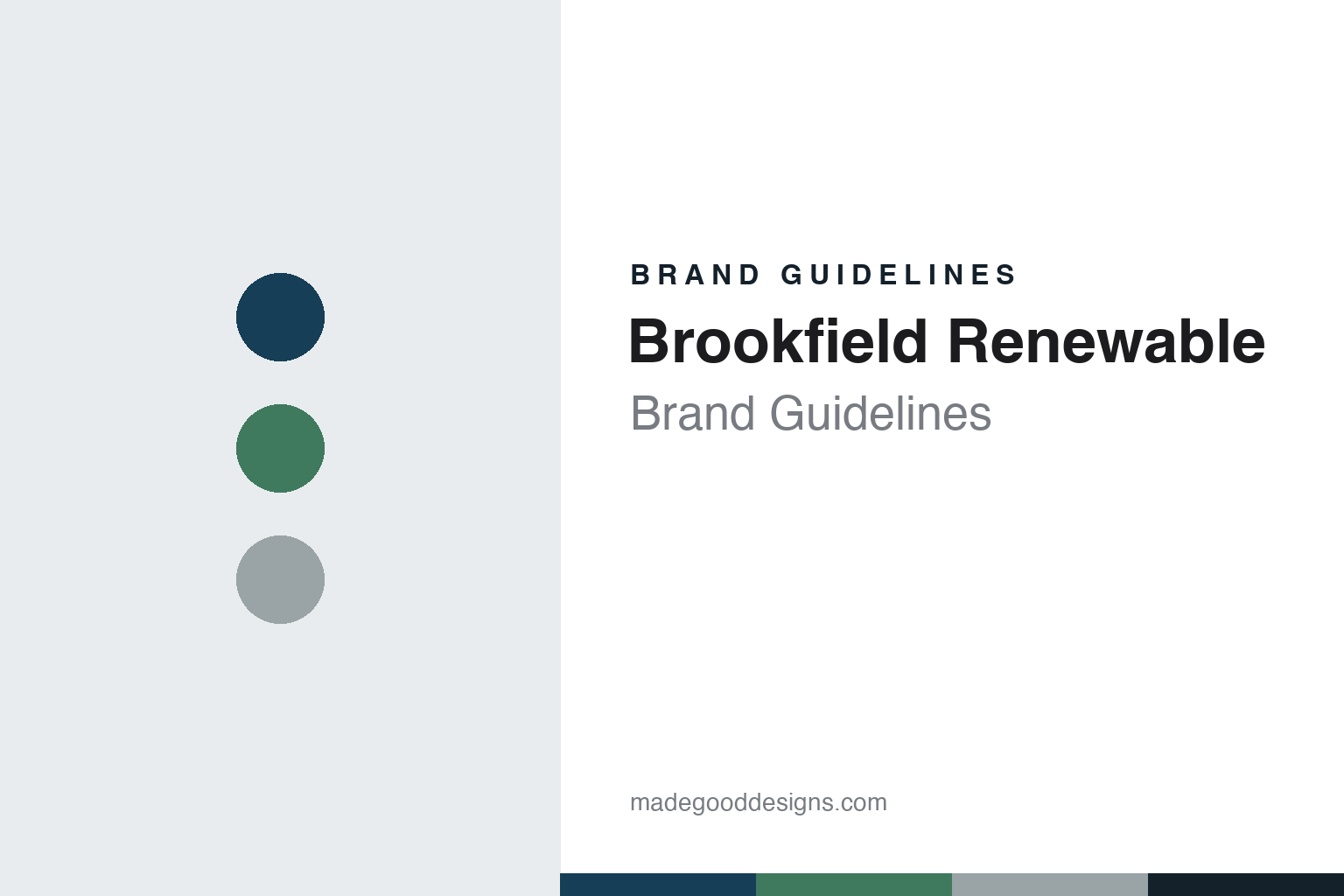
Brookfield Renewable Brand Guidelines
From Great Lakes Power hydro to a 2011 partnership.
Aa
Two constants: a reservoir blue, spillway green and river-stone grey palette and a measured corporate serif register. Abstract homage — not a Brookfield Renewable product or mark; no dam, logo or nameplate is reproduced.
Great Lakes Power
An Ontario hydro company and a Brazilian tramway group.
Brookfield Renewable’s roots are in Ontario hydro power. English Wikipedia’s history of the parent group says Great Lakes Power Company was incorporated in 1916 to supply hydro-electric power to Sault Ste. Marie and the Algoma District. The wider group began in 1899 as the São Paulo Tramway, Light and Power Company, building electricity and tram networks in Brazil; it became Brascan in 1969, EdperBrascan in 1997 and Brookfield Asset Management in 2005.
The listed renewable business grew out of a fund. Brookfield used its majority stake in Great Lakes Power as its main vehicle in renewable energy, English Wikipedia says, and when the Great Lakes Hydro Income Fund listed on the Toronto Stock Exchange in 1999, EdperBrascan held a majority of its units through its subsidiaries. The fund began with three hydroelectric stations in western Quebec; by the end of 2008 it owned and ran 27 hydro facilities and one wind farm across Ontario, Quebec, British Columbia and New England. In 2009 it was renamed Brookfield Renewable Power Fund. Alongside it sat Brookfield Renewable Power Inc., a wholly owned Brookfield subsidiary that held a 50.01% share of the fund and the rest of the group’s renewable assets.
Colour
A 2011 merger, then a run of acquisitions.
The present company dates from 2011. On 13 September that year Brookfield Asset Management and the fund announced that they would merge the fund with the generating assets of Brookfield Renewable Power Inc., the subsidiary that held the rest of Brookfield’s renewable assets. The deal closed on 30 November 2011, creating Brookfield Renewable Energy Partners, listed in Toronto and New York, with initial assets and development projects in Canada, the US and Brazil. When the deal closed, Brookfield Asset Management owned 73% of the combined business, which became the group’s main vehicle for buying and running renewable power assets. The name changed to Brookfield Renewable Partners on 10 May 2016, with the same stock symbol.
Growth came largely by acquisition. English Wikipedia lists the Comber wind farm in Essex County, Ontario, opened in 2012; four hydro plants in the south-eastern US bought from Alcoa with partners the same year; wind farms in Ireland in 2014, its first step into Europe; and a majority stake in the Colombian generator Isagen, which runs Colombia’s largest hydropower plant, in 2016, later raised to almost all of it. In December 2017 it completed the purchase of a controlling stake in TerraForm Power and the whole of TerraForm Global, and in March 2020 it announced that it would buy the rest of TerraForm Power. In December 2020 it and its institutional partners bought a distributed-generation solar platform of more than 1 GW from Exelon.
Nuclear followed. With the uranium company Cameco it announced in October 2022 the purchase of Westinghouse Electric Company from its sister company Brookfield Business Partners; the deal completed in November 2023, leaving Brookfield Renewable with a 51% interest, English Wikipedia says. Today the company describes itself as one of the largest publicly traded renewable power platforms globally. Investors can buy into it through Brookfield Renewable Partners L.P., a Bermuda-based limited partnership, or Brookfield Renewable Corporation, a Canadian corporation, which the company says are set up to give equivalent economic exposure. Its head office is in Toronto.
Typography
How power producers present themselves.
Independent power producers sell something nobody can see, so they lean on the places that make it. Their websites and reports tend to draw on a familiar set of pictures: gas turbines in clean halls, cooling towers against a pale sky, the domes of nuclear stations, rows of wind turbines and solar panels caught at dawn, and control rooms where operators watch walls of screens. The plant stands in for the product.
Many of these companies also face households directly. In the competitive retail markets of Texas and parts of the Northeast and Midwest, a single generator may own several retail electricity brands, each with its own name and look, alongside the parent’s corporate name. Vistra and NRG Energy both present themselves this way, as a “family” of brands, and some of those names are older than the parent that now owns them: TXU became the Texas company’s name in 1999, Vistra in 2016.
A newer theme is the long-term power contract with technology companies. In 2026, World Nuclear News reported 20-year agreements under which Amazon Web Services and Meta buy output from Vistra’s nuclear plants, and such deals now sit beside data-centre pages and press releases in the way these companies describe their future.
The rest of the visual record is practical: community and safety pages, plant fact sheets, sustainability reports and investor decks built around capacity charts measured in megawatts and gigawatts. This guide sets out what can be checked about each company — where it came from, who owns it and what it runs — and marks clearly where a statement is the company’s own.
Aa
A measured corporate serif for a group name. (Specimen set in Source Serif 4, a serif STAND-IN; NOT the Brookfield Renewable logo.)
Brookfield Renewable
Inside the Brookfield group.
Brookfield Renewable is part of the Brookfield group rather than a stand-alone company: English Wikipedia describes it as approximately 45% owned by Brookfield, and its own investor website lists it among Brookfield Corporation’s listed affiliates. Its deals are often done alongside group funds and partners. In March 2026 Brookfield and La Caisse, the Quebec pension investor formerly called CDPQ, agreed to buy the Montreal-based renewable producer Boralex; the purchase, made by Brookfield with institutional partners including Brookfield Renewable Partners, was completed on 14 August 2026, and the companies said Boralex would operate independently. A results summary published by The Globe and Mail in November 2026 added that Brookfield Renewable had also closed its purchase of the battery-storage business Aypa. On its investor website in November 2026 the company gave its operating capacity as about 49 GW, with a development pipeline of more than 200 GW.
Its structure is set to change, but has not yet. On 21 July 2026 Brookfield Renewable announced plans to convert its partnership and its corporation into one listed company, Brookfield Renewable Partners Inc. Shareholders of the corporation approved the plan on 14 October 2026; the partnership’s unitholder meeting, which needs the support of two-thirds of all outstanding units, was moved to 30 November 2026 to allow more votes to be cast, so the change was not completed at the time of writing.
For a design guide, Brookfield Renewable shows how a business can trade an old regional utility name for its parent’s name and keep it through a merger, a renaming and a run of purchases across several continents. Compare Brookfield Asset Management, the group name it shares, and Drax, another listed generator. For this guide we use a deep reservoir blue, a spillway green and a river-stone grey with a serif, an unofficial interpretation; no product or logo is reproduced.
Explore & save
Keep Brookfield Renewable’s identity on hand — save it to a board in the Made Good inspiration library.
Brookfield Renewable identity set
Pin the Brookfield Renewable reservoir blue, spillway green and river-stone grey palette and the measured corporate serif register to your own board.