Coutts Brand Guidelines
The Strand goldsmith-banker that kept its three crowns.
Aa
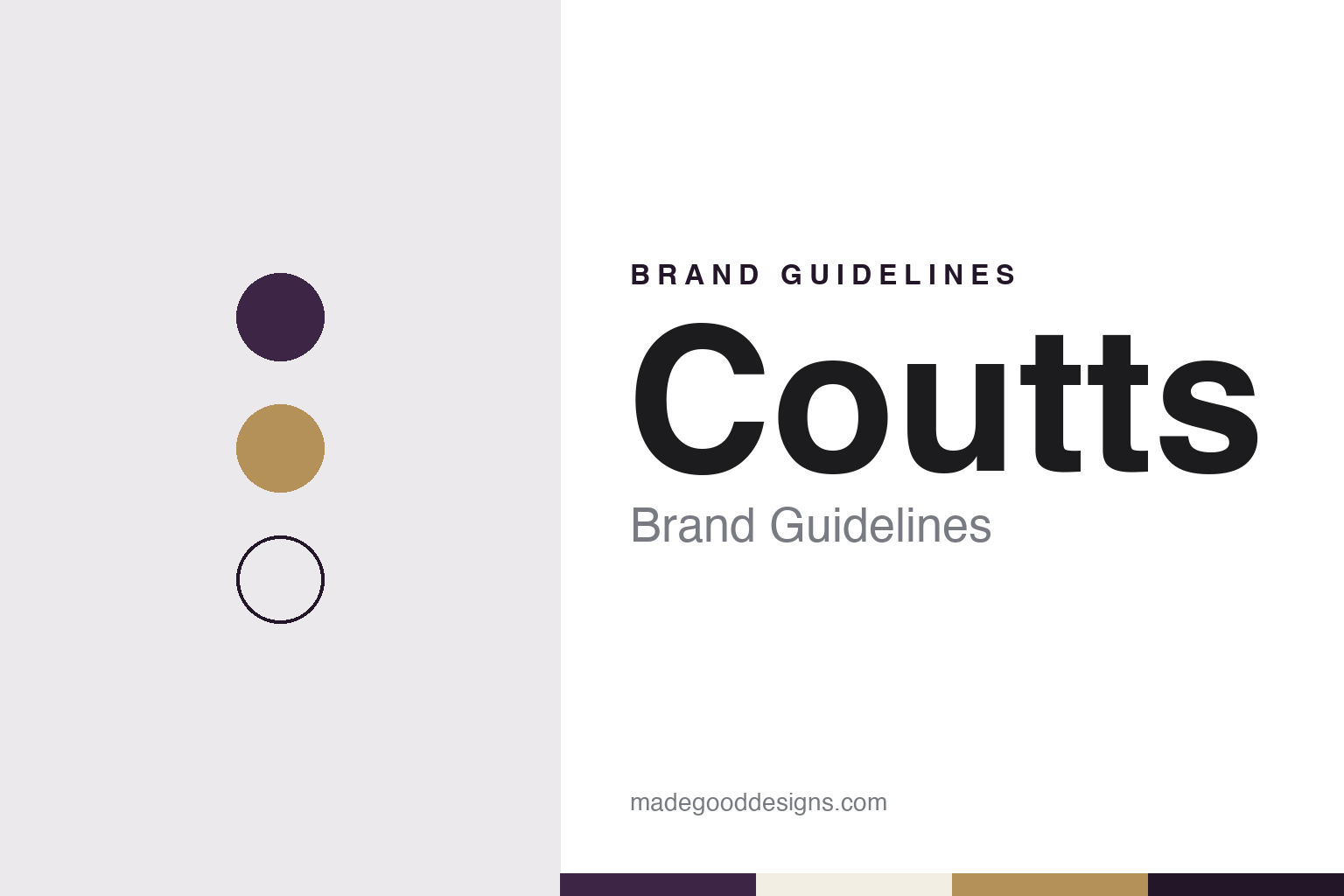
Two constants: a Coutts aubergine, gilt and ivory palette and a high-contrast serif register. Abstract homage — not a Coutts product or mark; no card, logo or sign is reproduced.
The Three Crowns
A Scottish goldsmith-banker on the Strand.
Coutts traces its start to 1692, when John Campbell of Lundie, a young Scottish goldsmith-banker, opened a shop on the Strand in London under the sign of the Three Crowns. Signs did the work of street numbers at the time, and English Wikipedia notes that the three crowns still appear in the Coutts logo and that the bank’s headquarters is still on the Strand. The bank’s own timeline says Queen Anne commissioned Campbell to make collars and badges for the Order of the Thistle, a reminder that the early business was as much goldsmith’s work as banking.
In 1708 Campbell took a second Scottish goldsmith, George Middleton, as partner. Under Middleton the firm moved further into banking; the bank says that from 1739 it occupied premises at 59 Strand, and the partners became known as the “Bankers of 59 Strand”. English Wikipedia describes these decades as unsettled, with the Jacobite rising of 1715 and the stock-market collapse of 1720 testing the firm, and says stability did not return until about 1735.
The name that stuck arrived in 1755, when the Scottish merchant James Coutts became a partner and the firm traded as Campbell & Coutts. From 1761 James ran it with his younger brother Thomas Coutts; after James retired in 1775, Thomas became senior partner and the business became Thomas Coutts & Company, which the bank calls a period of impressive growth. English Wikipedia says the Strand premises were substantially rebuilt between 1780 and 1790, and the name Coutts & Co dates from 1822.
The 19th century is closely tied to Angela Burdett-Coutts, Thomas’s granddaughter, who in 1837 inherited half of the bank’s profits but, the bank says, was not allowed by the terms of that inheritance to run the business. She became its public face and a major philanthropist, and Queen Victoria made her a peeress in her own right in 1871. In June 1892, after the Baring crisis of 1890, the partnership was dissolved and Coutts became an unlimited liability company; the UK companies register gives its incorporation date as 24 June 1892.
Colour
From partnership to part of a group.
In 1904, after 165 years at 59 Strand, the bank moved to 440 Strand, which is still its headquarters. In 1914 it acquired the City bankers Robarts, Lubbock & Co, gaining a Lombard Street branch and a seat in the Clearing House, and in 1919 it was amalgamated with the National Provincial & Union Bank of England while keeping its own name, management and style of service, according to the bank’s timeline.
From then on Coutts sat inside a larger group. A Park Lane branch opened in 1921 and others followed in London; English Wikipedia lists Eton, in 1961, as the first branch outside the capital. The bank says it was the first British bank to use a fully computerised accounting system, in 1963. The 1969 merger of National Provincial with Westminster Bank made Coutts part of National Westminster Bank, and between 1974 and 1978 the Strand headquarters was redeveloped by Frederick Gibberd and Partners, English Wikipedia says.
In 2000 the Royal Bank of Scotland Group bought NatWest, and Coutts became its private-banking arm; the group renamed itself NatWest Group in 2020, and Coutts now forms part of its wealth-management division. English Wikipedia records that the group agreed in 2015 to sell Coutts’s international division, with offices in Switzerland, Monaco, the Middle East and Asia, to Union Bancaire Privée of Geneva, which was required to rebrand that business. In the Channel Islands and the Isle of Man, Coutts Crown Dependencies is a trading name of The Royal Bank of Scotland International, and the same source says Coutts gained B Corp certification in 2021.
The record includes a regulatory finding. On 23 March 2012 the Financial Services Authority issued a final notice stating that, between December 2007 and November 2010, Coutts had failed to take reasonable care to maintain effective anti-money-laundering controls for higher-risk customers, including politically exposed persons; the bank agreed to settle at an early stage and was fined. Today the bank’s website presents three lines of business — wealth management, private banking and commercial banking — run from the Strand.
Typography
London’s old private banks.
Private banks and wealth managers sell trust, continuity and discretion rather than a product on a shelf, and their identities tend to say so quietly. Many lead with a founder’s surname or a family name set as a restrained serif wordmark, sometimes paired with a crest, a heraldic animal or a founding year. Pictet, for example, says its lion comes from a seventeenth-century family coat of arms and has carried the year 1805 beneath it since 1974.
Colour usually follows the same register. Deep green, navy, burgundy and dark brown are common choices across the sector, often set against cream, stone or white, with a muted gold or brass as an accent. The effect is closer to a bound annual report or a club library than to a retail bank, and bright, saturated colours are rare.
Imagery leans on history and people. Websites and printed material often show portraits of founders and partners, historic premises and archive photographs, alongside heritage timelines that count the generations or the years since the founding. Partnerships and family-controlled houses in particular use their age and ownership structure as part of the message, explaining how decisions are taken and who is responsible.
The content itself is advisory. Typical pages cover wealth planning and succession, family offices, investment views and house research, market commentary, sustainable investing and philanthropy services, often with long-form articles and reports rather than short promotional copy. For designers, the sector is a study in restraint: generous white space, careful typography and a narrow palette do much of the work that louder brands leave to slogans.
Aa
A high-contrast serif for a bank that dates to 1692. (Specimen set in Playfair Display, a serif STAND-IN; NOT the Coutts logo.)
Coutts
A shop sign that became a logo.
Coutts’s visual identity grows out of its oldest asset: the Three Crowns sign that hung over Campbell’s shop in 1692 and that, English Wikipedia notes, still features in the logo. The bank’s own timeline calls the sign “now-iconic”, and its address has stayed on the same street for more than three centuries, first at 59 Strand and since 1904 at 440 Strand.
The bank has also used design commissions as part of its brand. English Wikipedia records that the Savile Row tailor Ozwald Boateng designed the Coutts World charge card in 2004, that Stella McCartney designed a Coutts Visa debit card in 2006 with a translucent logo visible only when held up to the light, and that in 2013 the purple World card was replaced by the Silk card. The Silk design draws on the Chinese wallpaper brought back from Lord Macartney’s embassy to China in 1794 and given to Thomas Coutts, which lines the boardroom at the Strand headquarters. The Silk card still appears among the cards on the bank’s website.
The same source says the large glass atrium at the Strand headquarters is used for displays marking public events, that Thomas Coutts became a shareholder in what became the Royal Opera House in the early 19th century, and that the bank remains a principal benefactor there; it has also supported the London Design Festival.
For a design guide, Coutts shows how a single emblem taken from a shop sign can carry a bank through three centuries of mergers and changes of owner. Compare it with its parent group’s NatWest and with Union Bancaire Privée, which agreed in 2015 to take on its international business. For this guide we use an aubergine ink, a crown gilt and a silk ivory with a high-contrast serif, an unofficial interpretation; no product or logo is reproduced.
Explore & save
Keep Coutts’s identity on hand — save it to a board in the Made Good inspiration library.
Coutts identity set
Pin the Coutts aubergine, gilt and ivory palette and the high-contrast serif register to your own board.