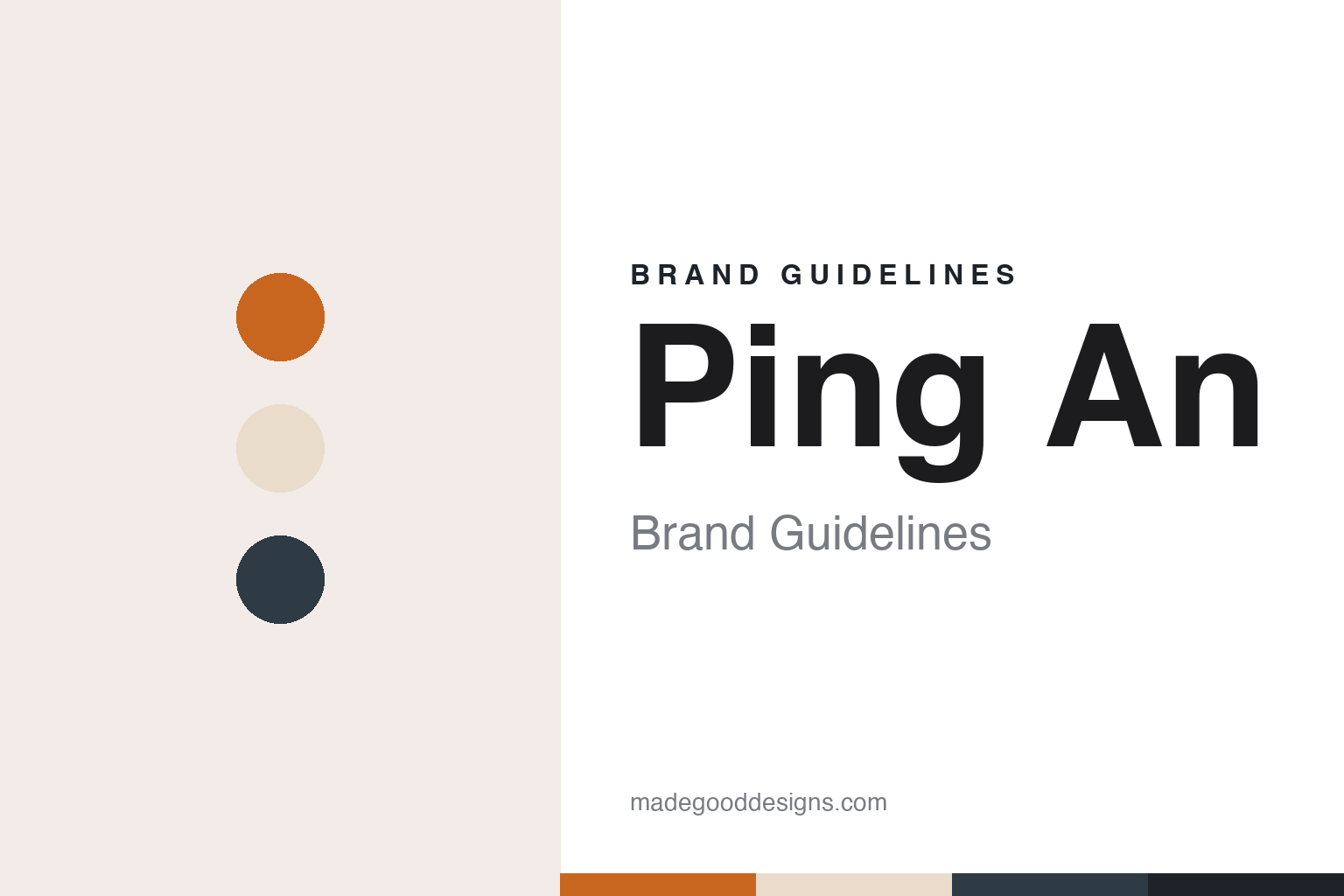
Ping An Brand Guidelines
The Shekou insurer of 1988 that grew into an integrated finance group.
Aa
Two constants: a persimmon, stone and slate palette and a rounded sans register. Abstract homage — not a Ping An product or mark; no logo or wordmark is reproduced.
Shekou, 1988
A joint-stock insurer from a Shenzhen port district.
Ping An began on 27 May 1988 in Shekou, the port district of Shenzhen, as Ping An Insurance Company. The group’s own history page calls it the first joint-stock insurance company in China and names Ma Mingzhe as its founder. English Wikipedia also lists him as founder, and says the business started as a property insurer before it moved into life cover, banking, asset management and health services. The name itself is a wish: English Wikipedia translates “Ping An” as “safe and well.”
The company widened quickly. On 4 June 1992 it was renamed Ping An Insurance Company of China and became a national insurer, the company says. In May 1994 it introduced an individual life-insurance marketing system built around sales agents, which it describes as the start of individual life business in China, and in June 1994 it brought in Morgan Stanley and Goldman Sachs as shareholders. A securities company followed in October 1995 and a trust company in April 1996. In October 2002 HSBC took a stake and became the single largest shareholder, according to the company’s timeline, a step English Wikipedia also records.
On 14 February 2003 the business was reorganised as Ping An Insurance (Group) Company of China, Ltd., a holding company for insurance, banking and investment that the company calls a pilot for integrated financial operations in China. Banking began the same year, with approval in December 2003 to acquire Fujian Asia Bank, and in July 2006 Ping An acquired Shenzhen Commercial Bank, which was later renamed Ping An Bank.
Colour
Two listings and a widening group.
The group went public in two stages. Its H shares began trading in Hong Kong on 24 June 2004, and its A shares listed on the Shanghai Stock Exchange on 1 March 2007; English Wikipedia gives the same dates and adds that yuan-denominated shares have been listed in Hong Kong since 19 June 2023. The company describes the Hong Kong offering as the largest IPO in Hong Kong that year. Ping An joined the Hang Seng Index with effect from 4 June 2007, English Wikipedia says.
Not every move went ahead. In early 2008 Ping An agreed to take half of Fortis Investments, the asset-management arm of the financial group Fortis, and the deal was cancelled in October 2008, English Wikipedia records, citing Reuters. In June 2009 Ping An became a strategic investor in Shenzhen Development Bank, and in July 2011 it became the controlling shareholder; the bank was later merged with the original Ping An Bank under the Ping An Bank name, the company says.
From 2012 the group built technology businesses alongside insurance. Lufax, set up in 2012, listed on the New York Stock Exchange in October 2020; OneConnect, a technology platform for financial institutions, listed in New York in December 2019; and Ping An Good Doctor, an online healthcare platform, listed in Hong Kong in 2018, according to the company’s timeline and English Wikipedia. In May 2021 Ping An launched Ping An Zhen Yi Nian, a brand aimed at urban elderly-care communities, English Wikipedia says, citing Coverager.
Typography
How Asian life insurers present themselves.
Asian life insurers tend to present themselves in a recognisable way. Wordmarks are usually short and set in warm, open sans-serif letters, often a single company name or a set of initials that can sit on an app icon, a branch fascia and a policy document without changing. Palettes lean on red, orange and blue, colours that read clearly on screens and signs, with plenty of white space around them.
Photography does much of the emotional work. Families, couples, children and older parents appear far more often than buildings or products, and health and everyday activity are recurring themes. Product pages are usually organised by need rather than by policy name: protection, savings, health and retirement, each with its own short explanation and a route to an adviser or an online quote.
Two audiences sit side by side on most of these sites. Customers are offered apps, service hotlines, online claims and, increasingly, wellness and senior-care programmes linked to their cover. Prospective agents are offered recruitment pages that describe training, career paths and the role of the adviser, since agents and partner banks remain important sales channels for many of these companies.
Behind the consumer pages sits a heavier layer of corporate publishing. Listed insurers produce annual reports, interim results and sustainability reports, often in two or more languages, and these documents carry the most formal version of the identity: the full logo, a restricted palette, long-form charts and governance pages. For a designer, studying both layers together shows how one identity stretches from a friendly app screen to a dense, regulated report.
Aa
A rounded sans for a short, two-word name. (Specimen set in Plus Jakarta Sans, a sans STAND-IN; NOT the Ping An logo.)
Ping An
Integrated finance, health and senior care.
Today Ping An describes itself as one of the three largest integrated financial groups in China, with financial services as its core business and a health and senior-care ecosystem that it says drives its growth. Its stated model is “one customer, multiple products, and one-stop services,” and it pairs integrated finance with health and senior care through what it calls “financial advisory, family doctor, and senior care concierge” services. The company reported 251 million retail customers as of 31 December 2025. English Wikipedia lists its largest holders, as of 31 December 2024, as CP Group and Shenzhen Investment Holdings, each with about 5.3%.
Much of the group’s standing is told through rankings. The company says it ranked 47th on the 2025 Fortune Global 500, first among insurance companies, 27th on the Forbes Global 2000, and first in the Brand Finance Insurance 100. English Wikipedia, citing a Brand Finance report of March 2024, says Brand Finance had ranked Ping An the most valuable insurance brand for six years running. The company also says that in 2019 it became the first asset owner in China to sign the United Nations-supported Principles for Responsible Investment, and that in 2020 it signed the Principles for Sustainable Insurance.
For the identity itself, the key date is recent. The company’s timeline says that in 2022 it promoted a new value-oriented management culture and “upgraded its brand identity, with a new logo.” A 2024 entry adds a customer promise of a “worry-free, time-saving, and money-saving” experience. The group site also quotes its founder: “First mover advantages are key to business competition.”
For a design guide, Ping An shows how a financial group can carry one short, meaningful name across insurance, banking, technology and health without changing it. Compare it with China Life, the Beijing life insurer listed in 2003, and with AIA, a pan-Asian insurer with roots in Shanghai. For this guide we use persimmon orange, warm stone and deep slate with a rounded sans, an unofficial interpretation; no product or logo is reproduced.
Explore & save
Keep Ping An’s identity on hand — save it to a board in the Made Good inspiration library.
Ping An identity set
Pin the Ping An persimmon, stone and slate palette and the rounded sans register to your own board.


