EBOS Brand Guidelines
The 1922 Christchurch lamp seller that became an Australasian healthcare wholesaler.
Aa
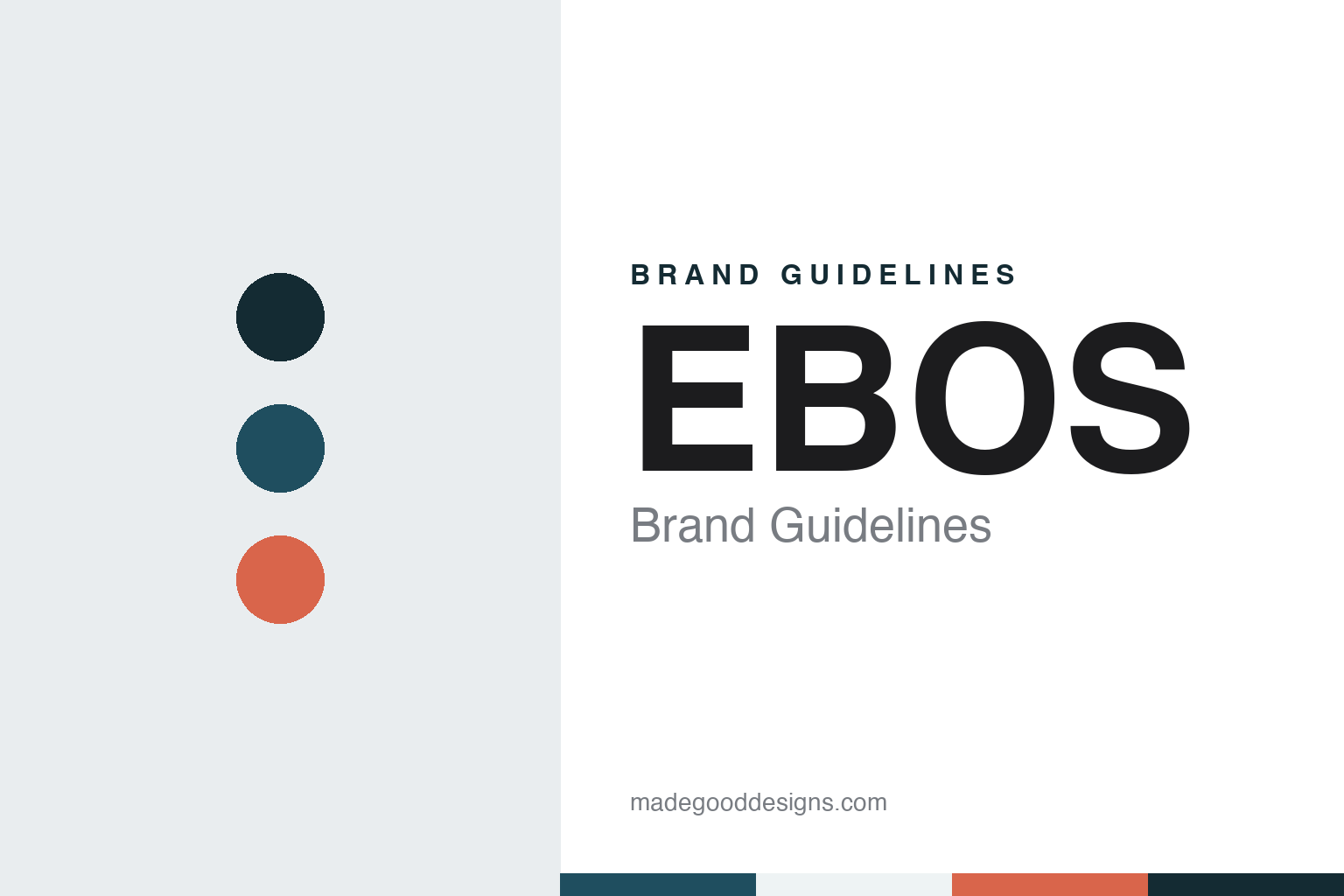
Two constants: an EBOS harbour teal and lamp coral palette and a Clean corporate sans register. Abstract homage — not an EBOS product or mark; no logo, livery or packaging is reproduced.
Early Brothers
From carriage lamps to surgical supplies.
EBOS began in Christchurch, New Zealand, in 1922 as Early Brothers Trading Company Limited. Both English Wikipedia and the company’s own timeline say its first trade was in lamps for horse-drawn carriages; Wikipedia adds that the range later widened to heating equipment, household appliances and healthcare supplies.
The business narrowed to healthcare in the 1950s. In 1954 it took the name Early Brothers Dental and Surgical Supplies, both sources agree. Its listing on the New Zealand stock exchange is dated 1960 in the company’s timeline and 1967 by English Wikipedia; the company dates a merger with a dental firm, Oral Supplies, to 1967. In 1986 it became EBOS Group Limited, the name it still uses.
Growth came through purchase. The company says it began trading in Australia in 1989 as an orthopaedic sales and marketing business, bought Kempthorne Medical Supplies — which it describes as New Zealand’s oldest medical company — in 1990, and entered the Australian market as a mainstream medical supplier in 1996 by buying Richard Thompson & Co of New South Wales. In 2002 it bought Health Support, a logistics business serving New Zealand’s district health boards, and Medic Corporation, a Wellington sales and marketing firm, by its own account.
Its first large deal with the Zuellig family business came in 2007, when it bought the New Zealand pharmaceutical wholesaler ProPharma and the logistics firm Healthcare Logistics from Zuellig, RNZ reported in 2013. ProPharma itself traces its origins to H.F. Stevens of Christchurch in 1886, EBOS says.
Colour
The Symbion deal.
The step that made EBOS an Australasian group came in 2013. On 29 May that year RNZ reported that EBOS was buying the Australian operations of Symbion from the Hong Kong-based Zuellig Group, which would take about 40 per cent of EBOS as part payment and become its largest shareholder. RNZ noted that EBOS had bought 18 businesses in the previous twelve years and was already New Zealand’s largest pharmaceutical distributor.
Shareholders approved the purchase at a meeting in June 2013, RNZ reported on 17 June; the managing director told them it was not a reverse takeover, that the head office would stay in New Zealand, and that a listing on the Australian exchange would be secondary. English Wikipedia, citing a company release of 4 December 2013, dates that ASX listing to 2013. With Symbion came the veterinary wholesaler Lyppard, the company says, and the Faulding name: Symbion traces its beginnings to the pharmacy Francis Hardy Faulding opened in Adelaide in 1845, by EBOS’s account.
Pharmacy banners followed. EBOS says Chemmart merged with Terry White Group in 2016 to form TerryWhite Chemmart, which it now owns outright and describes as a network of more than 550 pharmacies. It also lists the Cincotta Chemist chain, which began with a pharmacy opened in the Sydney suburb of Merrylands in December 1951, among its retail brands.
Wholesale contracts have moved both ways. In July 2018 Retail Pharmacy magazine reported that EBOS had won the tender to act as exclusive third-party pharmaceutical distributor to more than 400 Chemist Warehouse and My Chemist stores from 1 July 2019, replacing Sigma. In June 2023 Small Caps reported that Sigma had signed a new five-year supply deal with Chemist Warehouse, and that the EBOS contract would not be renewed when it expired in 2024.
Typography
How wholesalers present themselves.
Pharmaceutical wholesalers sit between the companies that make medicines and the pharmacies, hospitals and clinics that hand them out, so their public image is mostly an image of movement. The pictures these companies tend to show are long automated warehouse aisles, conveyor lines carrying plastic totes, and high racks of shelving, with staff in high-visibility vests picking orders between them. The aim of that imagery is to show scale and order rather than any single product.
The second recurring scene is the road. Fleets of liveried vans and temperature-controlled trucks carry the company name through towns and onto motorways and are often the most visible sign of a wholesaler on the street. Close-ups of insulated cold-chain boxes, data loggers and handheld barcode scanners carry the same message at a smaller size: goods are tracked from shelf to doorstep.
The third scene is the pharmacy counter. Because many wholesalers also run pharmacy networks, franchise banners or buying groups, their brochures often show a pharmacist behind a counter talking with a customer, which gives a logistics business a human face. These banners usually carry their own names and colours, separate from the parent company, so one wholesaler can stand behind several identities on the high street.
Beyond that, the visual record is corporate: trade-fair stands, investor presentations and annual reports with supply-chain diagrams of arrows linking factories, distribution centres and pharmacies. For a design study, the useful question is how one identity can work on a lorry side, a carton label, a pharmacy sign and a screen at the same time.
Aa
A clean corporate sans — a group of many banners. (Specimen set in Plus Jakarta Sans, a sans STAND-IN; NOT the EBOS logo.)
EBOS
Many banners, one group.
EBOS is now a group of many names rather than one storefront. The company describes itself as the largest and most diversified Australasian marketer, wholesaler and distributor of healthcare, medical and pharmaceutical products, with more than 6,200 staff in 136 locations across Australia, New Zealand and Southeast Asia; those are its own figures. Its two head offices are in Christchurch and Melbourne, and it is listed on both the NZX and the ASX.
Medical technology has grown into a larger part of the group: English Wikipedia dates its entry into medical-device distribution to 2019. Through the purchase of LifeHealthcare, EBOS took 51 per cent of the Singapore-based Transmedic in May 2022, a further 39 per cent in December 2023 and the remaining 10 per cent in 2025, according to a company release of 10 April 2025. In animal care, the group owns Masterpet, whose brands include Black Hawk and VitaPet, and on 31 March 2025 it bought SVS Veterinary Supplies, a New Zealand supplier to veterinary clinics, the same release says.
Its most visible investment has been in warehouses. On 28 October 2025 EBOS said a new Symbion distribution centre at Kemps Creek in western Sydney was fully operational, the sixth new site in a four-year renewal programme; its results release of 19 August 2026 said the programme was complete, and named Paringa Pet Foods, completed on 30 July 2026, and K-Talyst among its acquisitions in the year to June 2026.
For a design guide, EBOS shows how a wholesaler can stand behind several consumer-facing banners, such as TerryWhite Chemmart, Cincotta and Black Hawk, each with its own name. Compare Zuellig Pharma, which carries the name of the family group that sold Symbion to EBOS, and McKesson, another wholesaler that grew by acquisition. For this guide we use a harbour teal, a deep ink and a lamp coral with a sans, an unofficial interpretation; no product or logo is reproduced.
Explore & save
Keep EBOS’s identity on hand — save it to a board in the Made Good inspiration library.
EBOS identity set
Pin the EBOS harbour teal and lamp coral palette and the Clean corporate sans register to your own board.