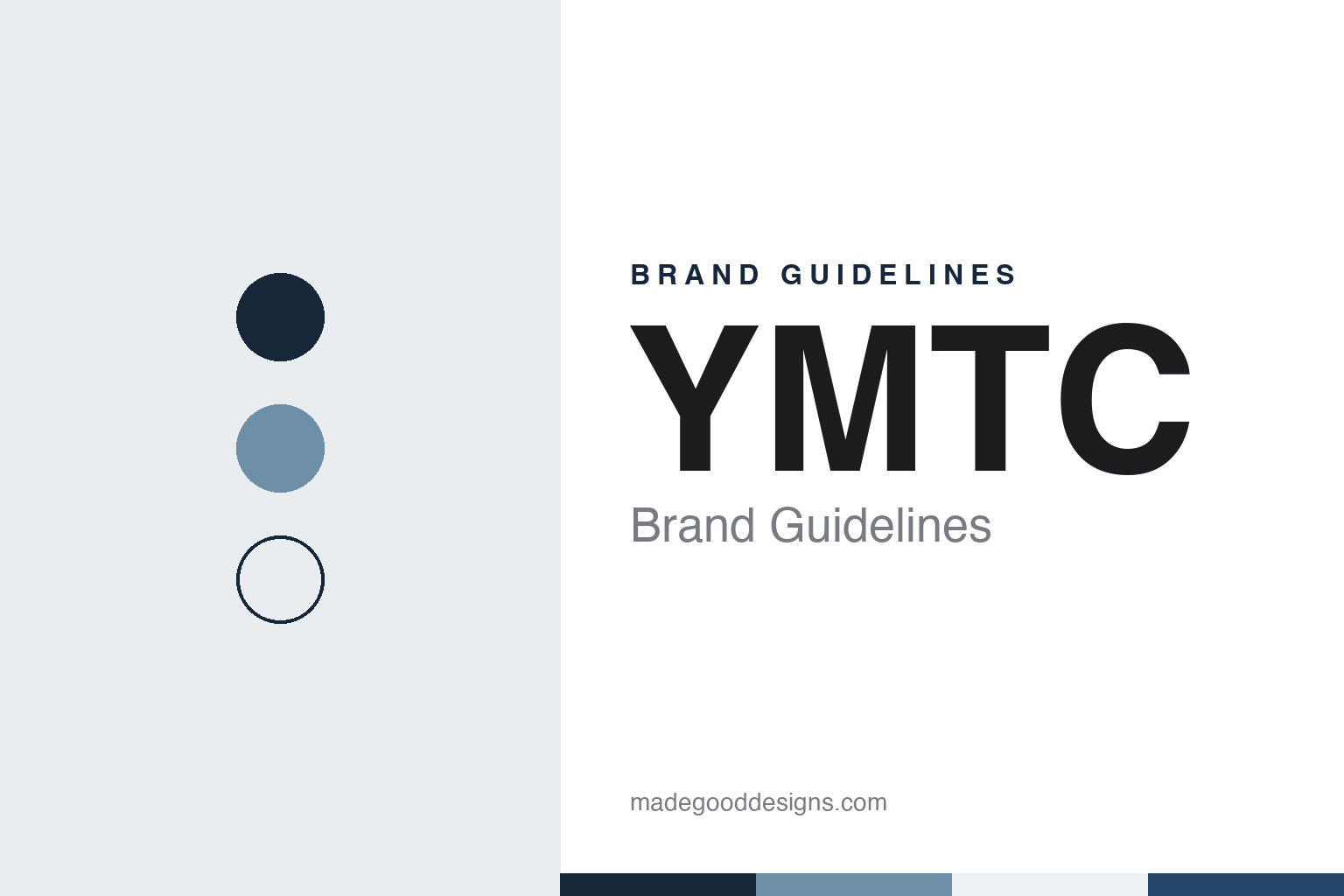
YMTC Brand Guidelines
The Wuhan maker of 3D NAND flash, built on two bonded wafers.
Aa
Two constants: a river blue, mist and wafer white palette and an industrial sans register. Abstract homage — not a YMTC product or mark; no chip, drive or logo is reproduced.
Wuhan, 2016
A state-backed start-up in 3D NAND.
Yangtze Memory Technologies, known as YMTC (长江存储 in Chinese), was founded in July 2016 in Wuhan, Hubei province, according to English Wikipedia, which gives the date as 26 July. It was set up by Tsinghua Unigroup, a partly state-owned group, with the Hubei provincial government and China’s national integrated-circuit investment fund among its investors. Its holding company is Changjiang Storage Holdings, which English Wikipedia lists as the 100 percent parent.
From the start YMTC concentrated on one product family: 3D NAND flash, the stacked memory inside solid-state drives, phones and memory cards. English Wikipedia says it announced mass production of 32-layer chips in 2018, of 64-layer chips in September 2019, and a 128-layer chip in April 2020, and unveiled a 232-layer chip in August 2022. It also notes that in January 2022 the company dropped plans for a second fab, citing financial difficulties at Tsinghua Unigroup.
Leadership changed in July 2022, when Chen Nanxiang became chief executive, according to the same source, which now lists him as chairman and chief executive. The company is based in Wuhan, and English Wikipedia says it sells enterprise SSDs under its own name and supplies flash to drive brands that resell it.
Colour
Xtacking and ZhiTai.
YMTC’s main technical signature is Xtacking, introduced in 2018. In this design, English Wikipedia explains, the memory-cell array and the CMOS logic that drives it are built on separate wafers and then joined face to face by wafer bonding, instead of being built one on top of the other on a single wafer. The company used the Xtacking name across later generations, numbered 2.0, 3.0 and 4.0, and English Wikipedia says the approach won YMTC a “Most Innovative Flash Memory Start-up Company” award in the Best of Show programme at the 2018 Flash Memory Summit.
For consumers the company introduced a separate brand, ZhiTai (致态), for SSDs in September 2020, according to English Wikipedia. Its range also includes eMMC and UFS embedded memory for phones and other devices. Two names therefore carry the business: Xtacking for the engineering, and ZhiTai on the retail box.
Export controls have shaped the company’s path. In October 2022 the US Commerce Department’s Bureau of Industry and Security placed YMTC on its Unverified List, and in a final rule published in the Federal Register on 19 December 2022, effective 16 December, it added Yangtze Memory Technologies Co., Ltd. and its Japanese arm to the Entity List. The rule said the agencies had found the companies posed “a significant risk of becoming involved in activities contrary to the national security or foreign policy interests of the United States,” citing a risk of diversion to listed parties, and it imposed a licence requirement on all items subject to US export rules. English Wikipedia, citing The New York Times, says Apple dropped a plan to use YMTC chips in its phones in October 2022.
Typography
How memory makers present themselves.
Memory chips are hard to show. A finished DRAM or flash die is a sliver of silicon sealed inside a black package, and the companies that make them sell mostly to other manufacturers rather than to the public. So memory makers tend to build their visual identity from the stages around the chip: the wafer, the module, the drive and the place where it all ends up.
The wafer is the most common image. A polished disc covered in a tight grid of identical dies, often lit so that the surface breaks into bands of colour, says “scale” and “precision” without needing a product name. Close-ups follow the chip outward: DRAM modules with rows of packages along a green board, SSD circuit boards with a controller and flash packages side by side, and cross-section diagrams that show memory cells stacked in layers, the shorthand for 3D NAND.
The factory is the second theme. Cleanroom corridors, staff in full-body suits and long rows of wafer-handling equipment appear in annual reports, recruitment pages and listing documents, usually photographed in cool, even light. At the other end of the chain come data-centre racks, banks of servers and drives that show where the memory is put to work.
Trade shows give the category its public stage. Memory and storage makers present new parts at events such as FMS, the Flash Memory Summit, and Computex in Taipei, where stands mix wafer displays, product cases and technical posters. Across these settings the typical register is a clean sans, a cool or dark palette with one bright accent, and diagrams in place of lifestyle photography; the guides in this series look at how each maker works within, or departs from, that pattern.
Aa
An industrial sans for a maker defined by a wafer-bonding process. (Specimen set in Barlow, a sans STAND-IN; NOT the YMTC logo.)
YMTC
Two lawsuits and a listing application.
YMTC has also been a plaintiff in the United States. On 9 November 2023 it filed a patent suit against Micron in the US District Court for the Northern District of California, The Register reported, alleging that Micron’s 96-, 128-, 176- and 232-layer 3D NAND chips infringed eight YMTC patents and asking for a jury trial, damages and an injunction. The complaint, the publication reported, argued that Micron knew of YMTC’s 3D NAND patents because many of them are cited on the face of Micron’s own patents, and named Micron SSDs among the products concerned. A YMTC spokesperson told the publication the company was confident the matter would be resolved swiftly; Micron said it does not comment on pending litigation.
A second case followed in June 2025, when YMTC sued Micron again, this time over publications about YMTC and its chips. That case, brought in Washington, D.C., against Micron and the public-affairs firm DCI Group, was dismissed with prejudice: according to a 14 August 2026 notice from Micron’s law firm, the court held that the publications were political rather than commercial speech and could not support YMTC’s false-advertising claims, and it denied leave to amend.
The company’s next step is a share listing. On 21 August 2026, Reuters reported, as carried by The Star, that the Shanghai Stock Exchange had accepted YMTC’s application to list on the STAR Market; the listing had not been completed at the time of writing. English Wikipedia says the applicant is the parent, Changjiang Storage Holdings, and that YMTC accounts for most of the group’s business.
For a design guide, YMTC shows how a young component maker can build recognition around a named process — Xtacking — and a separate consumer label, ZhiTai, while its corporate story is told through filings, rules and court records. Compare Micron, its counterparty in the patent case, and CXMT, another Chinese memory maker. For this guide we use a river blue, a soft mist blue and a wafer white with a sans, an unofficial interpretation; no product or logo is reproduced.
Explore & save
Keep YMTC’s identity on hand — save it to a board in the Made Good inspiration library.
YMTC identity set
Pin the YMTC river-blue, mist and wafer-white palette and the industrial sans register to your own board.