Eva Gonzalès painted ordinary moments with unusual composure: a girl at a table with a few cherries, a milliner sorting ribbons, a young woman tying a bunch of violets. Instead, the colour is held back to a few tones, and one small, saturated note does the work of drawing the eye. That economy is exactly why designers can learn from Eva Gonzalès today. Her paintings and pastels show how a near-monochrome layout can feel warm rather than flat, and how a single accent, carefully placed, can organise a whole composition.
Several of her works are held by American museums that flag them as public domain, so this guide includes scans from the Art Institute of Chicago and the Metropolitan Museum of Art. For more historic images cleared for reuse, browse the MGD museum inspiration collection.
Who was Eva Gonzalès?
The Art Institute of Chicago and the Cleveland Museum of Art both record her as French, 1849–1883. The Metropolitan Museum of Art and the National Gallery in London give her birth year as 1847, so both dates appear in museum records. The Met notes that she was born and died in Paris.
Her father, Emmanuel Gonzalès, was a novelist and playwright and a president of the Société des gens de lettres, the French writers’ society, which gave the family a place in literary Paris. She took lessons from the society portraitist Charles Chaplin in the mid-1860s. In 1869, the Belgian painter Alfred Stevens introduced her to Édouard Manet, and she became his pupil; the National Gallery in London and Britannica both describe her as his only formal student.
In 1879 she married Henri Guérard, an etcher and printmaker in Manet’s circle. She died in Paris in May 1883, shortly after the birth of her son and only days after Manet’s own death, according to the Web Gallery of Art and Britannica.
A dated career outline
- 1869, Manet’s studio. She begins working with Manet, who also paints her portrait at the easel. That large portrait, now in the National Gallery in London, is dated 1870.
- 1870, Salon debut. She shows at the Salon for the first time. Her entries included The Little Soldier (L’Enfant de troupe), a single figure against a plain ground that many writers read as a response to Manet’s The Fifer of 1866. Manet’s portrait of her hung at the same Salon.
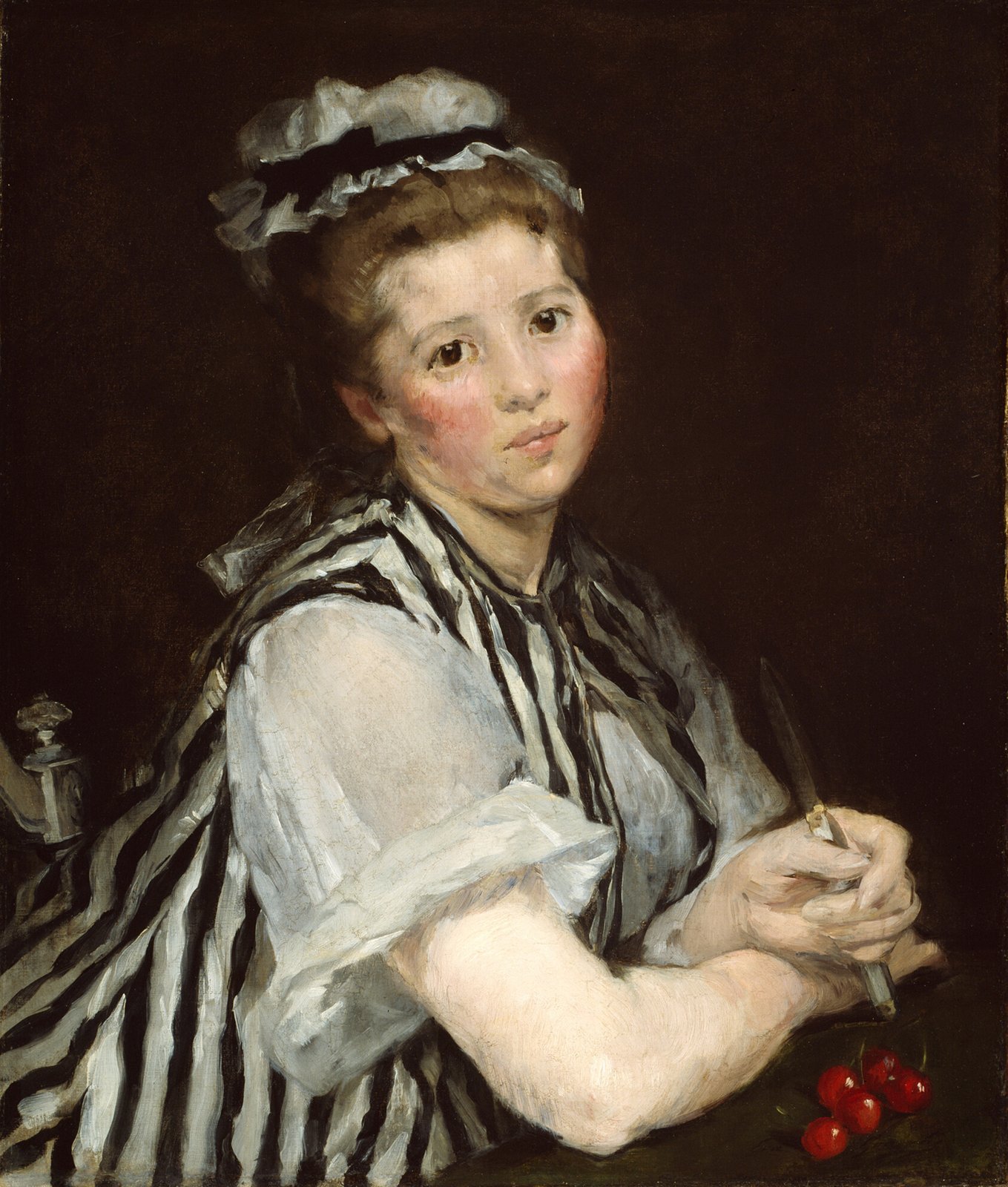
- About 1870, Girl with Cherries. Oil on canvas, 56.2 by 47.4 cm, in the Art Institute of Chicago.
- About 1874, A Box at the Théâtre des Italiens. Rejected by the Salon jury in 1874 and shown at the Salon of 1879, according to both the National Gallery in London and Smarthistory. It entered the national collection through a gift from Jean Guérard in 1927 and is now in the Musée d’Orsay, Paris.
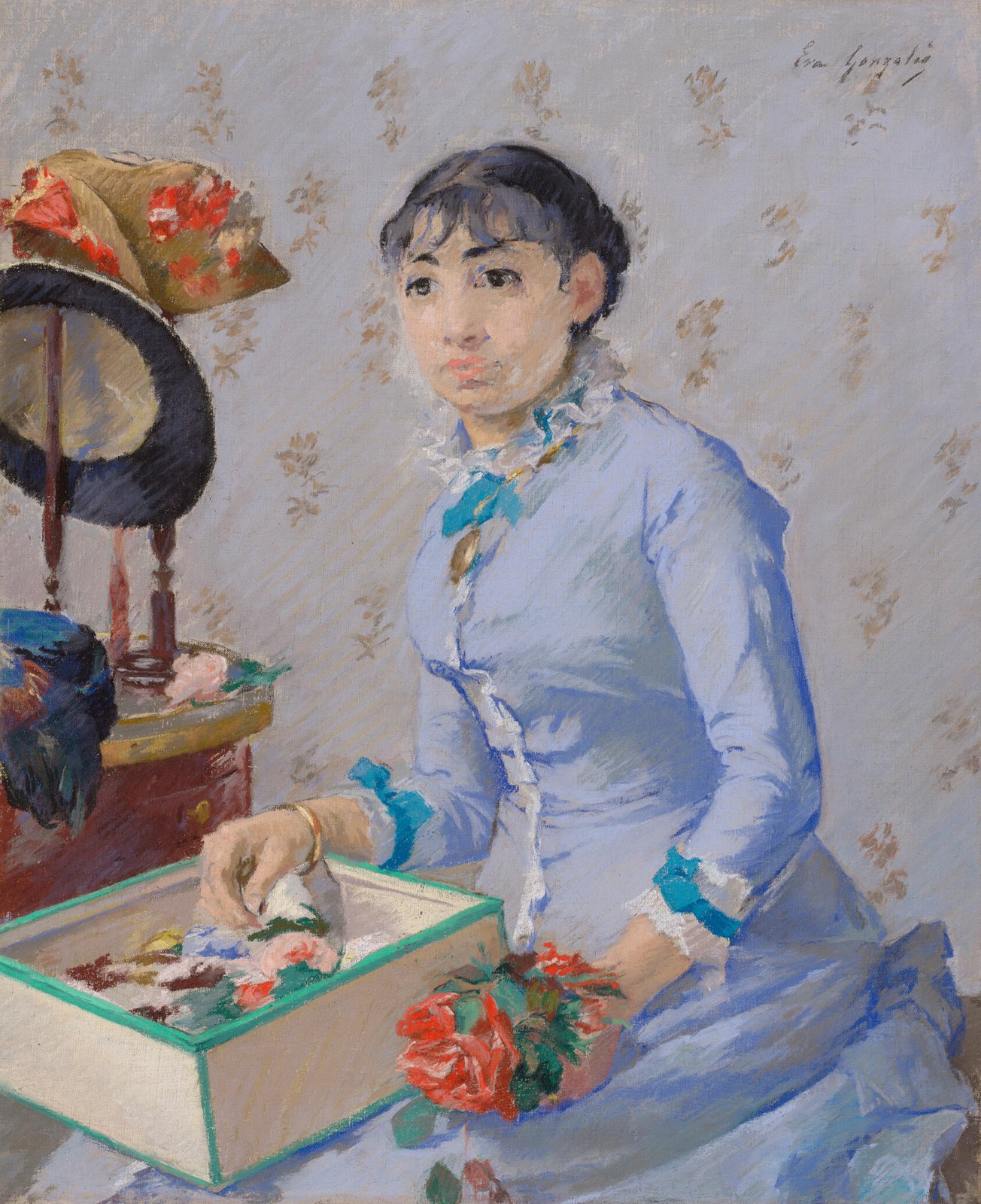
- About 1877, The Milliner. Pastel on canvas, 45 by 37 cm, in the Art Institute of Chicago.
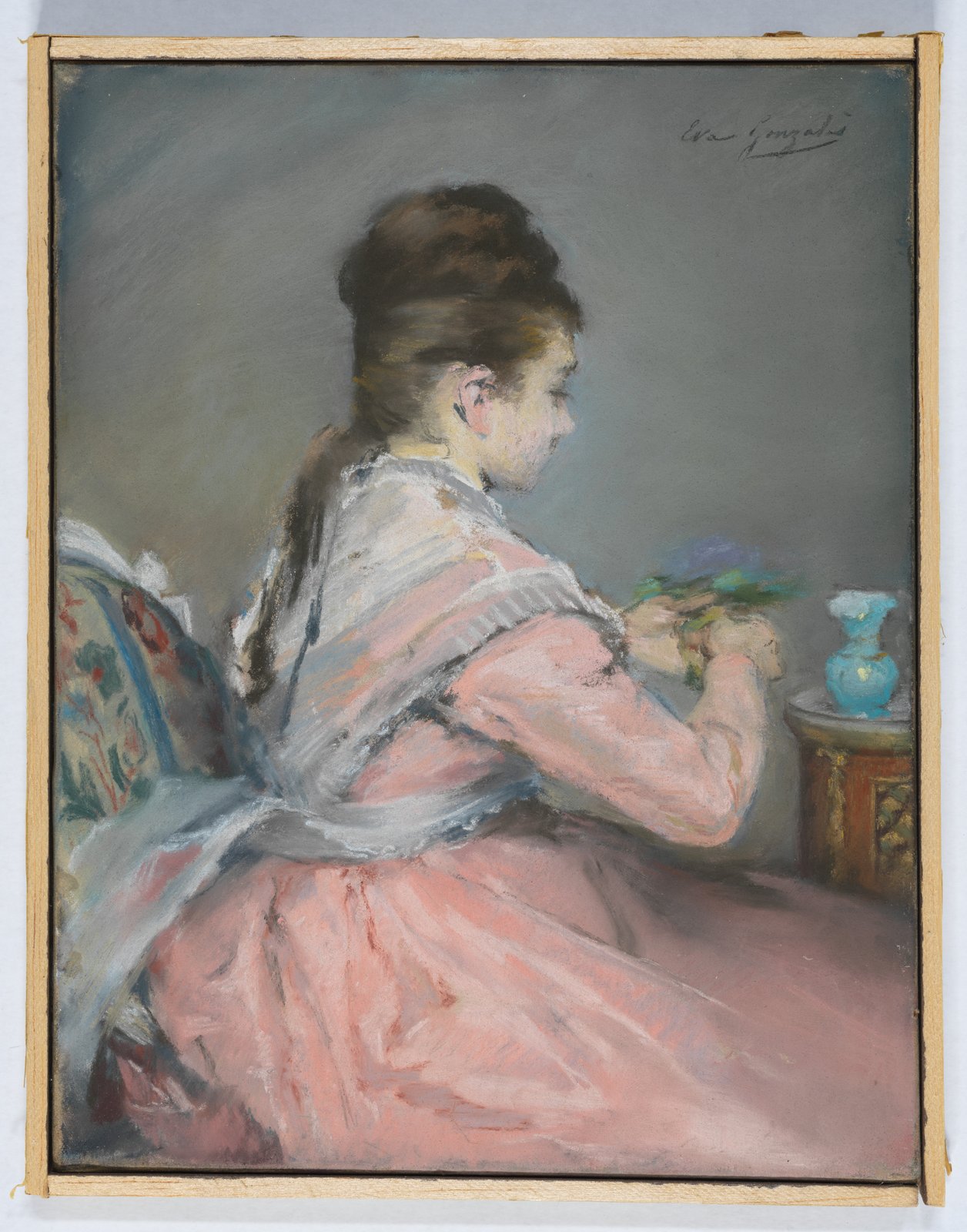
- 1877–78, The Bouquet of Violets and Nanny and Child. The Met dates its small pastel of violets to about 1877–78. The National Gallery of Art in Washington dates Nanny and Child, an oil of 65 by 81.4 cm painted at Dieppe, to 1877/1878.
- 1870s, Morning Awakening. A woman waking in bed, in the Kunsthalle Bremen. Dates of 1876 and 1877–78 both appear in published records.
What to look at in an Eva Gonzalès painting
A dark field with one bright note. In Girl with Cherries, most of the canvas is a deep brown-black. Measured from the Art Institute’s scan of this painting, the ground sits around #1f100d, the sleeves and cap around #d9cdb7, and the cherries at the lower right around #63100b. The red occupies a tiny fraction of the surface, yet it is where the eye lands after the face. Knife, cherries and clasped hands form a short diagonal back up to the sitter’s gaze.
Stripes as structure. The dark-and-white stripes of the girl’s wrap do the job a grid does in a layout. They describe the form of the shoulder and arm without any modelling, and their direction changes where the fabric turns. Gonzalès keeps the face soft and the stripes crisp, so texture tells you what matters.
Close values, cool palette. The Milliner works in the opposite key. The wallpaper, the dress and the box are all pale and cool. Measured from the museum’s scan, the wall reads around #a5a4ae, the blue-grey of the dress around #688396, and the roses in the sitter’s hand around #ac503e. Turquoise bows at the wrist and throat, and the green edge of the box, repeat one small accent colour around the figure so the eye moves in a loop.
The signature as a design element. In The Milliner and The Bouquet of Violets, the signature “Eva Gonzalès” sits in the upper-right corner, written small in a loose, slanted hand. It sits in the open wall space above the figure, a small counterweight to the dense lower half of each sheet. Treat it the way you would treat a small logo or folio: placed against the main mass, never competing with it.
Calm cropping. Her figures fill the frame at half or three-quarter length, often seen close up and slightly from the side. There is very little deep space; a wall, a curtain or a plain ground closes the background.
Technique: oil, pastel and the Manet connection
Her early oils follow Manet closely: flat, simplified forms, strong darks and a limited palette, laid down with broad, visible strokes. Girl with Cherries shows this in the way the white sleeve is built from a few quick, loaded passes of paint rather than careful blending.
She worked in pastel as well as oil, on paper and on canvas. Her Salon entries of 1870 already included a pastel portrait of her sister Jeanne, according to The Art Story and other summaries of her career. Pastel suited her lighter palette: the powdery surface keeps pinks, greys and blues soft, and the colour can be layered and rubbed without losing freshness. In The Bouquet of Violets, the pink dress is built from short parallel strokes, while the grey background is laid more broadly so the figure stands forward.
Like Manet, she showed at the official Salon rather than at the independent Impressionist exhibitions, according to the Encyclopædia Universalis. Her subjects and loose handling are close to those of Impressionism, which is why she is often grouped with Berthe Morisot, Mary Cassatt and Marie Bracquemond, although she never formally belonged to the group.
Prints after Eva Gonzalès
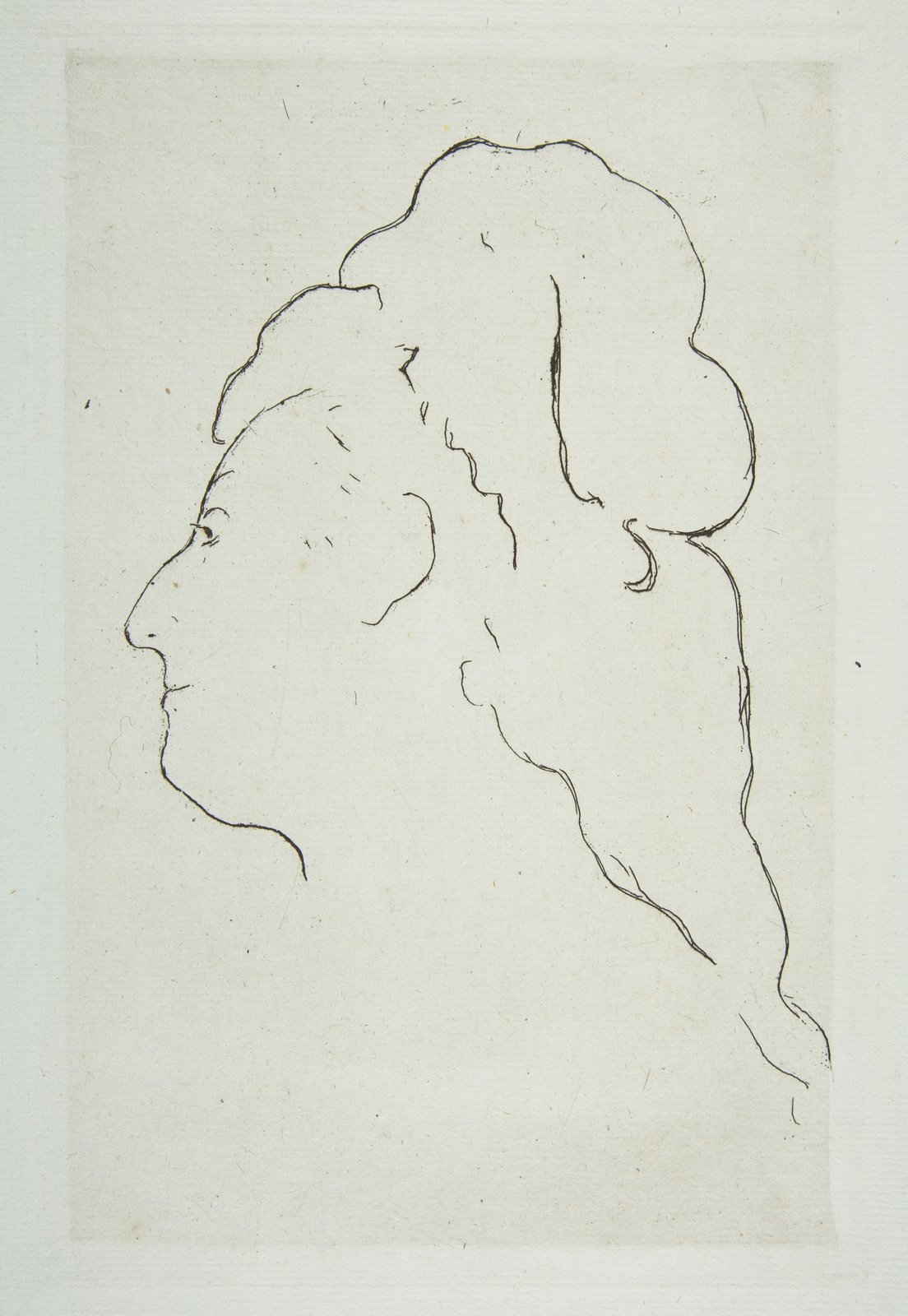
Her teacher drew her too. Édouard Manet made a small etched profile of her around 1870, a portrait in barely a dozen lines.
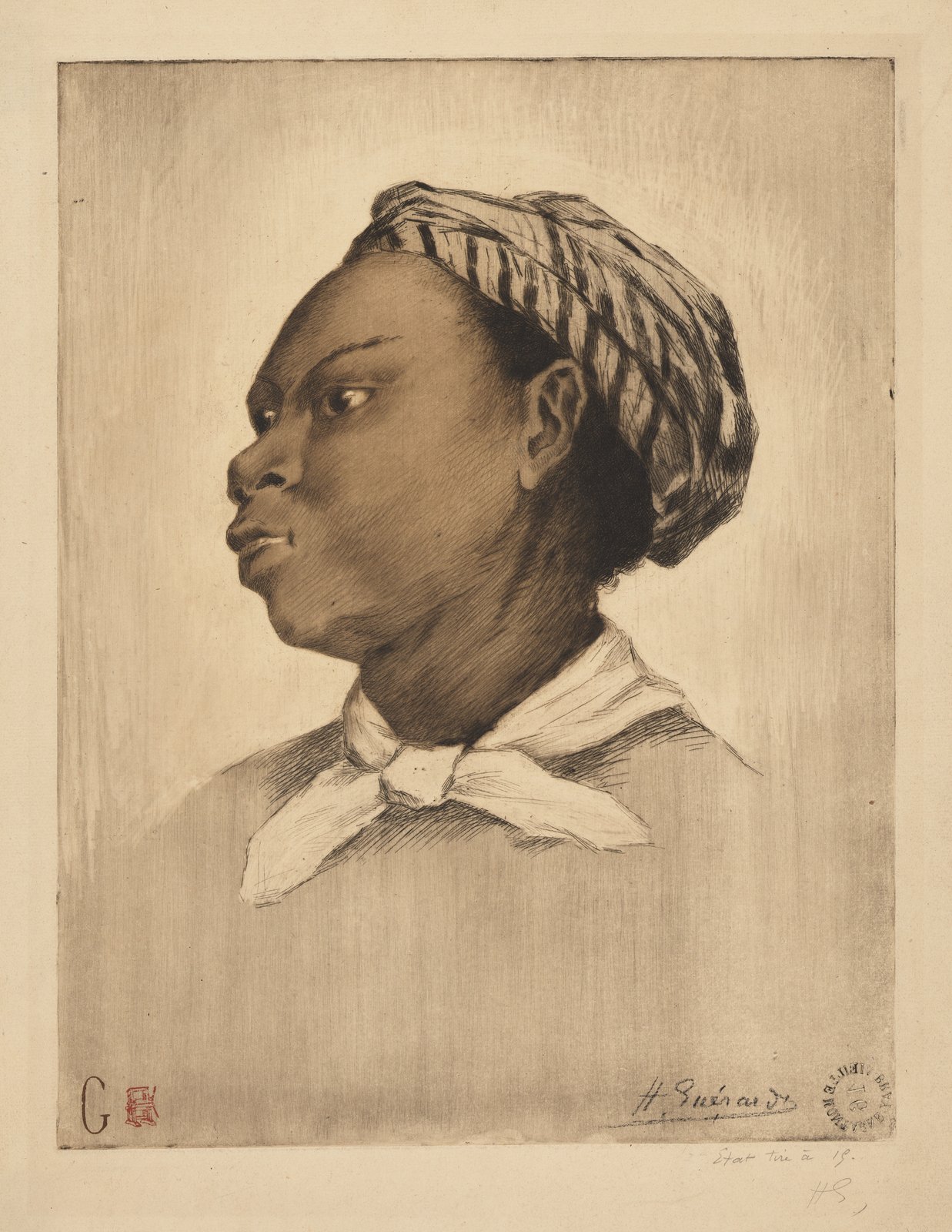
After her death, Henri Guérard made etchings after several of her works. The Met holds his Laure, after Eva Gonzalès, dated 1888, a second-state etching and drypoint printed in brown and black ink with plate tone, and the Cleveland Museum of Art holds further prints by Guérard after her compositions from around 1888–90. These reproductive prints show how a painted composition translates into a single-colour tonal print.
How designers can borrow from Eva Gonzalès
- Use one accent and protect it. Build a palette of four or five close, quiet tones, then add a single saturated colour in a small area, as with the cherries. Use the image colour picker on the public-domain scans to sample a starting set.
- Let pattern carry form. Stripes, checks or line textures can describe a shape without shading. Keep pattern crisp where you want attention and soft elsewhere.
- Repeat a minor colour in a loop. The turquoise in The Milliner appears at the throat, the wrist and the box edge. Repeating a secondary colour in three places guides the eye around a page or a poster.
- Place the signature against the mass. Put a small mark, credit or folio in the corner opposite the main visual weight, and keep it light and handwritten in feel.
- Translate to one colour. Guérard’s prints show how a painting survives as a brown monotone. Test a colour layout in a single ink before adding hue; if the values hold, the colour will too.
Frequently asked questions
Who was Eva Gonzalès?
Eva Gonzalès was a French painter and pastellist, born in Paris in 1849 according to most American museums (1847 in some records) and died there in 1883. She trained with Édouard Manet from 1869 and exhibited at the Paris Salon from 1870.
Was Eva Gonzalès an Impressionist?
Her subjects and loose brushwork are close to Impressionism, but, like Manet, she exhibited at the official Salon rather than with the independent Impressionist group, and she never formally belonged to it.
Where can I see her work?
The Musée d’Orsay in Paris holds A Box at the Théâtre des Italiens. In the United States, the Art Institute of Chicago, the Metropolitan Museum of Art and the National Gallery of Art in Washington hold paintings and pastels by her.
Are Eva Gonzalès images public domain?
The Art Institute of Chicago and the Met flag the works shown here as public domain, and they are public domain in the US. Check each museum’s own flag before reusing any image.


