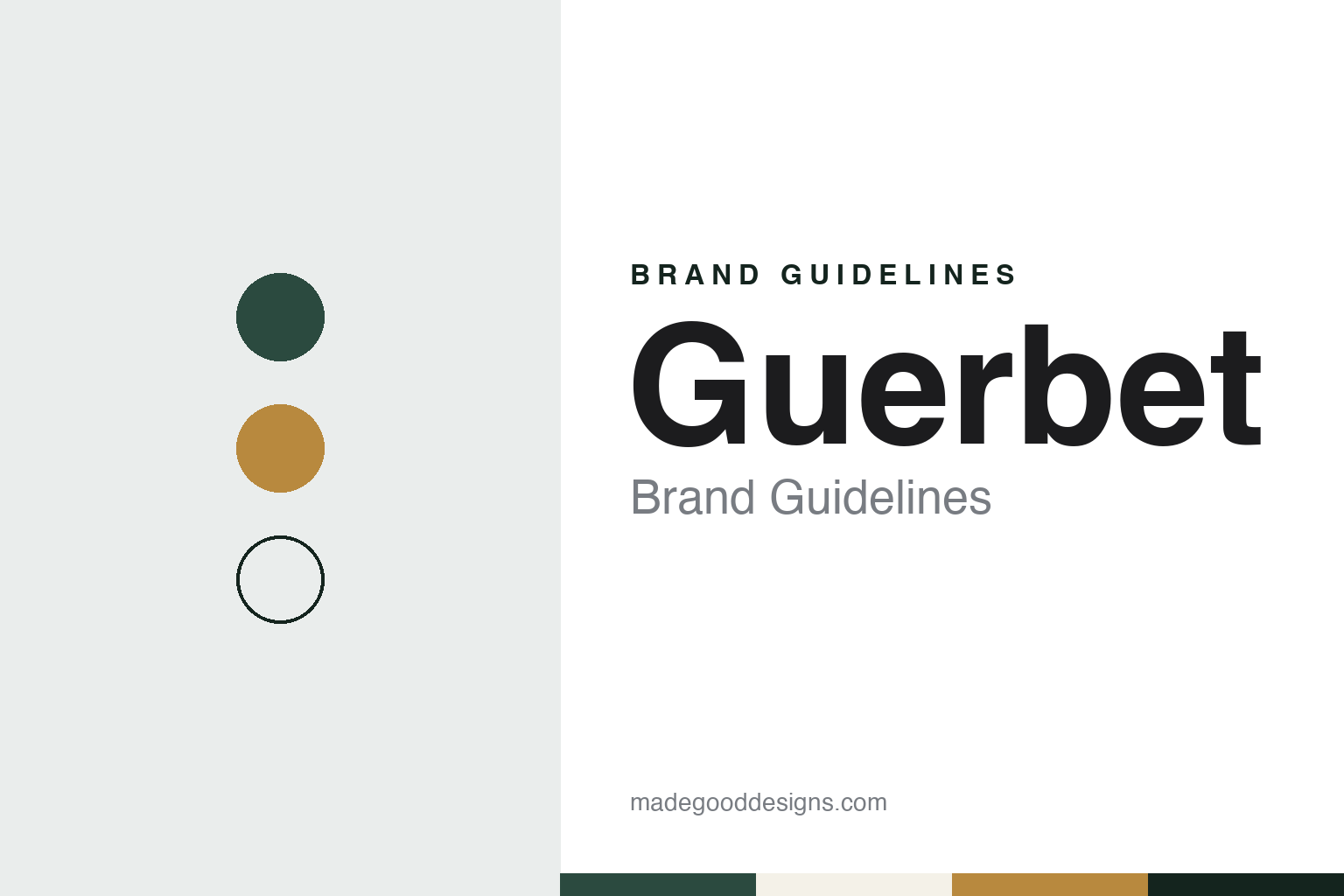
Guerbet Brand Guidelines
The Saint-Ouen laboratory built on an iodised oil from 1901.
Aa
Two constants: a green, amber and linen palette and a laboratory serif register. Abstract homage — not a Guerbet product or mark; no vial, logo or pack is reproduced.
Lipiodol
An iodised oil from 1901.
Guerbet’s story starts with a product rather than a company. In 1901 Marcel Guerbet developed Lipiodol, an iodised oil. Gale’s International Directory of Company Histories, in a history published in 2006, says it was produced for the medical market with a partner; Guerbet’s own web series on its history names that partner as Laurent Lafay, a friend with whom Marcel set out to improve existing iodinated oils, and says their formula held twice as much iodine.
Its place in imaging came later. In 1918 Lipiodol was found to be opaque to X-rays, which, the company says, made it the first iodinated contrast medium. Gale says the property was discovered by chance and let physicians see soft tissue and internal organs for the first time, and that Marcel Guerbet encouraged his son André to research contrast agents. The company’s series credits the physicians Sicard and Forestier with taking the oil into radiology.
The company itself dates from 15 November 1926, the official creation of the laboratory according to Guerbet. Accounts of the founding differ in emphasis. Guerbet says the group was founded by André Guerbet, and its timeline says Marcel and André set up a chemical and pharmaceutical production site in Saint-Ouen, north of Paris, that year. Gale says the business was incorporated in 1926 as Laboratoires Guerbet in Saint-Ouen, when André bought a 10 percent stake.
Guerbet’s own history series says that during the Second World War the company faced shortages, disrupted communications and the threat of bombing, and that its employees kept its expertise and activities going. Over the following decades, Gale says, it developed contrast media for angiography, bronchography, hysterosalpingography and urography, and for imaging the digestive tract.
Colour
Télébrix, Dotarem and the move to Villepinte.
A new generation took charge in the 1960s. The company says Michel Guerbet, André’s son, became chairman and chief executive in 1965, and that the business became SA Laboratoires André Guerbet that year; Gale gives 1964 for the renaming and says the family bought out the other shareholders to own the whole company. Gale describes Michel Guerbet as a physician and says a licence to sell Contrix, a contrast compound developed in the United States, in France helped pay for research.
New products followed. Gale dates the launch of Télébrix, developed in the company’s own laboratory, to 1964 and of Hexabrix to 1974. In 1968 Guerbet moved its facilities to Aulnay-sous-Bois, east of Paris; in 1977 it became a holding company, Guerbet SA, with separate subsidiaries for pharmaceuticals and for active ingredients; and in 1981 it opened a second production site at Lanester, which later became its main production facility. It floated on the Paris secondary market in 1986 and opened a headquarters at Villepinte, near the Aulnay plant, in 1987, the year it bought the fine-chemicals firm Simafex, Gale says.
Magnetic resonance imaging opened a new line. The company says it launched Dotarem for MRI in France in 1989, followed by Lumirem in 1993, the X-ray agent Xenetix in 1994 and Endorem in 1995. Its international network grew from a first subsidiary in Brazil in 1972 and a Japanese affiliate in 1978 to European subsidiaries in the Netherlands, Germany, Turkey and the United Kingdom in the early 1990s, according to Gale and the company. In 2002, Gale says, Guerbet bought the rights to the X-ray product Oxilan from the Cook Group and prepared to set up in the United States.
The company says its staff grew from 150 people in 1965 to 1,000 in 1990 and 1,500 in 2015.
Typography
Imaging agents and isotopes.
Radiopharmaceutical companies sell products that most people never see. A dose leaves a production site as a few millilitres in a small glass vial, travels inside a heavy shielded container and is given in a hospital’s nuclear-medicine department. So the industry’s pictures tend to show the places and machines around the product rather than the product itself.
The factory pictures are the most distinctive. Annual reports and websites in this field often show hot cells, the lead-shielded workstations where technicians handle radioactive material through thick windows and manipulator arms, and robotic dispensing systems that fill vials behind glass. Cyclotrons appear as large circular machines in bare concrete rooms, and research reactors are often photographed from above the pool, where the water glows blue around the core.
The second set of pictures comes from the scan itself. PET and SPECT images, usually shown in bright false colour over a grey outline of the body, are the clearest way to show what a tracer is for, and they recur in product pages, investor slides and congress booths. Alongside them sit images of time: couriers, vans and aircraft, because many isotopes decay within hours. Fluorine-18 has a half-life of about 110 minutes and technetium-99m about six hours, so supply chains are drawn as networks of sites and routes.
The trade meets at a small number of congresses, chiefly the annual meeting of the Society of Nuclear Medicine and Molecular Imaging (SNMMI) in North America and the congress of the European Association of Nuclear Medicine (EANM) in Europe, where booths, posters and product launches set much of the year’s visual language. This guide records what can be checked about each company’s history and ownership, and marks what rests only on its own word.
Aa
A laboratory serif for a century-old French maker. (Specimen set in Source Serif 4, a serif STAND-IN; NOT the Guerbet logo.)
Guerbet
Visibly different for a hundred years.
The largest step came in 2015. Guerbet announced in July 2015 that it would take over part of Mallinckrodt’s contrast media and delivery systems business, and the deal was completed in November 2015, English Wikipedia says; the company says its workforce rose to more than 2,900 after the purchase. Guerbet is listed on Euronext Paris and has its headquarters at Villepinte, in Seine-Saint-Denis.
Its recent products sit at the edge of nuclear medicine. On 21 September 2022 the company announced that the US Food and Drug Administration had approved Elucirem (gadopiclenol), an MRI contrast agent, and it says a European marketing authorisation followed in 2023; Bracco signed a global collaboration with Guerbet on gadopiclenol in 2022, English Wikipedia says. In 2023 the imaging-software company Intrasense joined the group, and in May 2024 Guerbet entered a strategic partnership with Nuclidium on radiotheranostics using copper radioisotopes, the company says.
Manufacturing has drawn regulatory attention. On 17 October 2025 the FDA issued a warning letter to Liebel-Flarsheim Company, a wholly owned subsidiary of Guerbet America in Raleigh, North Carolina, after an inspection from 25 March to 8 April 2025, citing significant violations of current good manufacturing practice regulations for finished pharmaceuticals.
The identity leans on age. The company presents its centenary story as “Visibly Different: The Guerbet Saga,” a web series in five episodes running from the founders and Lipiodol through the war years to the age of CT and MRI.
For a design guide, Guerbet shows how a single 1901 product can anchor a brand story for a century. Compare Bracco, its partner on gadopiclenol, and Curium, another maker of imaging agents. For this guide we use a deep green, an iodine amber and a linen white with a serif, an unofficial interpretation; no product or logo is reproduced.
Explore & save
Keep Guerbet’s identity on hand — save it to a board in the Made Good inspiration library.
Guerbet identity set
Pin the Guerbet green, amber and linen palette and the laboratory serif register to your own board.