IBK Brand Guidelines
A 1961 small-business bank under a tilted blue square.
Aa
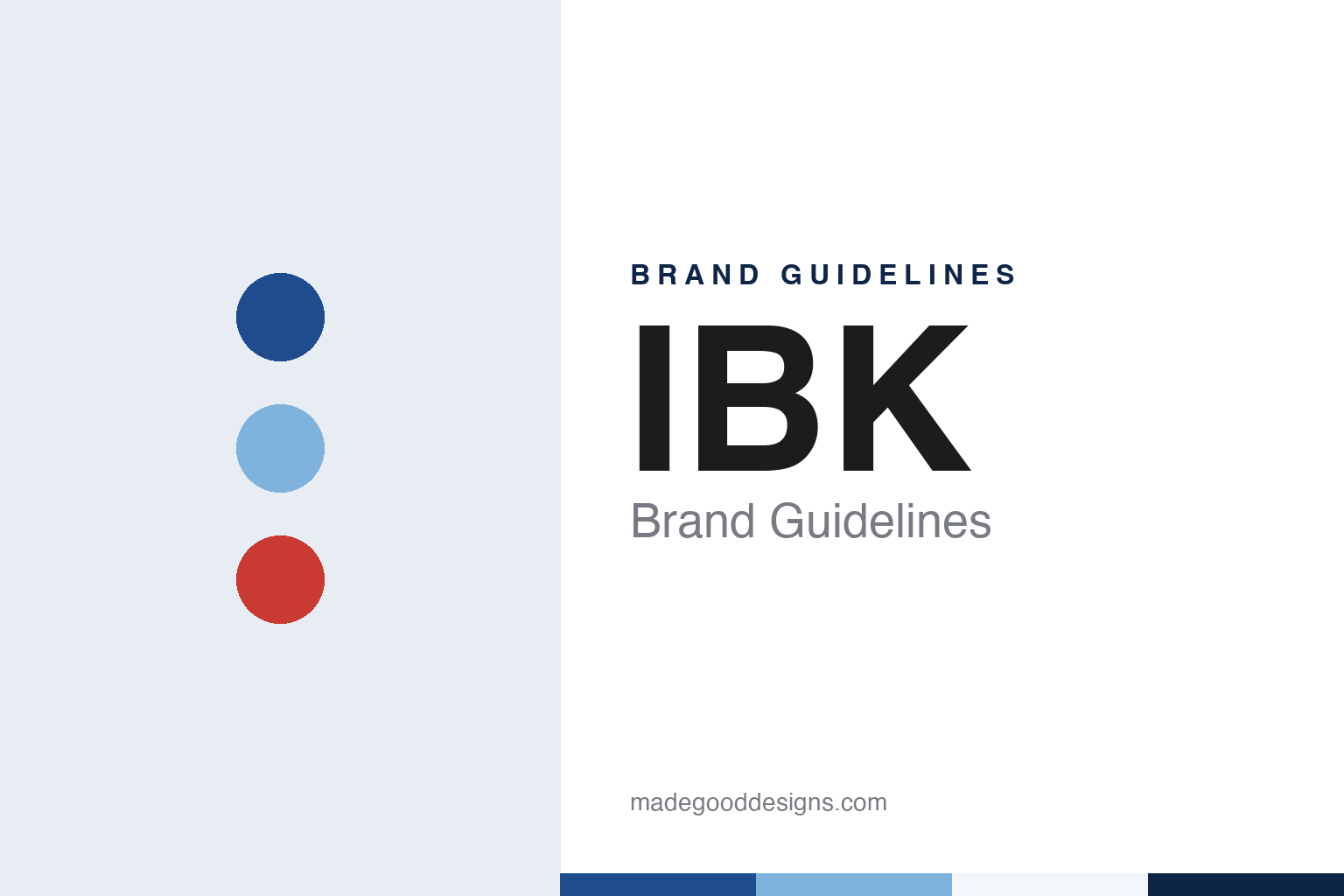
Two constants: an IBK blue, sky blue and red palette and a plain Korean sans register. Abstract homage — not an IBK asset; no logo, card or symbol is reproduced.
A bank for small business
A 1961 law, a single purpose and a long list of names.
IBK, the Industrial Bank of Korea, was established in August 1961. The bank’s own English history gives its first name as the Small and Medium-sized Business Bank, and Korean Wikipedia says it was set up under a law passed the month before, building on the city branches of the Agricultural Bank. That law, now the Industrial Bank of Korea Act, still sets its purpose: to lend to small and medium-sized enterprises and improve their economic position through an efficient credit system, as English Wikipedia summarises it.
The names have shifted more than the mission. The bank says its English name changed to Small and Medium Industry Bank in December 1978. At home it is still called 중소기업은행, or simply 기업은행, and Korean Wikipedia notes that “Industrial Bank of Korea,” “IBK” and “IBK기업은행” are used interchangeably; the three letters come from the bank’s international banking code, it adds.
The bank’s timeline is a record of steady growth outward. Its timeline lists a Tokyo branch office in February 1991 and calls New York, opened in November 1991, its first overseas branch; Hong Kong followed in 1993 and Tianjin in 1997. Its shares trade on the Korea Exchange: Korean Wikipedia dates the first listing to November 1994, and the bank says its shares moved from KOSDAQ to the main KOSPI market in December 2003. In November 1997 it changed status from a government-invested company to a government-affiliated one, the bank says, and its timeline records repeated cash injections from the government across the following decades.
Colour
State-run, and still policy-minded.
IBK remains a state-run lender, as The Korea Times described it in October 2026. The bank’s own shareholder page, dated 31 December 2025, lists the Ministry of Finance and Economy with 59.5 percent, the Korea Development Bank with 7.2 percent and the Export-Import Bank of Korea with 1.8 percent, leaving 31.5 percent with other holders. Its corporate-governance page says the chairman and chief executive is appointed by the President of the Republic of Korea on the recommendation of the chairman of the Financial Services Commission. Korean Wikipedia classes it as a public institution under the commission and a state-run special bank, and notes that the designation was lifted in January 2012 and restored in January 2014.
The everyday offer is broad. The bank runs the i-ONE Bank app, which its timeline says was reorganised in May 2019, and in December 2024 it launched the IBK Card app; its cards run on the BC Card network, Korean Wikipedia says. Since 2005 customers have been able to use passbooks at Korea Post counters through a partnership with the postal service, and since December 2015 IBK has issued the Narasarang card for military conscripts, a role it kept when the card was retendered in May 2025, according to Korean Wikipedia.
Much of what IBK publicises is aimed at founders and smaller firms. It has opened IBK ChangGong start-up centres, including one in Mapo in December 2017 and adding Daegu and a Silicon Valley centre in 2025, and its timeline lists programmes from online M&A platforms to e-commerce services for small businesses. Abroad it has subsidiaries in China, Indonesia and Myanmar. In October 2026 The Korea Times reported the formal launch in Hanoi of IBK Vietnam Bank, which began operating on 25 September after a licensing process that started in 2017; with it, the bank said, IBK has five overseas subsidiaries. The bank says it received approval to set up a subsidiary in Poland in November 2024, the first among Korean banks to do so.
IBK also lends its name to sport: Korean Wikipedia lists the women’s volleyball club Hwaseong IBK Altos among its affiliates, and the bank has issued cards linked to the team.
Typography
Korean banks and their marks.
South Korean banks tend to present themselves with short names and simple symbols. Many trade under initials or a single word, and they usually show the Hangul name and the Latin name side by side, so that the same mark works on a branch sign in Seoul, an overseas office and a phone screen. Bright, clean colours are common across the sector, from yellows and warm tones to teals, blues and greens, set against plenty of white space.
Several banks have built their identities beyond a logo. KB Financial Group publishes its own typeface family and a cast of mascots, the Star Friends, which appear in its advertising; Hana Financial Group has its own typeface too, and offers it free to the public. Character mascots, house fonts and short slogans give these brands a friendly face that carries across advertising, apps and branches.
Much of the customer’s contact now happens on a phone. Bank websites and apps tend to be minimal and app-first, with pages organised around deposits and savings, loans, mobile banking, overseas transfers and digital wallets, and many services that once needed a branch visit are offered online. Banks also use their apps for things beyond banking, such as event ticketing or tie-ins with sports clubs.
Sport and publishing round out the picture. Korean banks sponsor athletes, teams and running and golf events, and some produce branded dramas and web series for online audiences. Their annual reports and sustainability reports are published in Korean and English and set out each group’s structure, history and identity, which makes them a useful starting point for anyone studying how these brands are built.
Aa
A plain Korean sans for Latin and Hangul alike. (Specimen set in Noto Sans KR, a sans STAND-IN; NOT the IBK logo or wordmark.)
IBK
A tilted square with wings.
IBK is unusually open about its identity. The bank says it changed its corporate identity in January 2007; Korean Wikipedia shows the earlier logo as the one used from 1991 to 2006. Its English CI page explains the current mark in detail. A tilted square stands for “dynamic and progressive energy” moving forward, and the shape inside it is drawn to spell out IBK. The “I” stands for the customer, speaking in the first person. The “B” becomes a great bird the bank calls “Win-Wing,” its wings opening across the sky, and a small red triangle at the centre of the wings stands for the exchange between bank and customer. The blue sky and clouds, the bank says, were carried over from its previous identity.
The same page names the colour system in words: a main blue, a second main colour of sky blue and a supporting red. The brand slogan is “A Truly Good Bank,” which the bank presents as a pledge to the country, shareholders, customers and employees. Elsewhere its timeline records an official anthem and motto in August 2005, a “SMART Service” identity in August 2009 and, in July 2023, a new card brand line-up built around the letters I, B and K.
For a design guide, IBK shows how a policy bank can carry a strong, explained symbol and a plain promise without leaning on mascots. Compare KDB, another state-owned Korean lender, and NH NongHyup Bank. For this guide we use a deep blue, a sky blue and a small red with a sans, an unofficial interpretation; no product or logo is reproduced.
Explore & save
Keep IBK’s identity on hand — save it to a board in the Made Good inspiration library.
IBK identity set
Pin the IBK blue, sky blue and red palette and the plain Korean sans register to your own board.