IHS Towers Brand Guidelines
Sam Darwish’s 2001 Lagos tower builder and the MTN deal.
Aa
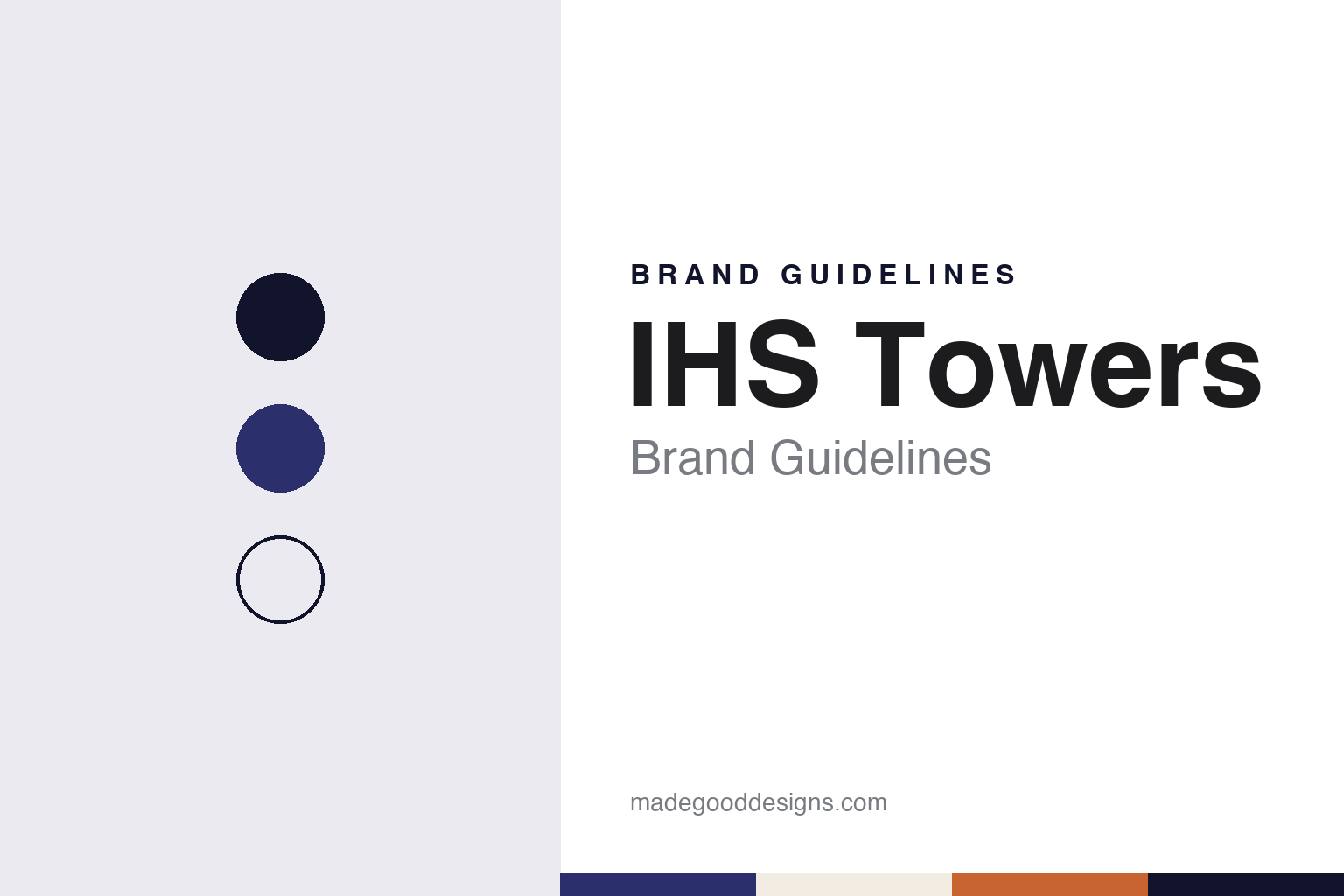
Two constants: an IHS Towers indigo and laterite palette and a Geometric sans register. Abstract homage — not an IHS Towers asset or mark; no tower, logo or nameplate is reproduced.
Lagos, 2001
A tower builder becomes a tower owner.
IHS Towers was founded in 2001 in Lagos, Nigeria, by Sam Darwish, according to English Wikipedia. The company’s own history describes its start as a builder of communication towers for mobile network operators in Nigeria, and says its founders still lead the business. The group’s holding company is IHS Holding Limited.
The company dates its change of model in two steps. In 2004, it says, it launched managed services for towers that operators owned, covering maintenance, security and power supply. In 2009 it began owning towers in Nigeria and leasing space on them to operators, starting the colocation business in which one tower carries the equipment of more than one carrier. Wikipedia also dates the launch of colocation services to 2009.
The expansion that followed came largely through deals with operators selling their towers. The company’s history lists the tower portfolios of MTN Côte d’Ivoire and MTN Cameroon in 2013, together with lease agreements for Orange’s towers in both countries; MTN’s portfolios in Zambia and Rwanda in 2014, alongside large purchases from 9mobile and MTN in Nigeria; Airtel’s towers in Zambia and Rwanda in 2015; and HTN Towers, with 1,211 towers in Nigeria, in 2016. Wikipedia confirms that IHS had acquired MTN’s tower portfolios in Côte d’Ivoire, Cameroon, Zambia and Rwanda by 2014, and names the operators it works with as including MTN, Orange, Airtel and Zain.
Colour
Three continents, then back to Africa.
In 2020 IHS left Africa. It completed a controlling investment in towers of the Kuwaiti operator Zain, a sale-and-leaseback with a first closing in February 2020, and acquired Cell Site Solutions, with towers mainly in Brazil and also in Peru and Colombia, according to its history and English Wikipedia, which says the company then operated across three continents. More Latin American purchases followed in 2021, including Skysites in Brazil and Centennial’s towers in Brazil and Colombia, and in Brazil IHS formed I-Systems, a fibre business, with TIM Brasil. In 2022 it entered South Africa by acquiring 5,691 towers from MTN South Africa, the company says.
The listing came in between. IHS listed on the New York Stock Exchange in October 2021, Wikipedia says, and the company’s own timeline records the initial public offering under 2021. That year it also obtained a licence to build, operate and lease telecom towers in Egypt, it says.
Then the footprint narrowed. The company records the sale of IHS Peru to affiliates of SBA Communications in April 2024, the sale of its 70% interest in IHS Kuwait to Zain in December 2024 and the sale of IHS Rwanda to Paradigm Tower Ventures in 2025; Wikipedia dates the Rwanda sale to October 2025. In 2026, Wikipedia says, IHS completed the sale of I-Systems in May and sold its tower operations in Brazil and Colombia in August. Today the company describes a portfolio of approximately 28,000 towers in five countries: Cameroon, Côte d’Ivoire, Nigeria, South Africa and Zambia.
Typography
Steel, sky and the people who climb.
Tower companies sell something most people never notice: space on a mast. A mobile operator rents a slot on a tower, a rooftop or a small cell, and several rivals can share the same steel. That makes the business hard to picture, so the companies that run it tend to lean on a small set of images to explain what they do.
The most common is the structure itself. A steel lattice mast against a wide sky, a slim monopole beside a motorway, a cluster of antennas over a city skyline at dusk, or a lone rural tower at sunset all stand in for coverage that cannot be seen. People appear too, usually climbers in harnesses and helmets working high on a tower, a reminder that the sites are built and maintained by hand.
The second register is the map. Annual reports and investor pages often show a country or a continent dotted with sites, because the number and spread of locations is the product. Site counts, country lists and phrases such as “neutral host” or “shared infrastructure” do much of the talking.
The industry also meets in public. Trade shows such as Connect (X) in the United States and the Mobile World Congress in Barcelona put tower companies beside the operators they serve, with stands, renderings of towers and maps of networks. For a design guide, the interest lies in how a business made of steel, leases and coordinates turns that into a calm, legible identity.
Aa
A geometric sans — the register of a company that calls itself an emerging-markets specialist. (Specimen set in Manrope, a sans STAND-IN; NOT the IHS Towers logo.)
IHS Towers
A pending return to MTN.
Its relationship with MTN, a customer and a shareholder, has also become its ownership question. MTN, which sold IHS many of its towers, held about 24.7% of IHS when it announced on 17 February 2026 that the IHS board had accepted its offer to take the company private through a cash merger, MTN said in a press release; the plan followed IHS’s announced sales of its Latin American assets and would end the New York listing. Connecting Africa reported on 5 August 2026 that IHS shareholders had approved the transaction by the required two-thirds majority at a meeting on 4 August 2026, and that completion still depended on regulatory approvals, which were ongoing. On completion IHS Holding Limited would become a wholly owned subsidiary of MTN. The deal was agreed in February 2026 and had not been completed at the time of writing.
Its self-presentation is that of a specialist. The company calls itself “an emerging markets specialist” and “expert partners in communications infrastructure,” and says it is one of the largest independent owners, operators and developers of shared communications infrastructure in the world, the largest independent tower operator in five of its markets and the only one in three of them. It sorts its work into six business models, which Wikipedia lists as colocation and lease amendments, new sites, in-building solutions, small cells, fibre connectivity and rural telephony. In October 2022 it published what Wikipedia calls a “Carbon Reduction Roadmap” for its own emissions. Long operator contracts are part of the story it tells: in 2024 it renewed master lease agreements in Nigeria with Airtel until 2031 and with MTN until 2032, it says.
For a design guide, IHS Towers shows how a company can be redrawn by its own deal-making: three continents after 2020, five African countries six years later. Compare Helios Towers and American Tower, both named by Wikipedia as competitors of IHS in Africa. For this guide we use a deep indigo, a laterite orange and sand with a sans, an unofficial interpretation; no product or logo is reproduced.
Explore & save
Keep IHS Towers’s identity on hand — save it to a board in the Made Good inspiration library.
IHS Towers identity set
Pin the IHS Towers indigo and laterite palette and the Geometric sans register to your own board.