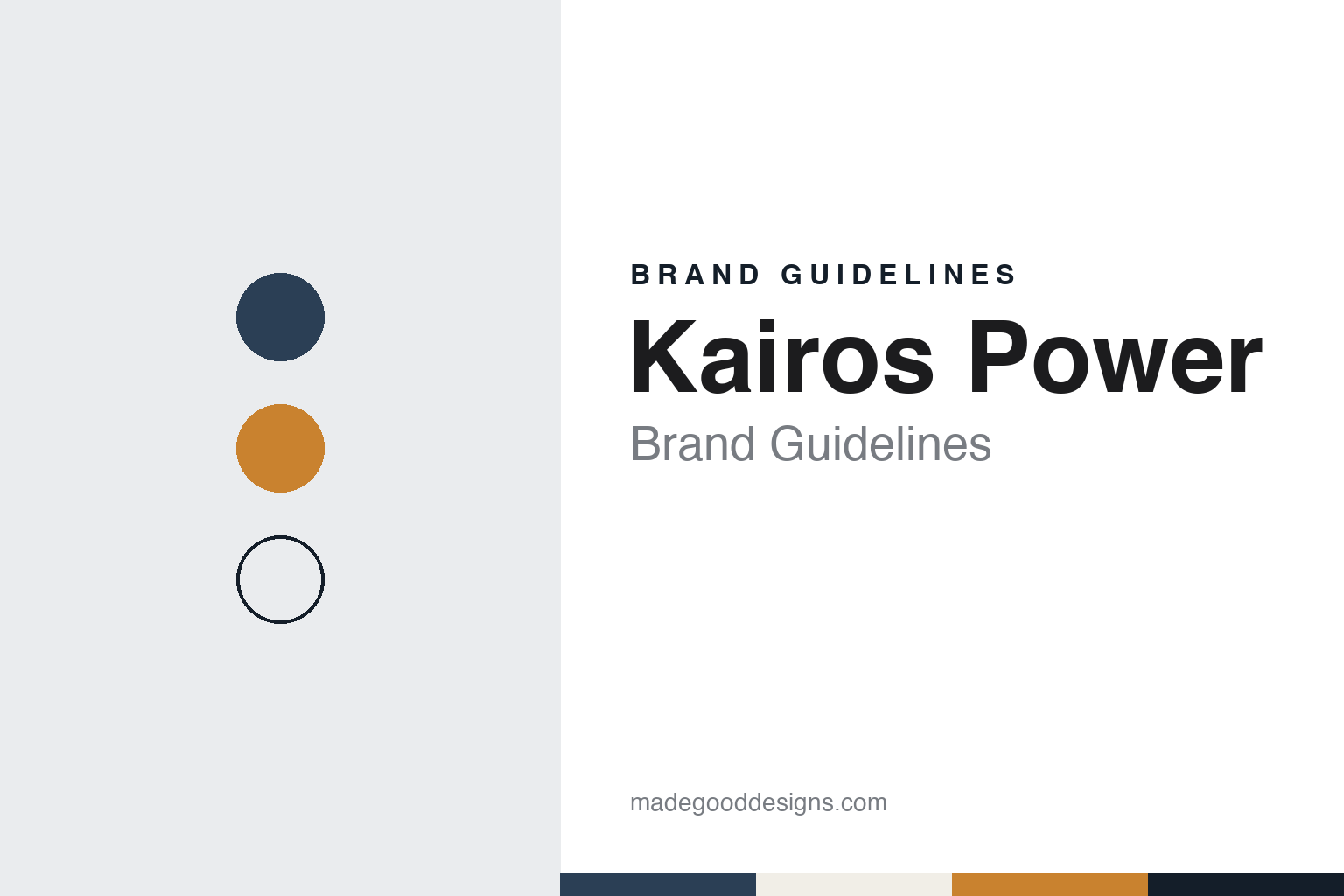
Kairos Power Brand Guidelines
Alameda’s molten-salt reactor developer and its Hermes plants.
Aa
Two constants: a Kairos Power slate, amber and salt-white palette and a technical sans register. Abstract homage — not a Kairos Power product or mark; no reactor, logo or fuel element is reproduced.
Alameda, 2016
Two co-founders and a Greek word.
Kairos Power was founded in 2016, English Wikipedia says, and has its headquarters in Alameda, California. The company names two co-founders: Mike Laufer, its chief executive, and Edward Blandford, its chief technology officer. It also explains its name: kairos is a Greek word for the right or opportune moment, and the company says the timing it has in mind is the gas-fired power plants built in the early 2000s, which will reach the end of their lives in the 2030s and 2040s; it intends its reactors as a replacement for that baseload power.
The company calls itself “vertically integrated,” making key parts of its reactors, fuel and coolant in-house. Engineering is led from Alameda; a manufacturing development campus at Mesa del Sol in Albuquerque, New Mexico handles manufacturing, salt production, fuel development and large non-nuclear test units, according to the company, and its facilities there include two engineering test units, a TRISO development lab and a pebble development lab. Its reactor projects are in Oak Ridge, Tennessee. In 2020 the Department of Energy signed a seven-year technology investment agreement with Kairos under its Advanced Reactor Demonstration Program, Wikipedia says. The company says it now has more than 500 staff.
Its reactor design is the KP-FHR, a fluoride salt-cooled high-temperature reactor. Wikipedia describes the combination: solid TRISO fuel particles set in graphite pebbles, cooled by a low-pressure molten salt of lithium fluoride and beryllium fluoride known as Flibe — the coolant mixture first used in Oak Ridge’s Molten Salt Reactor Experiment in the 1960s. The pebbles float in the salt and circulate through the core, which allows fuel to be added and removed while the reactor runs, the same source says. Commercial plants are planned around units of 75 megawatts of electricity, deployed in pairs.
Colour
Hermes, step by step.
Kairos builds in steps it calls iterative development: non-nuclear test units first, then small reactors, then commercial plants. The first reactor is Hermes, a low-power demonstration reactor at the East Tennessee Technology Park in Oak Ridge. Kairos applied to the Nuclear Regulatory Commission for a construction permit on 29 September 2021, and the NRC issued it on 14 December 2023, the commission’s project page says. Kairos describes Hermes 1 as the first non-water-cooled reactor to receive an NRC construction permit. Wikipedia says ground was broken in July 2024 and nuclear construction began in May 2025.
A second step, Hermes 2, followed. Kairos applied on 14 July 2023 for two 35-megawatt-thermal test reactors, also in Oak Ridge, and the NRC issued the construction permits on 21 November 2024. In August 2025, World Nuclear News reported, Kairos said it would instead raise Hermes 2’s output from 28 to 50 megawatts of electricity “generated by a single reactor,” with operation scheduled for 2030; Wikipedia says ground was broken at the Hermes 2 site in April 2026.
The supply chain is built in-house as well. Wikipedia says Kairos commissioned a Molten Salt Purification Plant on the Materion campus in Elmore, Ohio, in 2022 to make plant-scale quantities of Flibe, and in September 2025 announced a collaboration with BWX Technologies to look at TRISO fuel production. In January 2026, the same source says, the Department of Energy finalised a contract to supply high-assay low-enriched uranium for the first Hermes reactor. On 7 October 2026 the company announced an automated system for inspecting and tracking its fuel pebbles, and on 29 October 2026 it said it had completed salt production for a large Flibe test.
Typography
How nuclear developers present themselves.
Nuclear companies sell to a small number of buyers — utilities, governments and regulators — over very long timescales, and their imagery tends to reflect that. Corporate pages and reports often return to the same few scenes: cooling towers and reactor domes photographed under clear skies, turbine halls in clean, even light, and wide views of plants set against water or open country.
Newer reactor designers, many of which have not yet built a commercial plant, lean on renders instead. Small modular plants appear as low, compact buildings in green landscapes, sometimes beside a town or a data centre, with no smoke and few people. Large-reactor vendors show construction sites, cranes and heavy components such as reactor vessels and steam generators on the move, a way of picturing scale and progress at once.
People appear mostly as engineers in hard hats and overalls, inspecting a weld, reading a control-room screen or handling fuel. Two images recur across the trade: the blue Cherenkov glow of a spent-fuel or research-reactor pool, caused by charged particles travelling through water faster than light does in it, and ceramic fuel pellets held in a gloved hand. Both are used to make an invisible process visible.
The industry also presents itself in person, at trade gatherings such as the World Nuclear Exhibition and the meetings of the American Nuclear Society, where stands, renders and scale models carry much of the message. The companies in this guide range from Framatome, founded in 1958, and Urenco, set up by treaty in the early 1970s, to much younger reactor designers, and their visual languages vary just as widely.
Aa
A technical sans for a salt-cooled reactor developer. (Specimen set in Sora, a sans STAND-IN; NOT the Kairos Power logo.)
Kairos Power
Google, TVA and the grid.
The commercial anchor is Google. On 14 October 2024 Google announced what it called the world’s first corporate agreement to buy nuclear energy from multiple small modular reactors, to be developed by Kairos Power: the first reactor was to come online by 2030, with more through 2035, for up to 500 megawatts in all. In August 2025 the Tennessee Valley Authority signed a power purchase agreement for up to 50 megawatts from Hermes 2, feeding the grid that serves Google data centres in Montgomery County, Tennessee, and Jackson County, Alabama; World Nuclear News reported it as the first agreement by a US utility to buy electricity from an advanced, Gen IV reactor, and as the first deployment under the 2024 Google deal. None of these plants was operating at the time of writing.
The identity is quiet and technical. The company’s site speaks of “the opportune moment” and of “pioneering the next era of energy,” and its updates mix company news with explainers on Flibe and on building modular reactors. No official colour or typeface standard is published, so the tones in this guide are our own.
For a design guide, Kairos Power shows how a young developer can turn its own name into a story about timing. Compare X-energy, which also builds on pebble-type TRISO fuel, and TerraPower, another US developer of a reactor that is not water-cooled. For this guide we use a deep slate blue, a molten amber and a pale salt white with a sans, an unofficial interpretation; no product or logo is reproduced.
Explore & save
Keep Kairos Power’s identity on hand — save it to a board in the Made Good inspiration library.
Kairos Power identity set
Pin the Kairos Power slate, amber and salt-white palette and the technical sans register to your own board.