Intellia Brand Guidelines
The Cambridge company working on CRISPR editing inside the body.
Aa
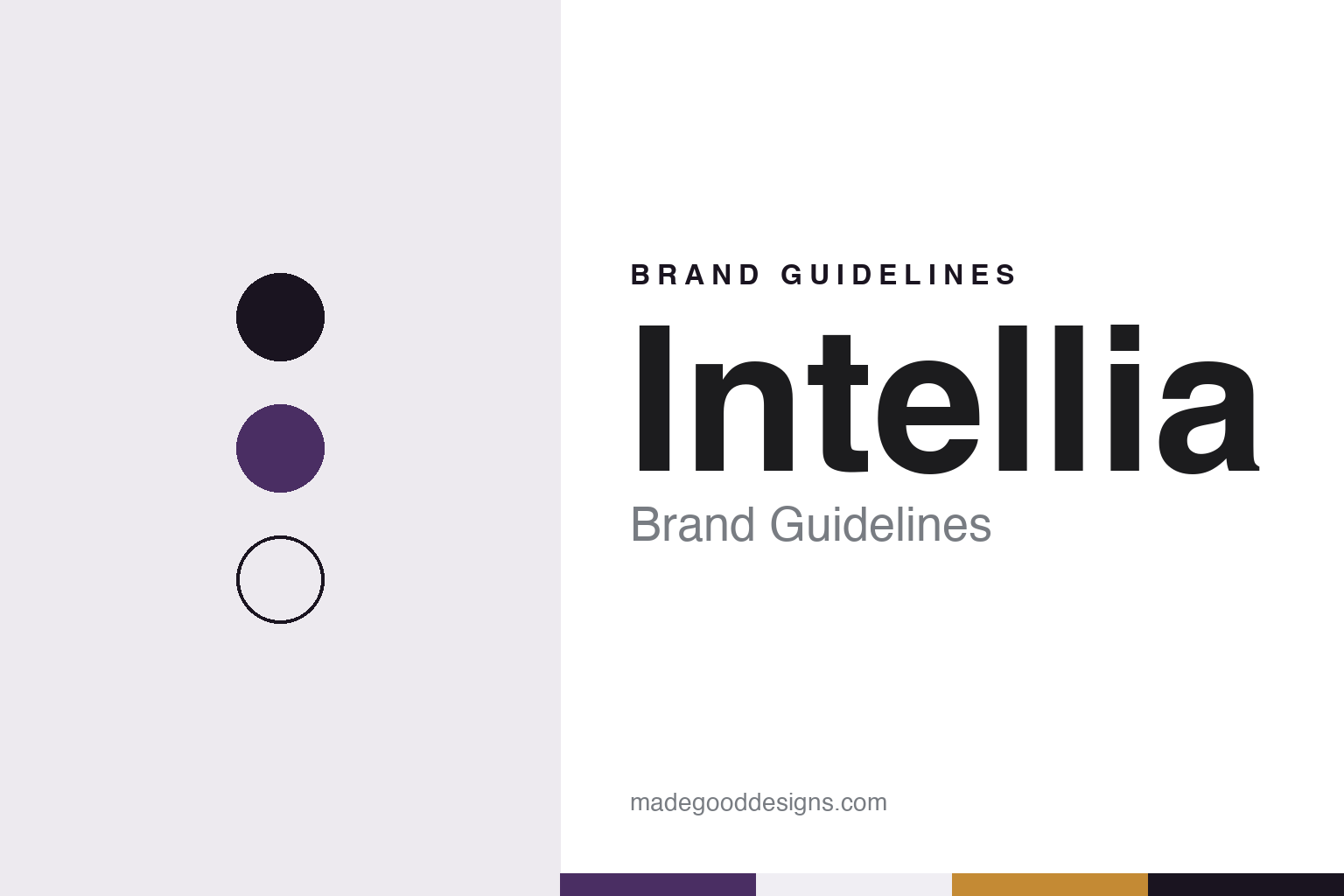
Two constants: a plum, ink and amber palette and a rounded geometric sans register. Abstract homage — not an Intellia product or mark; no logo, label or pack is reproduced.
Atlas and Novartis
A venture-built CRISPR company with a Nobel co-founder.
Intellia Therapeutics was founded in November 2014 to develop medicines using CRISPR, according to English Wikipedia, which says it was backed by the venture firm Atlas Venture and by Novartis. Its founding chief executive was Nessan Bermingham of Atlas, and its founding chief scientific officer was John Leonard, formerly of AbbVie, who became chief executive in December 2017. The academic founders named by Wikipedia include Jennifer Doudna, Rodolphe Barrangou, Rachel Haurwitz, Luciano Marraffini, Erik Sontheimer and Derrick Rossi.
Doudna’s place among the founders is part of the company’s own story: its about page notes that she shared the 2020 Nobel Prize in Chemistry with Emmanuelle Charpentier for their work on CRISPR. The patents were contested from the start. Wikipedia explains that Intellia in-licensed rights from Caribou Biosciences, which held a licence to University of California patents, and that by 2017 the University of California had lost a challenge to the Broad Institute’s CRISPR patents, which Wikipedia says put Intellia at a disadvantage.
Novartis was a partner as well as an investor. In January 2015 the two agreed that Novartis could use Intellia’s CRISPR work in its CAR-T programmes, and Intellia ran that collaboration through a division called eXtellia. In April 2017 Intellia formed a wider partnership with Regeneron. The company listed on the Nasdaq in May 2016, and in December 2016 it moved into new laboratory and office space in Cambridge, Massachusetts, where it is still based.
Its list of partners has kept growing. English Wikipedia names research and development collaborations with Regeneron, Avencell, SparingVision and Kyverna, among others, and says Intellia also runs research programmes in areas including cancer, alpha-1 antitrypsin deficiency and haemophilia. The same article notes that the company is working on further editing methods beyond the standard CRISPR cut, including base editing and what it calls DNA writing.
Colour
Editing inside the body.
Intellia’s focus is in vivo editing, in which the editing system is given directly to the patient rather than applied to cells in a laboratory. Its approach, as Wikipedia describes it, packs a guide RNA and the messenger RNA for the Cas9 enzyme into lipid nanoparticles that travel to the liver; the company disclosed at its listing that it had licensed this delivery system from Novartis. Its two lead candidates are both of this kind.
The first, NTLA-2001, now named nexiguran ziclumeran or nex-z, is aimed at transthyretin amyloidosis. In June 2021 Intellia released interim Phase 1 data, published in the New England Journal of Medicine that August, which Wikipedia describes as the first human clinical data for an in vivo gene-editing candidate. Two Phase 3 trials followed, MAGNITUDE and MAGNITUDE-2. On 29 October 2025 the FDA placed both on clinical hold after a serious liver-related adverse event in MAGNITUDE. NeurologyLive reported on 28 January 2026 that the FDA had lifted the hold on MAGNITUDE-2 after the company agreed enhanced monitoring of liver tests, and the Oligonucleotide Therapeutics Society reported in May 2026 that the hold on MAGNITUDE had also been lifted after four months.
The second candidate, lonvoguran ziclumeran or lonvo-z, is aimed at hereditary angioedema. HCPLive reported on 8 September 2026 that the FDA had accepted Intellia’s Biologics License Application for lonvo-z in patients aged 16 and over, with priority review and a target action date of 10 March 2027. It was not approved at the time of writing. The company has also reshaped itself along the way: Wikipedia records a cut of 15 per cent of staff in January 2024 and a further net reduction of 27 per cent a year later.
Typography
Design and documentation.
Cell and gene therapy companies sell something that is hard to picture. A treatment may be a patient’s own cells, collected, changed in a laboratory and returned as a single dose, or a gene carried into the body by a modified virus. With no tablet or pack to show, these companies build their imagery from a small, shared set of motifs.
The most common is the abstract double helix, often drawn in light against a dark ground, followed closely by glowing cells, strands and particles rendered in soft blues, violets and teals. Where the science is shown more literally, the pictures move to the laboratory: gloved hands holding cryobags and vials, technicians in gowns, and clean manufacturing suites with stainless steel and bright, even light. Manufacturing matters to the story, because many of these treatments are made one patient at a time.
The other half of the visual language is human. Because most of these therapies are aimed at rare and inherited diseases, the companies lean on portraits of patients and their families, photographed at home or outdoors rather than in clinics, and on first-person stories told in their own words. Treatment centres, patient-support programmes and the steps of the “patient journey” often get as much space on a website as the science itself.
The field also has its own calendar. Companies present data and court investors and clinicians at meetings such as the annual meeting of the American Society of Gene & Cell Therapy (ASGCT), the American Society of Hematology (ASH) meeting in December, where blood-disorder therapies are discussed, and the Cell & Gene Meeting on the Mesa, an industry gathering. Names in the sector can change through spin-offs, sales and rebrands, so the identity a company shows at one meeting may not be the one it uses a few years later.
Aa
A rounded geometric sans for a soft-spoken science brand. (Specimen set in Manrope, a sans STAND-IN; NOT the Intellia logo.)
Intellia
A coined name that hints at precision.
Unlike several of its peers, Intellia did not name itself after the tool. The company trades simply as Intellia, a coined word that sits apart from the CRISPR acronym, with “Therapeutics” kept for the legal name and the stock listing. That gives the brand room: it can talk about CRISPR, base editing and other editing methods without being tied to one technique by name.
The company’s site leans on explanation. Its about page carries glossary notes for terms such as in vivo and genome editing, and the about page sets out a plain account of how CRISPR works before turning to the pipeline. Patient stories have their own section. A design guide for a company like this has to make room for definitions, trial names and regulatory dates as everyday content, with typography that stays readable at small sizes in long scientific copy.
The trial history is also part of the record a brand has to carry. The clinical hold of October 2025, and its lifting in early 2026, were reported in trade press in plain regulatory language, and a sober tone in headings and colour suits that kind of news.
For a design guide, Intellia shows how a coined name and an explanatory voice can hold together a pipeline of investigational medicines. Compare Novartis, an early backer and partner, and CRISPR Therapeutics, which chose the opposite naming route. For this guide we use a deep plum, a dark ink and a warm amber with a sans, an unofficial interpretation; no product or logo is reproduced.
Explore & save
Keep Intellia’s identity on hand — save it to a board in the Made Good inspiration library.
Intellia identity set
Pin the Intellia plum, ink and amber palette and the rounded geometric sans register to your own board.