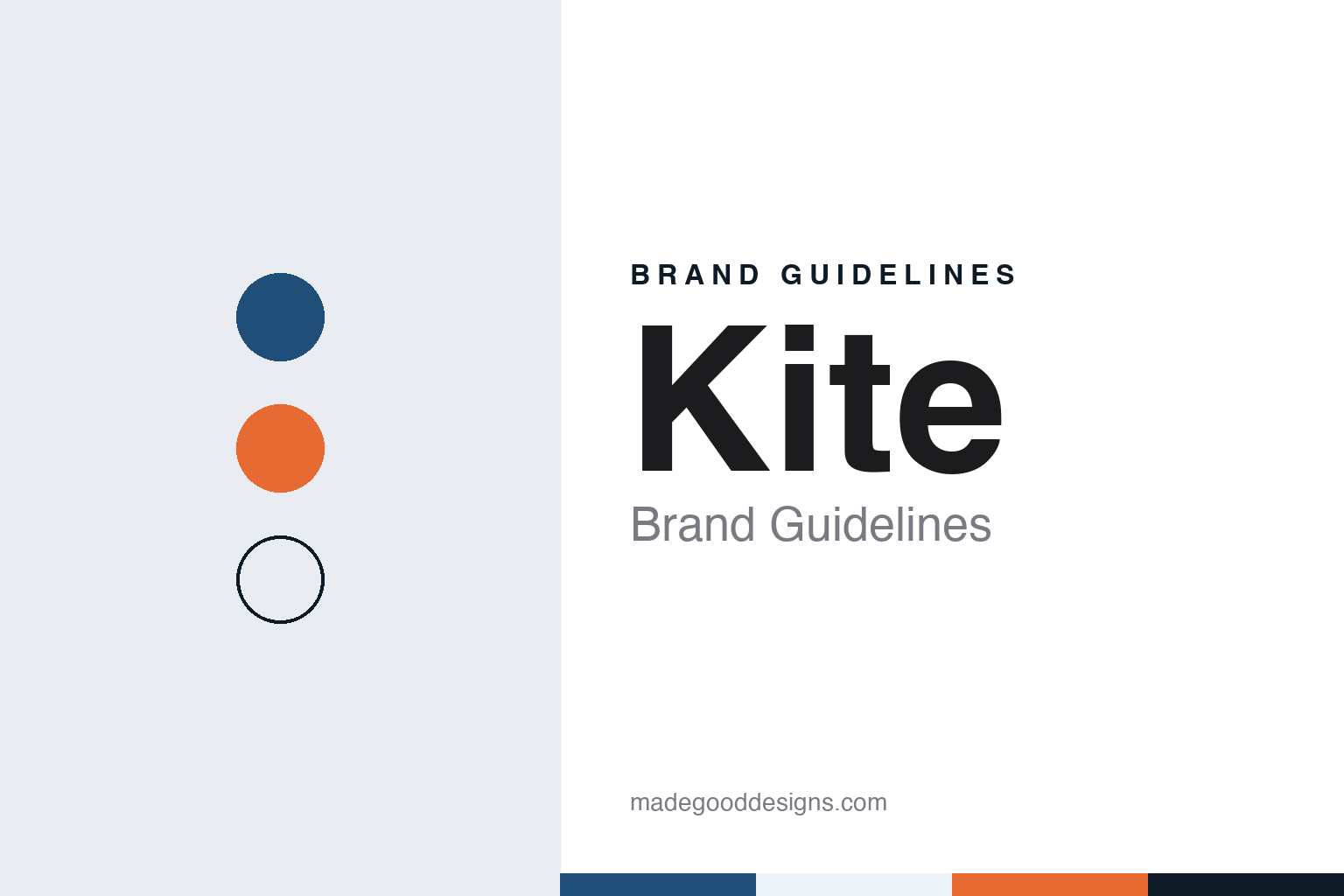
Kite Brand Guidelines
Santa Monica’s CAR T specialist, a Gilead company since 2017.
Aa
Two constants: a Pacific blue and kite-tail orange palette and an open geometric sans register. Abstract homage — not a Kite product or mark; no therapy, logo or pack is reproduced.
Santa Monica, 2009
A cell therapy start-up built on government science.
Kite was founded in 2009 and is based in Santa Monica, California. English Wikipedia, citing Life Science Leader (2020), names its founder as Arie Belldegrun, an Israeli-American oncologist who served as chairman, president and chief executive, with Joshua Kazam as co-founder and director. The company’s own short history calls it “a pioneer in cell therapy research” from the start, and describes a “singular focus” on cell therapy that it still uses as its headline.
The science behind Kite came largely from the public sector. In October 2012 Kite signed a Cooperative Research and Development Agreement with the US National Cancer Institute, Wikipedia says, and the company itself names that agreement as the moment its position was “solidified.” The National Cancer Institute’s own Cancer Currents blog explained in October 2017 that the therapy that became Kite’s first product was initially developed at the institute by Steven Rosenberg and colleagues in the Surgery Branch of its Center for Cancer Research, and was later licensed to Kite for further development and commercialisation.
Kite went public in June 2014, listing on the Nasdaq under the ticker KITE, according to Wikipedia. The following year it bought T-Cell Factory, a privately held biotechnology company in the Netherlands, and renamed it Kite Pharma EU, a move Wikipedia says gave it access to European manufacturing. Through 2015 and 2016 it signed a long run of research agreements, with Amgen, bluebird bio, the Netherlands Cancer Institute, Leiden University Medical Center and the University of California, Los Angeles among the partners Wikipedia lists. In 2016, the company says, its commercial manufacturing site in El Segundo, near Los Angeles International Airport, opened.
Its partnerships reached abroad before its first approval. In January 2017, Wikipedia records, Kite agreed to work with Daiichi Sankyo to develop and sell its lead therapy in Japan, and formed a joint venture with Fosun Pharma for China. The same year MIT Technology Review placed Kite seventh in its annual list of the 50 Smartest Companies, according to Wikipedia.
Colour
Engineered T cells, two named therapies.
Kite works on CAR T-cell therapy, in which a patient’s own white blood cells are collected, engineered to carry a chimeric antigen receptor, grown in number and then infused back into the same patient. The company sets out that process on its home page in five numbered steps, from collection to infusion, and calls each therapy “uniquely designed for each patient.” When Gilead announced the purchase in 2017 it described Kite as developing engineered cell therapies that use either a chimeric antigen receptor or an engineered T cell receptor, depending on the type of cancer.
Its first approved product is Yescarta (axicabtagene ciloleucel). The FDA announced its approval on 18 October 2017 for certain adults with large B-cell lymphomas whose cancer had progressed after at least two earlier treatment regimens, the National Cancer Institute reported on 25 October 2017, noting that it was the second CAR T-cell therapy the FDA had cleared, a month after the first. Wikipedia notes that the FDA had earlier given the candidate, then known as KTE-C19, Breakthrough Therapy Designation in December 2015, and that in the same month Kite and GE Global Research said they would work on an automated manufacturing system for engineered T-cell therapy. Kite names Tecartus (brexucabtagene autoleucel) as its second marketed therapy. Kite calls CAR T-cell therapy custom-made for each patient, and says its cell therapy manufacturing runs in El Segundo, California, Frederick, Maryland and, for Europe, Amsterdam, with a European office in Hoofddorp in the Netherlands.
On its website Kite presents patient stories titled by first name, a five-step process diagram and a newsroom whose headlines pair the names Gilead and Kite. The palette on this page is our own interpretation.
Typography
How cell and gene therapy companies present themselves.
Cell and gene therapy companies sell something that is hard to picture. A treatment may be a patient’s own cells, collected, changed in a laboratory and returned as a single dose, or a gene carried into the body by a modified virus. With no tablet or pack to show, these companies build their imagery from a small, shared set of motifs.
The most common is the abstract double helix, often drawn in light against a dark ground, followed closely by glowing cells, strands and particles rendered in soft blues, violets and teals. Where the science is shown more literally, the pictures move to the laboratory: gloved hands holding cryobags and vials, technicians in gowns, and clean manufacturing suites with stainless steel and bright, even light. Manufacturing matters to the story, because many of these treatments are made one patient at a time.
The other half of the visual language is human. Because most of these therapies are aimed at rare and inherited diseases, the companies lean on portraits of patients and their families, photographed at home or outdoors rather than in clinics, and on first-person stories told in their own words. Treatment centres, patient-support programmes and the steps of the “patient journey” often get as much space on a website as the science itself.
The field also has its own calendar. Companies present data and court investors and clinicians at meetings such as the annual meeting of the American Society of Gene & Cell Therapy (ASGCT), the American Society of Hematology (ASH) meeting in December, where blood-disorder therapies are discussed, and the Cell & Gene Meeting on the Mesa, an industry gathering. Names in the sector can change through spin-offs, sales and rebrands, so the identity a company shows at one meeting may not be the one it uses a few years later.
Aa
An open geometric sans for a company that explains its science in numbered steps. (Specimen set in Manrope, a sans STAND-IN; NOT the Kite logo.)
Kite
A Gilead company that keeps its own name.
On 28 August 2017 Gilead Sciences and Kite announced an agreement under which Gilead, based in Foster City, would buy Kite for cash; the release said the deal had been approved unanimously by both boards. Wikipedia dates completion to 3 October 2017, and Kite’s own history says it was acquired “in October 2017.” Weeks later Yescarta was approved, so Kite’s first product reached the market under Gilead ownership.
Kite did not disappear into its parent. The company says it has been an “independent operating company” within Gilead since 2019, and its releases sign off as “Kite, a Gilead Company,” while its website footer carries Gilead’s copyright. Its corporate headquarters remain in Santa Monica. Under Gilead it has kept adding to the business: Wikipedia records the purchase of Tmunity Therapeutics in February 2023, and on 28 April 2026 Gilead completed its acquisition of Arcellx, with Kite saying the investigational CAR T therapy anito-cel will advance within Kite alongside its global manufacturing, regulatory and commercial teams. Wikipedia also notes that after the sale Kite’s founders went on, in 2018, to start Allogene Therapeutics with CAR T assets from Pfizer.
For a design guide, Kite shows how a specialist unit can keep its own short name and voice inside a larger group, signing “a Gilead Company” rather than giving up its identity. Compare Gilead Sciences, its parent, and Legend Biotech, another CAR T developer. For this guide we use Pacific blue, night ink and a kite-tail orange with a sans, an unofficial interpretation; no product or logo is reproduced.
Explore & save
Keep Kite’s identity on hand — save it to a board in the Made Good inspiration library.
Kite identity set
Pin the Kite Pacific blue and kite-tail orange palette and the open geometric sans register to your own board.