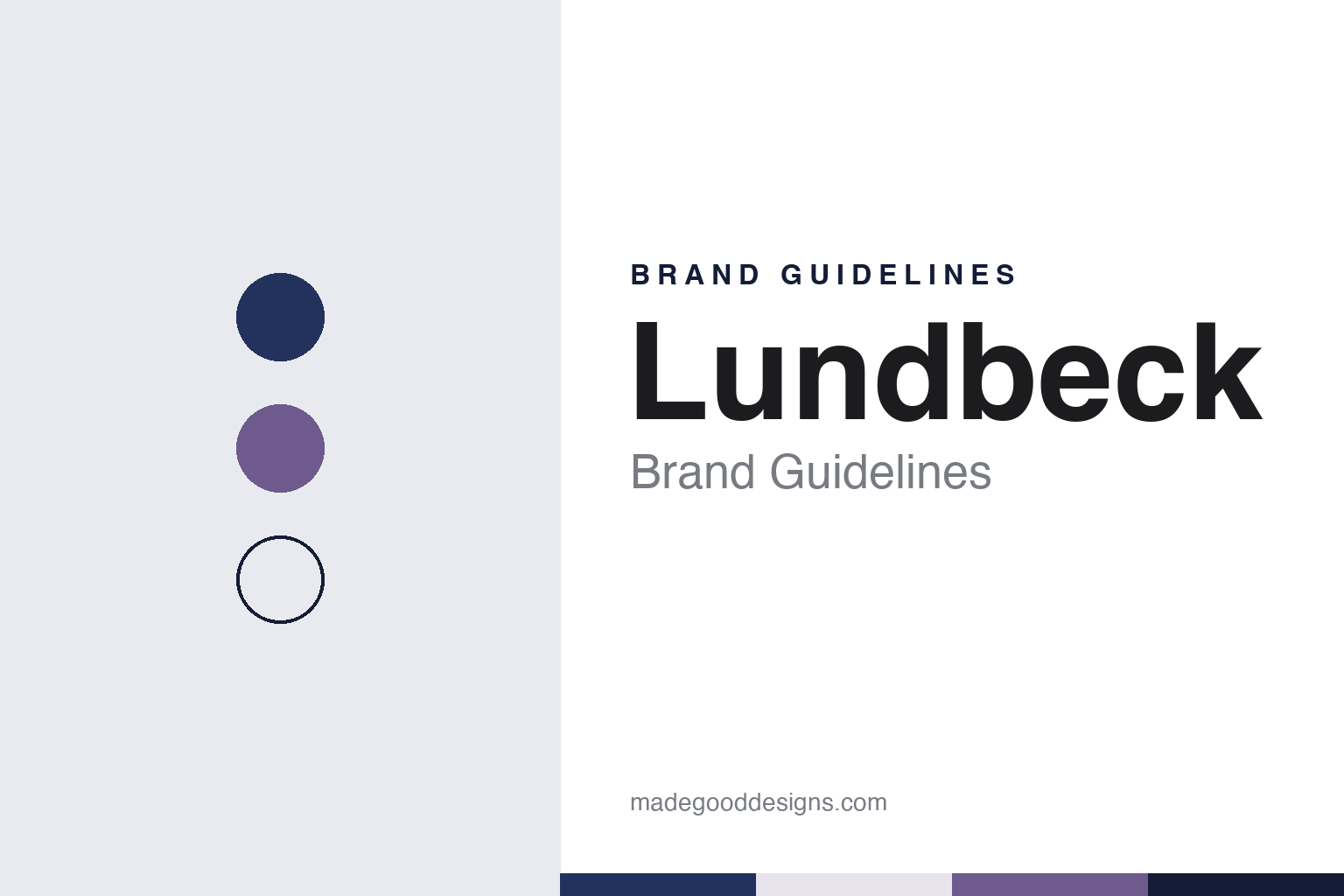
Lundbeck Brand Guidelines
A Copenhagen trading house that became a brain-disease specialist.
Aa
Two constants: a navy, violet and lilac palette and a clean humanist sans register. Abstract homage — not a Lundbeck product or mark; no pack, logo or nameplate is reproduced.
A trading house
Biscuits, cameras and foil before medicines.
Lundbeck began as a general trading company. The company says Hans Lundbeck founded it in Copenhagen on 14 August 1915, and that in its first years it dealt in “everything from machinery to biscuits”: confectionery, sweeteners, cinema equipment, cameras, photographic paper and aluminium foil, besides renting out vacuum cleaners. English Wikipedia gives the same founder and date and describes the early business as a trading house supplying the Danish market.
Medicines arrived in the mid-1920s. Danish Wikipedia and the company both credit Eduard Goldschmidt, hired in 1924, with bringing agency contracts for pharmaceuticals; the company adds that cologne and creams joined the range and that it bought its first tablet press. In the 1930s Lundbeck began producing and packing medicines itself in Denmark, the company says, and in 1937 it hired its first scientific employee, the pharmacist Oluf Hübner.
That year, the company says, it developed its first original product, a wound-healing preparation called Epicutan, together with the biological institute of the Carlsberg Foundation. In 1939 it moved to Valby, a district of Copenhagen, to gain manufacturing space; its headquarters are still there. Under Hübner it set up its first chemical research laboratory, and by then employed 45 people, according to its own history.
Denmark was under German occupation from April 1940 to May 1945. English Wikipedia says Lundbeck’s production continued through the Second World War but was limited by a shortage of raw materials. After the war, the company says, it stepped up its research; it became a stock company in 1950 and counted about 180 employees at the start of that decade.
Colour
From Truxal to citalopram.
The turn toward psychiatry came in the 1950s. In 1954 Lundbeck took a licence to sell a German psychiatric product, the company says, and in 1959 it launched Truxal, which it describes as one of the first antipsychotics; English Wikipedia dates Truxal to 1957, so the two sources differ. To make more active ingredients, Lundbeck bought a former dairy at Lumsås in north-west Zealand in 1961, and in the early 1960s it launched the antidepressant Saroten.
The company grew abroad through the 1960s and 1970s, opening offices in New York and Paris and, in 1972, a British company at Luton. At the end of the 1970s it decided to phase out its old agencies and its cosmetics department, and through the 1980s it narrowed its work to medicines for the central nervous system, the company says. English Wikipedia describes the same shift, from a broad agency business to a company devoted to brain disorders.
The product that took Lundbeck international was citalopram, an antidepressant launched in 1989, according to English Wikipedia, and sold in Europe as Cipramil and in the United States as Celexa through the American firm Forest Laboratories, Danish Wikipedia says. Its successor, escitalopram, was launched in 2002 as Cipralex and Lexapro, the company says. Vortioxetine followed in 2014 under the names Brintellix and Trintellix, according to Danish Wikipedia.
Citalopram also brought Lundbeck its best-documented legal case. On 19 June 2013 the European Commission fined Lundbeck and several generic manufacturers over agreements made in 2002 to delay the market entry of generic citalopram, which the Commission found broke EU competition rules. The EU’s General Court dismissed the companies’ appeals in September 2016, and on 25 March 2021 the Court of Justice dismissed the further appeals, upholding the decision, according to the court’s press release.
Typography
How the sector presents itself.
Europe’s mid-sized drug makers tend to present themselves through their origins. Many began as a single pharmacist, doctor or industrialist with a laboratory, and their corporate histories still open with a founder, a town and a first product. Family holding companies and foundations often remain in the background as long-term shareholders, and the companies’ own timelines give as much space to new factories and research centres as to the medicines that came out of them.
The visual language that follows is restrained. Corporate sites and annual reports favour photographs of scientists at the bench, production lines seen through glass, and patients in ordinary settings — at home, at work, outdoors — rather than in hospital. Long-serving research campuses, some in use for half a century or more, appear again and again as proof of continuity, alongside newer laboratories in biotech districts abroad.
Identity systems are usually simple: a short word mark or set of initials, a single deep blue or green as the lead colour, and a clean sans for running text. Because prescription medicines cannot be advertised to the general public in the European Union, much of the visible branding lives at medical congresses rather than in shop windows: the dermatology meeting of the EADV, the multiple sclerosis congress of ECTRIMS and the reproductive-medicine meeting of ESHRE are among the places where these companies set up stands, posters and symposia for specialists.
This guide sets out what can be checked about each company — who founded it, who owns it, where it makes and researches its medicines, and how its history is told — and marks plainly what rests only on the company’s own word. The palettes and typefaces shown here are our own interpretations, not official brand assets.
Aa
A clean humanist sans, in keeping with a corporate science register. (Specimen set in Plus Jakarta Sans, a sans STAND-IN; NOT the Lundbeck logo.)
Lundbeck
A company owned by a foundation.
Lundbeck’s ownership sets it apart from most listed drug makers. The Lundbeck Foundation was established in 1954 by Grete Lundbeck, the company and Danish Wikipedia say, to secure and expand the business and to support scientific research; Danish Wikipedia says it made its first research grants in 1962. Lundbeck’s shares were listed on the Copenhagen stock exchange in June 1999, and the foundation still holds about 70% of them, with the rest traded, according to the company. Danish Wikipedia adds that the foundation also holds controlling stakes in the allergy company ALK and the rescue and safety group Falck.
Today the company calls itself a global pharmaceutical company specialised in brain diseases, using the phrase “Progress in Mind.” It says it has about 5,300 employees, production in Denmark, France and Italy, research centres in Denmark, Asia and the United States, and products registered in more than 80 countries. Its headquarters in Valby combine research and production, the company says.
Acquisitions widened its reach. Danish Wikipedia says Lundbeck bought the Chicago-based Ovation Pharmaceuticals in February 2009, which became Lundbeck Inc.; English Wikipedia lists later purchases including Chelsea Therapeutics in 2014, Prexton Therapeutics in 2018 and Alder BioPharmaceuticals in 2019, and says Lundbeck agreed in October 2024 to buy the American epilepsy-drug developer Longboard Pharmaceuticals, a name Lundbeck now lists among its own sites. In 2012 it sold a portfolio of older products to Recordati, English Wikipedia says. Charl van Zyl, previously at UCB, has been president and chief executive since September 2023.
For a design guide, Lundbeck shows how a century-old Danish trading name can be narrowed to one field and carried by a single surname. Compare Novo Nordisk, another Danish drug maker, and UCB, the Belgian group where Lundbeck’s chief executive previously worked. For this guide we use a deep navy, a muted violet and a pale lilac with a sans, an unofficial interpretation; no product or logo is reproduced.
Explore & save
Keep Lundbeck’s identity on hand — save it to a board in the Made Good inspiration library.
Lundbeck identity set
Pin the Lundbeck navy, violet and lilac palette and the clean humanist sans register to your own board.