UCB Brand Guidelines
Union Chimique Belge, Brussels 1928, and the turn to biopharma.
Aa
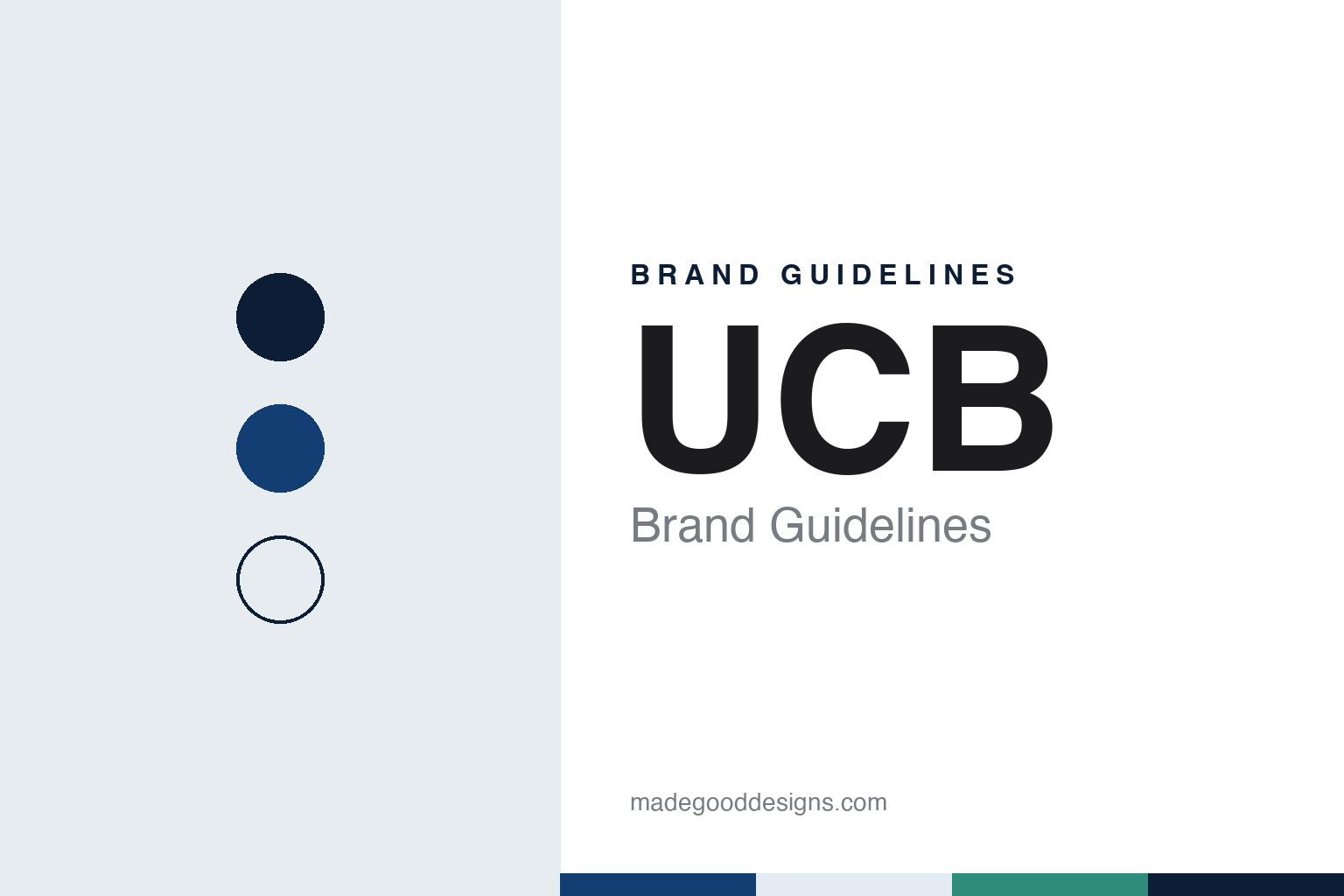
Two constants: a UCB blue, teal and frost palette and a geometric sans register. Abstract homage — not a UCB product or mark; no pack, logo or medicine is reproduced.
Union Chimique Belge
Industrialists, a notary and a synthetic-ammonia plant.
UCB stands for Union Chimique Belge, and it was founded in Brussels on 18 January 1928, English Wikipedia says. The company names Emmanuel Janssen, a Belgian industrialist, as its founder. Its commissioned history, UCB: The First Ninety Years, 1928–2018 by the historian Kenneth Bertrams, published by Lannoo in 2018, opens with a winter meeting at a Brussels notary’s office, where representatives of the country’s big business groups, including the Société Générale de Belgique and the Banque de Bruxelles, came together to form the new company.
It began as an industrial chemicals group. Bertrams describes the synthetic-ammonia plant at Zandvoorde, near Ostend, built in 1925 by the coke-oven firm Semet-Solvay, as “in full swing” when U.C.B. was formed; English Wikipedia adds that the company also included a small pharmaceutical division built around the Meurice laboratories. The company says it entered the American market in the 1930s.
The war years are told plainly in the company history. Results slowed after September 1939, and after the German invasion of May 1940 some staff fled to France before the whole team was back in Brussels by the end of July. Emmanuel Janssen chaired the board through the occupation. Bertrams writes that UCB, like much of Belgian industry, kept production at a moderate level under the so-called “Galopin Doctrine,” meant to prevent the dismantling of industry and the transfer of workers to Germany; in June 1942 the founder’s son was fined for opposing an order to hand over a list of staff, but the occupying authorities still deported several dozen UCB workers to Germany. The plants came through the war without heavy bomb damage, the book says.
Colour
Atarax, Nootropil and a campus at Braine-l’Alleud.
Dutch Wikipedia says the pharmaceutical division grew strongly after the Second World War, helped in part by war-damage payments, and gained a research department. Bertrams dates the first two discoveries to the 1950s: Postafene in 1953 and Atarax, the hydroxyzine product, in 1954, for which UCB chose Pfizer as a partner to sell it worldwide. In the 1970s came Nootropil, the piracetam product that English Wikipedia describes as one of UCB’s key products.
For decades UCB was three businesses in one: chemicals, packaging film and pharmaceuticals, with the film side making Cellophane-type and polypropylene films and, from 1973, owning the British film maker Sidac. A new laboratory at Braine-l’Alleud, south of Brussels, was completed at the start of the 1970s, according to Bertrams, and Dutch Wikipedia describes the site today as a modern research and production unit. Two medicines then carried the company abroad. The company says it registered a new antihistamine in the 1980s — Zyrtec, the cetirizine product — and launched an antiepileptic, Keppra, in the 1990s. Its head office moved with it: after about fifty years in the Wiltcher’s building, UCB went to the Blue Tower in central Brussels in 1981 and to a new site in Anderlecht in 1999, the history says.
Every three years the company also presents the UCB Award, under the patronage of the Queen Elisabeth Medical Foundation, to support neuroscience research, with the winner chosen by an independent scientific committee, English Wikipedia says.
Typography
How mid-sized drug makers present themselves.
Europe’s mid-sized drug makers tend to present themselves through their origins. Many began as a single pharmacist, doctor or industrialist with a laboratory, and their corporate histories still open with a founder, a town and a first product. Family holding companies and foundations often remain in the background as long-term shareholders, and the companies’ own timelines give as much space to new factories and research centres as to the medicines that came out of them.
The visual language that follows is restrained. Corporate sites and annual reports favour photographs of scientists at the bench, production lines seen through glass, and patients in ordinary settings — at home, at work, outdoors — rather than in hospital. Long-serving research campuses, some in use for half a century or more, appear again and again as proof of continuity, alongside newer laboratories in biotech districts abroad.
Identity systems are usually simple: a short word mark or set of initials, a single deep blue or green as the lead colour, and a clean sans for running text. Because prescription medicines cannot be advertised to the general public in the European Union, much of the visible branding lives at medical congresses rather than in shop windows: the dermatology meeting of the EADV, the multiple sclerosis congress of ECTRIMS and the reproductive-medicine meeting of ESHRE are among the places where these companies set up stands, posters and symposia for specialists.
This guide sets out what can be checked about each company — who founded it, who owns it, where it makes and researches its medicines, and how its history is told — and marks plainly what rests only on the company’s own word. The palettes and typefaces shown here are our own interpretations, not official brand assets.
Aa
A geometric sans for a company named by its initials. (Specimen set in Manrope, a sans STAND-IN; NOT the UCB logo.)
UCB
From chemicals and film to biopharma.
The turn came in the early 2000s. At the end of 2002 UCB merged its chemicals and film divisions and added resins, additives and adhesives bought from Solutia; the film business went to Innovia Films in September 2004, and the surface specialties division to Cytec Industries in March 2005, English Wikipedia says. In May 2004 UCB bought the British biotechnology company Celltech, which Dutch Wikipedia calls the first large acquisition in its 76-year history and which brought the antibody Cimzia. In 2006 it bought the German drug maker Schwarz Pharma, adding Neupro and Vimpat. Later deals included Ra Pharma, completed in April 2020, and Zogenix, completed in March 2022; in 2024 UCB sold its mature neurology and allergy business in mainland China, with its Zhuhai plant, to CBC Group and Mubadala, Dutch Wikipedia says.
The record includes legal findings. English Wikipedia, citing The New York Times and ICIS, says the European Commission fined UCB in 2004 for its part in a choline chloride cartel. In June 2011, the Associated Press reported, UCB’s American subsidiary pleaded guilty in federal court in Washington to a misdemeanour over the promotion of Keppra for migraine, a use not on its approved label, and settled related civil claims.
Today UCB describes itself as a biopharma company headquartered in Brussels, with more than 10,000 employees, focused on neurology and immunology, including epilepsy, myasthenia gravis and psoriasis. Its shares trade on Euronext Brussels, and Dutch Wikipedia says the largest shareholder, with about 36%, is Financière de Tubize, in which the Janssen family is the reference shareholder. In 2022 UCB opened a gene-therapy research centre in Leuven.
For a design guide, UCB shows how a company can keep its initials while changing nearly everything behind them. Compare Lundbeck, the Danish drug maker focused on brain diseases, and Ipsen, a French drug maker founded a year later. For this guide we use a deep blue, a teal and a pale frost with a sans, an unofficial interpretation; no product or logo is reproduced.
Explore & save
Keep UCB’s identity on hand — save it to a board in the Made Good inspiration library.
UCB identity set
Pin the UCB blue, teal and frost palette and the geometric sans register to your own board.