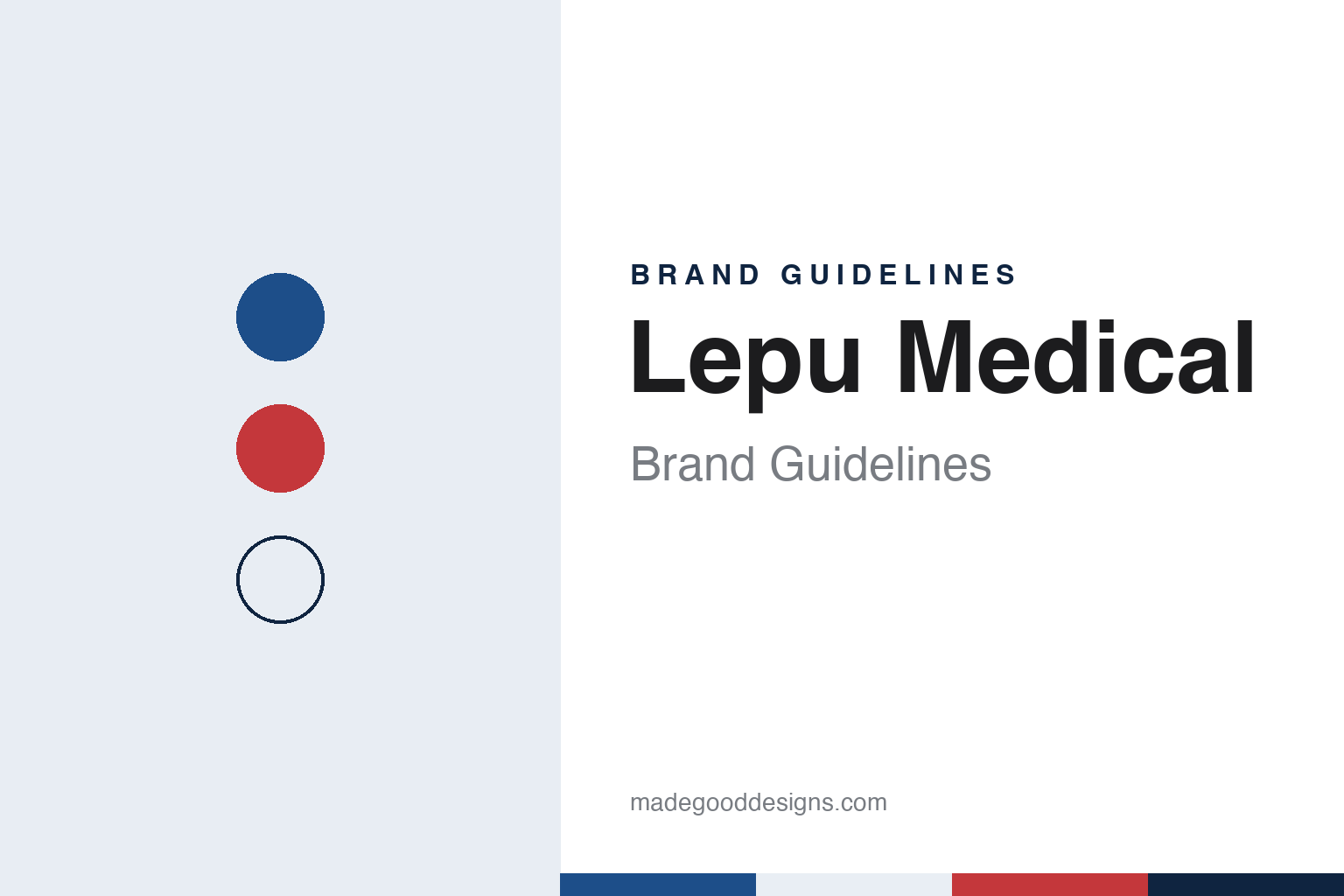
Lepu Medical Brand Guidelines
The Beijing stent maker that grew into a broad cardiovascular group.
Aa
Two constants: a blue, red and pale grey palette and a technical sans register. Abstract homage — not a Lepu Medical product or mark; no device, logo or pack is reproduced.
A Beijing start
A research institute, a partner and a coronary stent.
Lepu Medical was established in Beijing in 1999. The company calls itself one of China’s earliest enterprises engaged in the research and development of interventional cardiology devices, and the SIX Swiss Exchange, in a release of September 2022, also gives 1999 as its founding year. Its full name today is Lepu Medical Technology (Beijing) Co., Ltd., and the exchange described it as specialised in the development, manufacture and marketing of high-tech medical devices and equipment. Chinese Wikipedia calls it a Chinese medical device company and one of the country’s platform companies for medicines used in managing cardiovascular disease.
Chinese Wikipedia adds detail on the start. It says the company was set up in June 1999 in Beijing’s Changping district as a joint investment by the 725th Research Institute of China Shipbuilding Industry Corporation and an American company, WP Medical Technologies, and that its first business was devices for coronary intervention. It says the company took its present name in 2008.
The company’s own timeline marks the early products. It lists the H-Stent in 2000, which it calls the first coronary stent made in China, and the Partner stent in 2005, which it describes as the first drug-eluting stent made in China and says received a CE certificate. In 2007, the company says, it secured an investment from the American private-equity firm Warburg Pincus, and in 2008 it began developing in vitro diagnostic products.
The listing followed in 2009. Lepu Medical says its shares were listed that year on the Growth Enterprise Market of the Shenzhen Stock Exchange, under the stock code 300003; Chinese Wikipedia dates the first day of trading to 30 October 2009.
Colour
From stents to a wider cardiovascular range.
After the listing, Lepu Medical widened its range year by year, according to its timeline. It lists the NANO stent in 2011, which it calls a carrier-free drug-eluting stent; the GuReater stent in 2012, made of cobalt-chromium; and, in the same year, a mechanical heart valve, which it describes as an Asian first, together with a move into pharmaceuticals. Chinese Wikipedia says that from 2013 the company made a large number of acquisitions and moved further into medicines.
The company then added product families outside the catheter lab. Its timeline lists anaesthesia, critical care and surgical products from 2015, haemodialysis from 2016 and patient monitoring and ECG equipment from 2017. In 2019, the company says, it introduced the NeoVas stent, which it calls the first bioabsorbable stent made in China; in 2021 its MemoSorb biodegradable occluder; and in 2023 a MemoSorb occluder for patent foramen ovale, which it says received approval from China’s NMPA. The same timeline notes a move into endoscopy and the acquisition of an overseas factory in 2023.
The SIX Swiss Exchange release of September 2022 summed up the range as products for cardiovascular interventions, structural heart disease, cardiac rhythm management, anaesthesia and critical care, in vitro diagnostics and general surgery. Today the company’s website groups its catalogue into cardiovascular and peripheral products — coronary stents, coronary balloons including an intravascular lithotripsy balloon, catheters and guide wires — and further families for structural heart, pacemakers and leads, haemodialysis, orthopaedics, patient monitoring and angiography systems, alongside a pharmaceutical business.
The company also gives figures for its approvals, all as its own claims: 609 certificates from China’s NMPA for medical devices, CE certificates for 214 products and 34 approvals from the US FDA.
Typography
Design and documentation.
Cardiovascular device makers sell to a narrow audience: interventional cardiologists, electrophysiologists, cardiac surgeons, hospital buyers and regulators. Their visual language follows from that. A heart valve, a stent or a pacemaker is small, precise and usually hidden inside the body once it is in use, so the product photograph does much of the work. Valves, stents and leads tend to be shot in close-up on white or pale grey, lit to show struts, mesh and metal edges, with the device itself as the only subject.
The second register is the catheterisation laboratory. Brochures, websites and congress stands return again and again to the same scene: a patient table, a C-arm X-ray system arched over it, banks of monitors showing angiograms or mapping images, and clinicians in scrubs, lead aprons and caps. These pictures place the device in the room where it is used, without showing the patient’s body in detail.
Between the two sits illustration. Cutaway hearts, cross-sections of arteries and simplified diagrams of the conduction system explain where a valve sits, how a stent opens or how a lead reaches the heart. They are often rendered in reds and soft pinks against white, with the brand’s own colour kept for the device, the arrows and the type. Much of the copy is technical, built around product names, trial names and regulatory approvals as the companies state them.
Much of the category’s public life happens at medical congresses. TCT in the United States, EuroPCR in Paris and the ESC Congress of the European Society of Cardiology bring makers, clinicians and trade press together each year, and companies use them to show new devices and announce study results. The makers in this guide range from family-owned German engineering firms to Chinese groups with several listed subsidiaries, and their identities reflect that range more than any shared house style.
Aa
A technical sans for a technical catalogue. (Specimen set in IBM Plex Sans, a sans STAND-IN; NOT the Lepu Medical logo.)
Lepu Medical
Shenzhen, Zurich and Hong Kong.
Lepu Medical remains a listed company. On 21 September 2022 it listed global depositary receipts on the SIX Swiss Exchange in Zurich under the ticker LEPU, the exchange announced, becoming the fifth company to do so since the launch of the China–Switzerland Stock Connect scheme in July that year; each receipt represents an interest in five of its Shenzhen-listed A shares. In the exchange’s release, Pu Zhongjie, chairman of the board and head of technology, called it “the start of a new and exciting chapter” for the company. At that time, the exchange said, its products were sold in more than 80 countries. The company’s profile lists the Swiss receipts alongside its Shenzhen stock code, 300003.
The group has listed parts of itself separately. Lepu Medical says two subsidiaries, the drug developer Lepu Biopharma and Lepu ScienTech, were both listed on the Hong Kong stock exchange in 2022. The company now says its products reach more than 160 countries and regions, that it holds local registrations in more than 60 countries and that it works with more than 100 OEM partners. It also says it has offices in the United States and the Netherlands.
Its own site describes a growing network abroad. It names Lepu Germany, founded in Frankfurt, with local warehouses for faster delivery; an office in the Netherlands that serves as its EU authorised representative; sales subsidiaries in Brazil, India and Indonesia; and a subsidiary in Malaysia with what it calls an independent manufacturing facility, where it says it plans to make haemodialysis, surgical and in vitro diagnostic products in future.
For a design guide, Lepu Medical shows how a Chinese stent maker grew into a broad cardiovascular group under one name. Compare MicroPort, another Chinese cardiovascular group, and Biosensors, a stent maker based in Singapore. For this guide we use a deep blue, a signal red and a pale grey with a sans, an unofficial interpretation; no product or logo is reproduced.
Explore & save
Keep Lepu Medical’s identity on hand — save it to a board in the Made Good inspiration library.
Lepu Medical identity set
Pin the Lepu Medical blue, red and pale grey palette and the technical sans register to your own board.