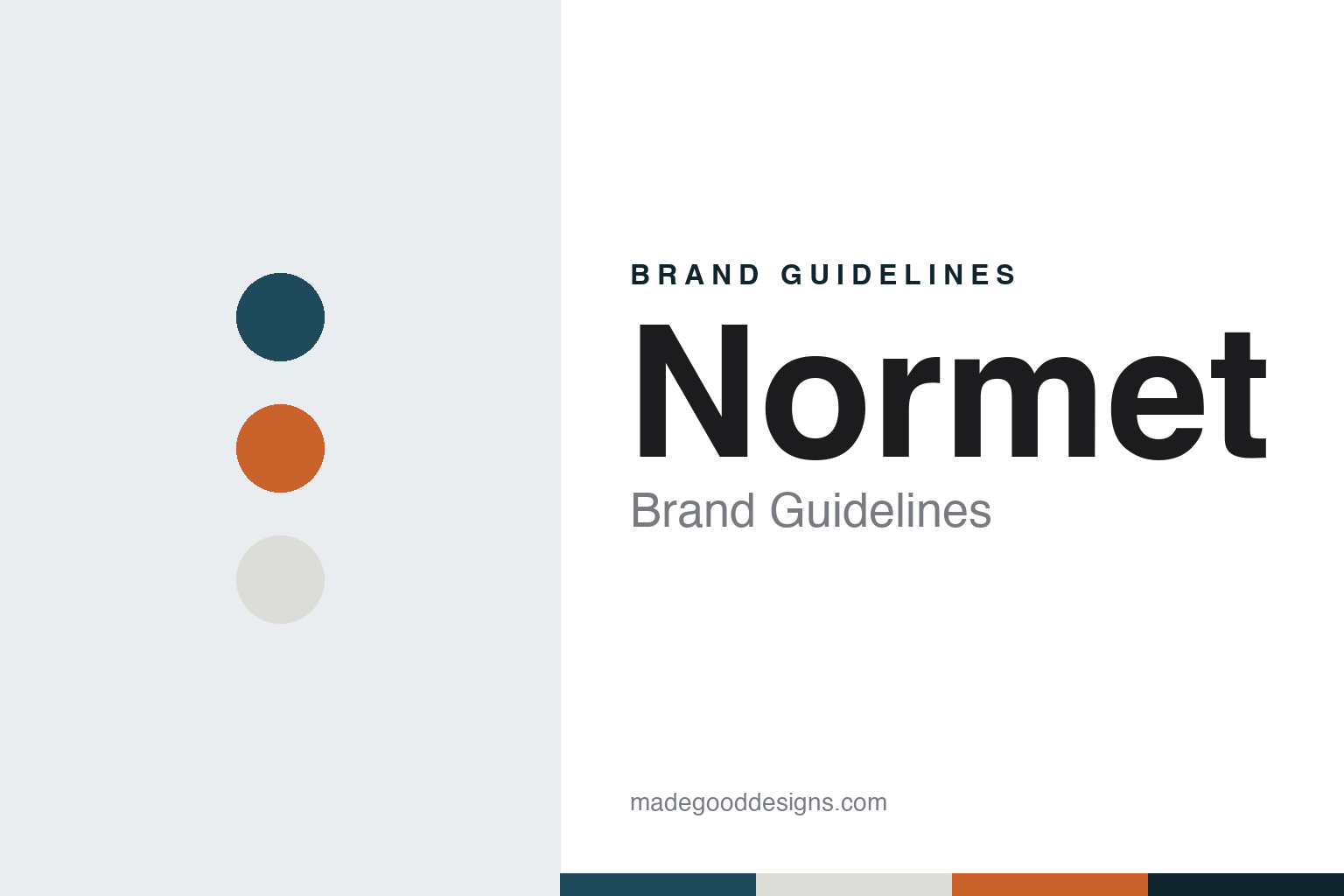
Normet Brand Guidelines
A 1962 farm workshop that turned to mining machines in Iisalmi.
Aa
Two constants: a lake blue, concrete grey and orange palette and a condensed sans register. Abstract homage — not a Normet product or mark; no machine, logo or nameplate is reproduced.
Peltosalmen Konepaja
Two brothers and an old barn.
Normet began on a farm. In 1962 the brothers Jaakko and Jussi Sarvela, a farmer and an agronomist, set up a machine workshop on their farm after giving up livestock, Finnish Wikipedia says. The business, first called Peltosalmen Konepaja, the Peltosalmi machine workshop, has its roots in Iisalmi in Northern Savo, Yrittäjät, the news site of Finland’s entrepreneurs’ federation, reported in October 2026.
Work started in the farm’s old barn with two employees, making earthmoving attachments for tractors. Within three years the workforce had passed fifty, the range had shifted mainly to forestry machines and exports had begun, Finnish Wikipedia says. One of its products was a tractor loader, which the same article says won an award at an international patent fair in New York and took more than half of the Finnish loader market; the workshop also built a skidding winch and Finland’s first three-axle forestry tractor. The Sarvela brothers received a national entrepreneur award in 1969.
In 1972 the Sarvelas sold the company, then employing 180 people, to the pharmaceutical group Orion. Finnish Wikipedia explains the deal by Orion’s fear that the state might socialise medicine manufacturing: a machine workshop would leave it at least one business if that happened. With the sale the name became Normet Oy, and the company began exporting mining machines to Sweden; in its early years it developed products with the mining company Outokumpu. Yrittäjät dates the move into mining machines to 1970, under Orion’s ownership. In early 1999 Orion sold Normet to Fenno Management, a fund manager linked to the Finnish innovation fund Sitra, together with the company’s management, Finnish Wikipedia says; about 310 people worked there.
Colour
The Cantell years.
In March 2005 all of Normet’s shares were sold to a new company, Normet Group. Finnish Wikipedia gives its owners at the time as Cantell Oy, the company of the board professional and investor Aaro Cantell, with 70 per cent, and Anssi Soila and Normet’s management with the rest. Cantell is still the main owner and chairman of the board, Yle reported in February 2026, and Yrittäjät named Cantell Oy as main owner and Edoardo Santamaria as chief executive in October 2026. English Wikipedia says Santamaria succeeded Robin Lindahl in 2019.
Growth came partly through acquisitions. Normet took 40 per cent of the construction-chemicals company TAM International in 2010 and full ownership of the TAM group in 2012; in 2011 it bought Essverk Berg of Ludvika, in Sweden, which made and serviced mining and tunnelling equipment. By 2008 Normet had 17 offices in nine countries, and in 2012 new subsidiaries opened in Mexico, Norway and South Africa, Finnish Wikipedia says. In 2016 it bought Atlas Copco’s dry concrete-spraying business, including the MEYCO Piccola and MEYCO GM products, Finnish Wikipedia says. In 2022 it added Garock of Australia, a maker of ground-support systems, and Aliva Equipment, which makes sprayed-concrete equipment; in 2023 it bought the Finnish boom-system maker Rambooms, the attachments supplier Marakon and the industrial-internet firm Remion, English Wikipedia says.
The company says its equipment is used for concrete spraying and transport, explosives charging, scaling, lifting and installation, and underground logistics, and that its Charmec vehicles handle explosives charging with emulsion or ANFO. It also supplies construction chemicals, concrete admixtures and rock reinforcement. Its battery-electric platform, Normet SmartDrive, has been on the market since 2019, the company says; English Wikipedia says the first SmartDrive vehicle to reach the market was a concrete-spraying machine.
Typography
How the trade presents itself.
Mining equipment makers sell machines that most people never see at work. Their customers are mine operators, tunnelling contractors and quarry owners, and the machines spend their working lives underground or at the far end of an open pit. So the trade’s imagery tends to bring the site to the viewer: a drill rig in a floodlit tunnel, its booms reaching towards a rock face; a loader or haul truck in yellow or orange, picked out against grey stone; the beam of a headlamp in the dark.
Above ground, the favoured view is from high up. Photographs of open-pit mines show stepped benches cut into the earth, with trucks and drill rigs reduced to small bright shapes on the terraces. Underground pictures work the other way, close and cramped, with the machine filling the frame and the rock wall just beyond it.
Much of the rest of the visual language comes from proving that the machines work. Makers show equipment in test mines and at customer sites, and show it to the trade at fairs such as MINExpo International, which is organised by the US National Mining Association and describes itself as the industry’s largest global mining event; its next edition is scheduled for September 2028. Stands at such fairs put full-size rigs and loaders on display, often alongside screens showing the same machines below ground.
Behind the pictures sit very different companies. Some are divisions or spin-offs of large listed engineering groups; others are family firms or privately owned specialists built around one process, such as spraying concrete or charging explosives. This guide sets out what can be checked about each brand — who founded it, who owns it and where it says its machines are made — and marks clearly what rests only on the company’s own word.
Aa
A condensed sans for an underground workhorse. (Specimen set in Barlow Condensed, a sans STAND-IN; NOT the Normet logo.)
Normet
Still assembled in Iisalmi.
Iisalmi remains the centre of the business. Yle reported on 6 February 2026 that Normet is the town’s largest private employer, with about 480 people there, some 250 of them in production, and that more than 95 per cent of the machines it makes are exported; besides Iisalmi, the company has factories in Chile and India. The Iisalmi plant has some 15,000 square metres of hall space and was running two shifts, with plans to move part of the workforce to three, Yle said. English Wikipedia says heavy mining equipment was being built in Iisalmi and in Santiago de Chile by 2010, and that a technology and production hub opened in Jaipur, India, in 2022. Product development and the most technically complex equipment are concentrated in Northern Savo, Yrittäjät reported.
The company describes itself as headquartered in Finland with more than 1,800 employees in over 50 locations across 30 countries; Yrittäjät gave a figure of more than 2,000 worldwide in October 2026. Recognition has followed at intervals. English Wikipedia says Normet Group received the President of the Republic’s Internationalisation Award in 2011, and Yrittäjät reported that in October 2026 Normet was one of three companies to receive Finland’s national entrepreneur award, presented at a gala in Lahti — 57 years after the Sarvela brothers received the same kind of honour.
For a design guide, Normet shows how a farm workshop’s name gave way to a corporate one built around specialist underground processes such as concrete spraying and explosives charging. Compare Metso, another Finnish name in mining equipment, and Atlas Copco, which sold Normet its dry concrete-spraying business in 2016. For this guide we use a lake blue, a concrete grey and an orange with a condensed sans, an unofficial interpretation; no product or logo is reproduced.
Explore & save
Keep Normet’s identity on hand — save it to a board in the Made Good inspiration library.
Normet identity set
Pin the Normet lake blue, concrete grey and orange palette and the condensed sans register to your own board.