Recipharm Brand Guidelines
A Pharmacia plant buyout that moved to Baar.
Aa
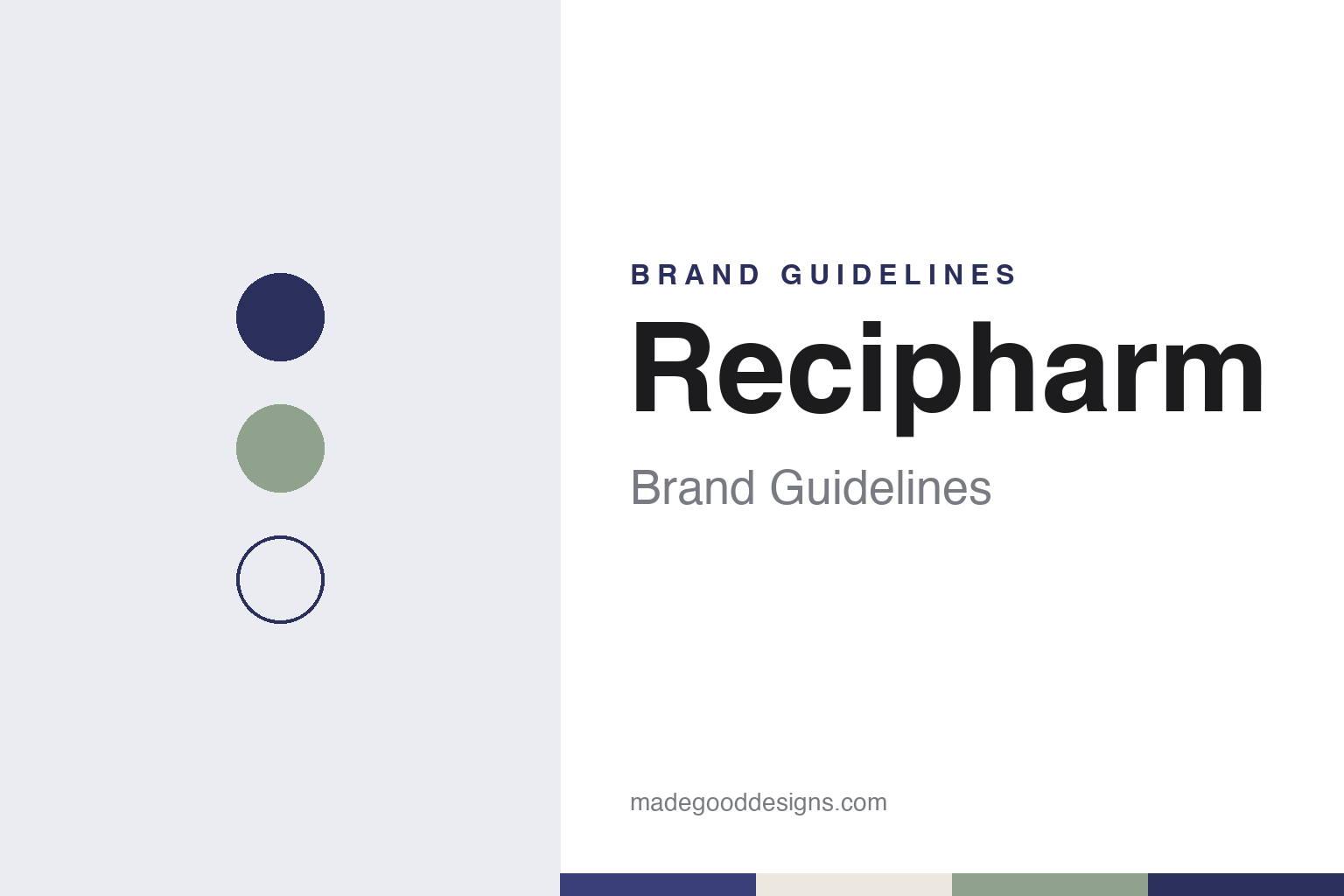
Two constants: a Recipharm indigo, sage and stone palette and a geometric sans register. Abstract homage — not a Recipharm product or mark; no tablet, pack or logo is reproduced.
Recip
A buyout of a Pharmacia tablet plant.
Recipharm began with a factory that was due to close. In March 1995, English Wikipedia says, Thomas Eldered and Lars Backsell led a management buyout of a Pharmacia plant making solid-dose tablets in Årsta, in southern Stockholm, and formed a company called Recip. Swedish Wikipedia gives the background: Pharmacia had decided to move its tablet production to Italy, Eldered was the plant’s manager and Backsell headed Pharmacia’s self-care division, and Apoteksbolaget, the Swedish pharmacy chain, was the new company’s main customer.
Recip went on making products for Pharmacia during a transition period while developing medicines of its own, and began taking contract work from other drug companies. English Wikipedia says that in 1997 Recip was believed to be the first pharmaceutical company in the world to certify its entire operations to the ISO 14001 environmental management standard. From 1998 it bought further plants in Sweden, three of them between 1998 and 2004, according to Swedish Wikipedia.
The name Recipharm was created in 2001 for the growing contract-manufacturing side. In 2007 the company sold the Recip business and its own product portfolio to Meda and concentrated on contract manufacturing, taking the Recipharm name for the whole company, according to the English and Swedish Wikipedias. The same year it bought its first plant outside Sweden, at Monts in France, Swedish Wikipedia says, followed by purchases in the United Kingdom, France, Switzerland and Spain; several of those plants had been threatened with closure.
Colour
Listing, acquisitions and EQT.
Recipharm grew through acquisitions. It listed on Nasdaq Stockholm in 2014, English Wikipedia says, and used further purchases in Europe, the United States and India to widen its services and enter new markets. In 2020 it took over the British company Consort Medical, its largest acquisition to that date, which added around 2,000 employees, ten European facilities and drug-delivery device work. In November 2020, Swedish Wikipedia says, Recipharm agreed with Moderna to manufacture its covid-19 vaccine for markets outside the United States at one of its French plants.
Then the founders took the company private with a partner. On 14 December 2020 the private equity fund EQT IX, through a company called Roar BidCo, announced a public offer for Recipharm’s shares and convertible bonds, which it raised on 28 January 2021. By 1 March 2021 Roar BidCo held about 96 per cent of the share capital and had started the compulsory acquisition of the rest, with 5 March 2021 as the last day of trading on Nasdaq Stockholm, according to its press release of that date. The release says Lars Backsell and Thomas Eldered took part in the offer alongside EQT IX.
Mark Funk became chief executive in March 2021, with Eldered staying on the board, English Wikipedia says. Under its new ownership Recipharm moved further into biologics: in 2022 it bought the CDMOs Arranta Bio and Vibalogics, among others, to build up biologics and virus manufacturing, and its advanced-therapies business now trades as ReciBioPharm. Greg Behar became chief executive in January 2024, with Funk remaining on the board.
The company says it makes solids, semi-solids and liquids, offers sterile vial filling, prefilled syringes and cartridges, lyophilisation, blow-fill-seal and ampoules, and works on xRNA, viral vectors and microbial products in its biologics arm.
Typography
Contract manufacturing for medicines.
Contract development and manufacturing organisations, or CDMOs, make medicines for other companies. A drug developer may hand them a cell line, a molecule or a finished formula, and the partner develops the process, makes the drug substance, fills it into vials, syringes or capsules and packs it for trials or for sale. Most of that work happens out of public view, under the customer’s name rather than the maker’s, so the manufacturer’s own brand speaks mainly to other businesses.
The imagery of the trade is fairly consistent. Websites and brochures tend to show tall stainless-steel bioreactors and rows of single-use bags in bright, white production suites; operators in full gowns, hoods and gloves working in cleanrooms; and filling lines carrying glass vials. Aerial photographs of large new plants, often shown under construction or on opening day, stand in for scale, and site maps of a global network do the same job for reach.
Much of the brand work happens at trade events. CPHI, the pharmaceutical trade fair, and the BIO International Convention in the United States are where these companies take stands, announce deals and, at times, unveil new identities: Pharma Manufacturing reported that Catalent introduced its new corporate brand at CPHI Frankfurt in 2025.
This guide sets out what can be checked about each company — where it began, who owns it now, which sites and services it describes, and what has been reported about it — and separates documented facts from what the companies say about themselves. The colours and typefaces used here are our own interpretation, not official brand assets.
Aa
A rounded geometric sans. (Specimen set in Manrope, a sans STAND-IN; NOT the Recipharm logo.)
Recipharm
A narrower focus and a Swiss headquarters.
In 2024 Recipharm narrowed its focus. In April 2024 it agreed to sell seven sites to the US private equity firm Blue Wolf Capital Partners and spun out its inhalation-device business as a stand-alone company, Bespak, with its chief executive based at Holmes Chapel in England, according to English Wikipedia and the pharmaceutical trade association DCAT. Recipharm said on 3 September 2024 that the sale had been completed: the sites were Solna, Strängnäs, Höganäs, Karlskoga and an Uppsala development unit in Sweden, Pessac in France and Parets in Spain. It named its core areas as oral solid doses for newer and more potent drugs, advanced therapy medicinal products, and sterile fill-and-finish. Pharma Manufacturing reported that in February 2026 it sold its active-ingredient development site in Israel to Scinai Immunotherapeutics.
The company is no longer run from Sweden. Recipharm announced in late October 2026 that it had moved its headquarters from Sweden to Baar, in the Swiss canton of Zug, and had completed a refinancing, Pharma Manufacturing reported on 30 October 2026. Chief executive Greg Behar told the magazine that the Basel and Zurich areas offered “a concentration of talent and a lot of our customers.” The magazine described a private company with 17 facilities in eight countries and more than 4,500 employees, including two sites in the Boston area; Recipharm’s own locations page lists 16 facilities, with Stockholm and Uppsala still among them.
Recognition has come mostly for its founders and its environmental record. English Wikipedia says Eldered and Backsell received an Ernst & Young Entrepreneur of the Year prize for international growth in 2012 and an enterprise medal from the Royal Patriotic Society in 2014, and that Recipharm received the SwedenBIO Award in 2015. For years the company also gave its own International Environmental Award for environmental work in the pharmaceutical industry and academia; the last one, for 2020, was presented in 2021.
For a design guide, Recipharm shows a name coined in a Stockholm buyout that has carried through a stock listing, private ownership and a move abroad. Compare Vetter, a family-owned filler of injectable drugs, and Lonza, a Swiss contract manufacturer. For this guide we use a deep indigo, a muted sage and a pale stone with a sans, an unofficial interpretation; no product or logo is reproduced.
Explore & save
Keep Recipharm’s identity on hand — save it to a board in the Made Good inspiration library.
Recipharm identity set
Pin the Recipharm indigo, sage and stone palette and the geometric sans register to your own board.