Relativity Space Brand Guidelines
The printed-rocket company that retired its first launcher after one flight.
Aa
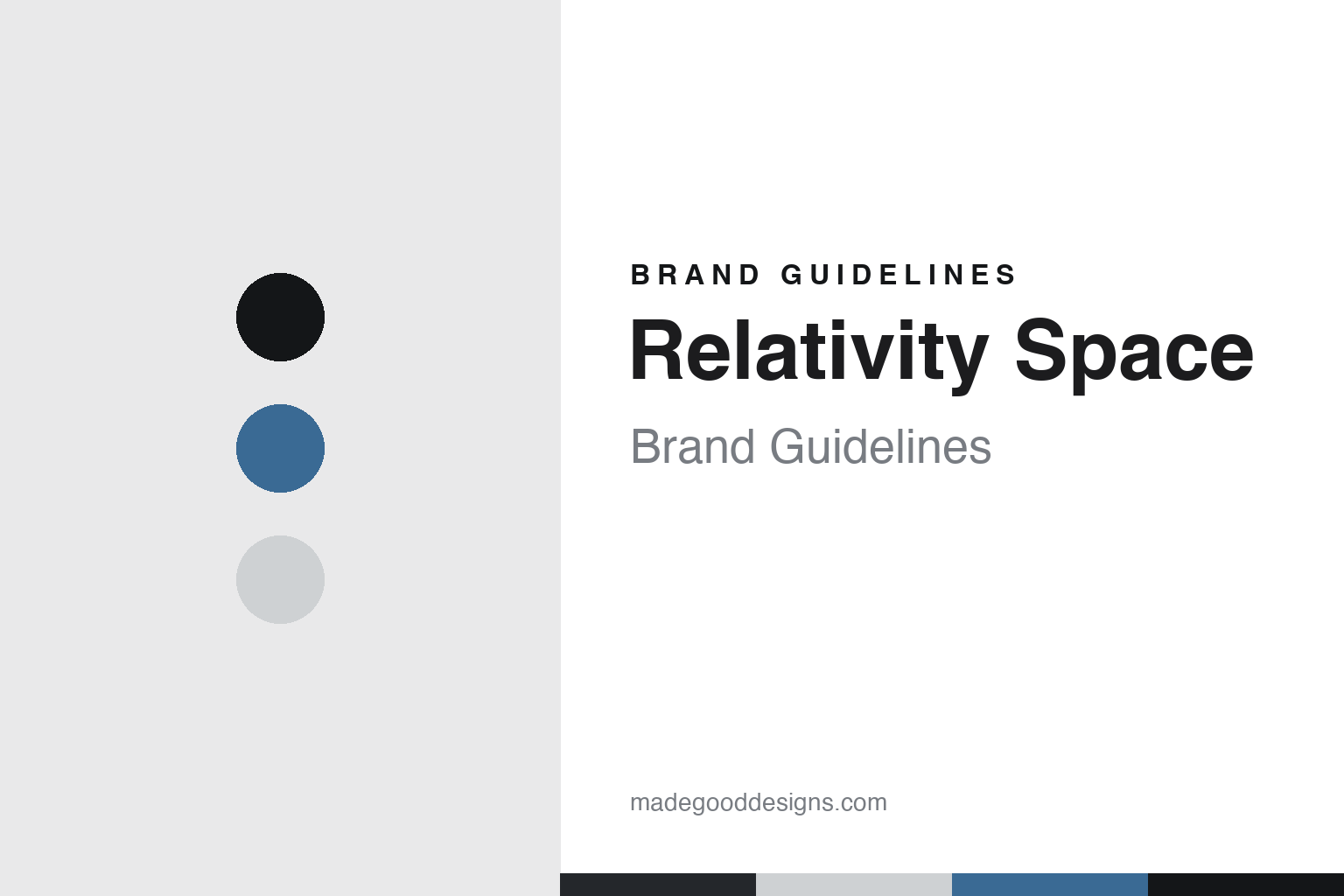
Two constants: a graphite, alloy and methane-blue palette and a technical grotesque register. Abstract homage — not a Relativity Space product or mark; no rocket, engine or logo is reproduced.
A printed rocket
Two founders and an idea about how rockets are made.
Relativity Space was founded in 2015 by Tim Ellis, its first chief executive, and Jordan Noone, its first chief technology officer, English Wikipedia says. Its starting point was manufacturing: it set out to build small launchers, and to make much of them by 3D printing. TechCrunch, writing in March 2025, described the company as known for building rockets with unusual techniques, including 3D printers, automated robots and artificial intelligence. Its first engine, the Aeon 1, was printed in a proprietary copper alloy and assembled from fewer than a hundred parts, English Wikipedia says, and ran on liquefied natural gas and liquid oxygen.
The company built its test base early. In March 2018 it signed a 20-year lease at NASA’s Stennis Space Center in Hancock County, Mississippi, to test engine components and, later, complete engines; it widened that work in 2019 to a large share of a building on the site and, in late 2023, leased the A-2 test stand for vertical stage testing. English Wikipedia describes it as the largest commercial tenant at Stennis. In January 2019 it won a US Air Force competition to build and operate Launch Complex 16 at Cape Canaveral, a pad once used for Titan and Pershing missiles.
Relativity’s home is Long Beach, California. It announced a headquarters and factory there in February 2020, where the Terran 1 was built, and in 2022 took over the former Boeing C-17 production plant in the city for its larger rocket, English Wikipedia says. The company says the site houses design, manufacturing and component testing for that rocket.
Colour
One flight for Terran 1, then a larger rocket.
The first product was Terran 1, a two-stage, expendable small launcher with nine Aeon 1 engines on its first stage and one vacuum-optimised version, the AeonVac, on its second. After two scrubbed attempts earlier in the month, it flew on 23 March 2023 on a mission named “Good Luck, Have Fun,” carrying no payload. It passed the point of maximum aerodynamic pressure, but an anomaly in the upper stage engine stopped it reaching orbit, English Wikipedia says. TechCrunch reported that the flight showed the printed technology could work, though the rocket did not reach orbit, and that a month later the company said it would stop work on Terran 1.
That decision, announced in April 2023, moved everything onto Terran R, a much larger, partially reusable two-stage rocket. English Wikipedia says it uses less additive manufacturing than Terran 1, with conventional tanks and some parts such as domes and fairings bought from outside suppliers. Its first stage is designed for thirteen Aeon R engines burning liquid oxygen and methane, with an Aeon V on the second stage, and to land on a recovery ship downrange so it can be flown again. English Wikipedia says the Aeon R was qualified in July 2025.
The company’s own monthly updates show where the rocket stands. Its September 2026 update, published in October, describes all thirteen engines installed on the first-stage thrust structure and gimbal testing under way in Long Beach, the second stage on the A-2 stand at Stennis with an Aeon V engine fitted and a wet dress rehearsal completed, and construction work continuing at the Cape Canaveral pad. Launch contracts for Terran R include multi-launch agreements with OneWeb in 2022, Intelsat in 2023 and an expanded deal with SES in 2025, English Wikipedia says.
Typography
How launch companies present themselves.
Launch companies sell something few customers ever see up close, so their public image is built almost entirely from pictures and broadcasts. The familiar set is a rocket standing on its pad at dawn or under floodlights, the long-exposure streak of an ascent across a night sky, and the plume photographed from miles down the coast. Engine test stands supply a second genre: a horizontal or downward jet of fire, usually shot from a safe distance, which stands in for years of engineering that is otherwise invisible.
Factories are shown the other way round. Clean white halls, rows of tank sections, workers in coveralls and cleanroom suits suggest order and repetition rather than drama. Many launches are also accompanied by a mission patch, a small embroidered emblem in the tradition of NASA crew patches, which turns a single flight into something that can be collected and worn.
The countdown livestream has become a format in its own right, with hosts, telemetry overlays and replays of the booster or upper stage. Not every company has worked this way: in April 2016 Inverse described one maker that gave a day’s notice of its flights and published an edited highlights video afterwards, with no live webcast. Coverage now often runs alongside posts from executives on social media, which journalists quote in their reports.
The industry also meets in person. The Space Symposium in Colorado Springs and the International Astronautical Congress, which moves to a different host city each year, are where companies unveil models, sign agreements and show their identities on stands and banners. This guide looks at what can be checked about each company: who founded it, who owns it, what it has flown, and what it says about itself.
Aa
A technical grotesque for a manufacturing-led rocket company. (Specimen set in Space Grotesk, a sans STAND-IN; NOT the Relativity Space logo.)
Relativity Space
A new chief executive and a widening remit.
The biggest change in the company’s ownership came in March 2025. Former Google chief executive Eric Schmidt took over as chief executive, a company spokesperson confirmed to TechCrunch on 10 March; Schmidt had told staff he had made a significant investment and taken a controlling stake, The New York Times first reported. He succeeded co-founder Tim Ellis, who said he would stay on the board. Relativity had raised money from a long list of investors before then; English Wikipedia names among them Fidelity, BlackRock, Baillie Gifford and Y Combinator.
Under the new leadership the company has spread beyond launch. In 2025 it set up Horizon Manufacturing Technologies to take its additive-manufacturing work into other industries and a Dark Matter Lab for prototyping, English Wikipedia says, and both now sit alongside Terran R on the company’s website. In June 2026 it announced an Interplanetary Sciences Program, whose first planned mission is a Mars orbiter targeted for 2028; English Wikipedia says NASA announced on 17 June 2026 that Relativity would provide the spacecraft, launch and operations while NASA supplied an atmospheric instrument suite called Aeolus, developed at its Ames Research Center. The company now describes itself as building reusable rockets that “make access to space more reliable and routine.”
For a design guide, Relativity Space shows how a brand built on a manufacturing idea can keep that idea at the centre while its product, its leadership and even its use of printing change. Compare Firefly Aerospace, another young American launcher, and Boeing, whose former C-17 plant in Long Beach Relativity now uses. For this guide we use graphite, an alloy silver and a methane blue with a sans, an unofficial interpretation; no product or logo is reproduced.
Explore & save
Keep Relativity Space’s identity on hand — save it to a board in the Made Good inspiration library.
Relativity Space identity set
Pin the Relativity Space graphite, alloy and methane-blue palette and the technical grotesque register to your own board.