Riverstone Brand Guidelines
A Selangor glove-service shop turned cleanroom nitrile maker.
Aa
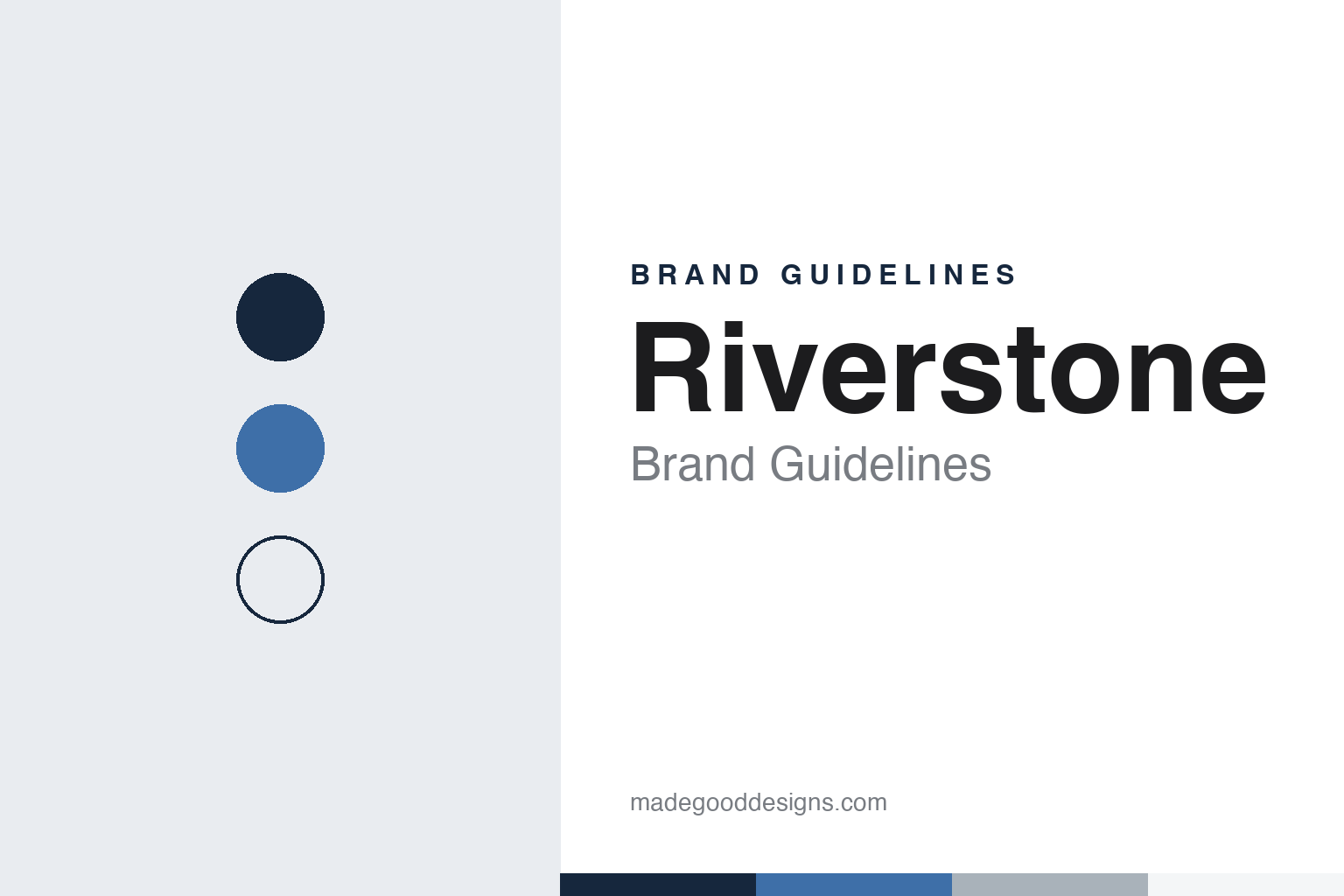
Two constants: a Riverstone navy, blue and white palette and a Technical sans register. Abstract homage — not a Riverstone product or mark; no glove, logo or pack is reproduced.
T S Enterprise
A service business for other glove makers.
Riverstone did not start by making gloves. Its own corporate history says that in the late 1980s Wong Teek Son set up a sole proprietorship called T S Enterprise in Selayang, Selangor, to provide chlorination, laundry and packaging services to Malaysia’s glove manufacturers. The Edge Malaysia, interviewing Wong in December 2020, described him as the man “who founded Riverstone in 1989.”
The manufacturing business came next. On 27 November 1991, the company says, Wong and Lee Wai Keong set up Riverstone Resources Sdn Bhd to take over T S Enterprise and to make cleanroom gloves in natural rubber and nitrile for contamination-controlled factory environments. At the end of 1994 it leased a factory in Kepong with a Class 1000 cleanroom and four dipping lines. The company says it believes this made it the first cleanroom-glove maker in the Asian region with a fully integrated production process, and that in the same year it became a pioneer of nitrile gloves in Malaysia; both are its own claims.
The range widened through the 1990s. A packaging subsidiary, Ringletex, was set up in May 1995 to make cleanroom packaging materials and was renamed Riverstone Industrial Products in 1998. In 1996 Riverstone began making nitrile finger cots with its own production technique, and from 1997 it built a run of factories on two-acre plots in the Bukit Beruntung industrial estate in Selangor. In 2000, the history says, it developed nitrile gloves for Class 10 cleanrooms and installed a dipping line used only for research.
The company’s own figures trace the build-up. It says the Kepong factory began with an annual capacity of 120 million gloves; that the Thai plant opened with two dipping lines and about 120 million more; and that by 2005, after a seventh dipping line with two rows of formers went into a new Bukit Beruntung building, the group could make about 601 million cleanroom gloves a year, alongside hundreds of millions of finger cots.
Colour
Hard-disk and semiconductor customers.
The customers were electronics makers. Riverstone’s history ties the growth of the late 1990s to demand from the hard-disk-drive and semiconductor industries, and the company followed them abroad: a sales office in Penang and a Singapore company in 1998, a representative office in the Philippines in 2000, a Thai manufacturing company in January 2001 — renamed Protective Technology Company Limited in December 2004 — a US sales office in March 2001, and Riverstone Resources (Wuxi) in China in April 2004 to chlorinate and pack gloves for customers there.
Healthcare gloves came later. Wong told The Edge Malaysia in 2020 that the group had focused mainly on nitrile cleanroom gloves from 1995 to 2008, then moved into healthcare gloves after cleanroom demand fell sharply in the 2008 financial crisis. By 2020 the same paper put the group’s headquarters in Bukit Beruntung, with its main and largest plant in Taiping, Perak, and further plants in Thailand and China. Wong said the cleanroom gloves were made and sold under the company’s own brand names, directly to end customers.
The balance has shifted with each cycle. In September 2026 The Edge Malaysia reported an annual capacity of nine to ten billion gloves across four Malaysian plants — three in Taiping and one in Bukit Beruntung — plus one each in Thailand and China, with about a fifth of that capacity given to cleanroom gloves and the rest to healthcare gloves. Wong said the company mainly serves the Class 10 and Class 100 end of the cleanroom market, that Thailand, with its many hard-disk component suppliers, is its largest market for cleanroom gloves, and that about 70% of its healthcare gloves go to the United States.
The pace of growth has been a choice. In the 2020 interview, as rival Malaysian makers added capacity during the pandemic, Wong said Riverstone had decided to expand “conservatively and responsibly,” adding about 1.5 billion pieces a year, mainly at Taiping, and keeping its lines interchangeable between cleanroom and healthcare gloves.
Typography
How glove makers present themselves.
Disposable gloves are among the most anonymous products in healthcare. They arrive in plain dispenser boxes, are worn for minutes and are thrown away, and most of the companies that make them sell to distributors, hospital buyers and other brands rather than to the public. Their visual identities are therefore built less around the product in use and more around the factory, the material and the scale of output.
The pictures repeat across the category. A gloved hand in blue or purple nitrile is held against a white ground; long dipping lines carry rows of ceramic hand-shaped formers through tanks of latex or nitrile; finished gloves are stripped, stacked and boxed; and dispenser boxes are piled into walls of colour, each size and material given its own shade. Cleanroom and hospital scenes supply the setting, with gowned staff, stainless steel and soft, even light.
Geography is part of the story. Malaysia and Thailand, both rubber-growing countries, are home to many of the makers in this series, and corporate material from the region often opens with aerial views of factory complexes, rows of long white sheds, alongside figures for lines, plants and annual capacity. Makers in China, Europe and elsewhere use the same vocabulary of automation, testing laboratories and certificates.
Trade fairs are where many of these brands meet their buyers. Stands at MEDICA in Düsseldorf and at the Dubai healthcare show long known as Arab Health tend to show stacked boxes, glove samples and product walls, with a company name in a clean sans and a colour that can carry from carton to booth. The guides in this series look at how individual makers handle that shared language.
Aa
A technical sans for a cleanroom supplier. (Specimen set in Archivo, a sans STAND-IN; NOT the Riverstone logo.)
Riverstone
More than gloves for the cleanroom.
The listed company is a later layer. Riverstone’s investor pages say Riverstone Holdings was incorporated in Singapore in August 2005 as a private company and became a public company, under its present name, in October 2006, as part of a restructuring ahead of its listing on the Singapore Exchange. Twenty years on, The Edge Malaysia still described it in September 2026 as a Singapore-listed glove maker, with Wong as founder, executive chairman and chief executive. Its operating company, Riverstone Resources, remains Malaysian.
The product list now runs beyond gloves. Riverstone’s website groups its range into cleanroom gloves, healthcare gloves, cleanroom face masks, finger cots and cleanroom packaging, with other cleanroom consumables. In the 2026 interview Wong said the company was expanding cleanroom face-mask production at its Taiping plant and wanted to grow packaging-bag output, describing the aim as offering customers “a full package of clean room products.” The company also lists a run of Malaysian business awards from 2003 to 2005, including the Enterprise 50 programme and the 2003 Selangor Product Excellence Award.
For a design guide, Riverstone shows how a supplier to electronics factories can sell under its own name directly to the factories that use its gloves. Compare Hartalega, another Malaysian nitrile specialist, and Top Glove. For this guide we use a navy, a nitrile blue, a cool grey and a cleanroom white with a sans, an unofficial interpretation; no product or logo is reproduced.
Explore & save
Keep Riverstone’s identity on hand — save it to a board in the Made Good inspiration library.
Riverstone identity set
Pin the Riverstone navy, blue and white palette and the Technical sans register to your own board.