S-OIL Brand Guidelines
A 1976 joint venture that changed partners twice and kept refining at Onsan.
Aa
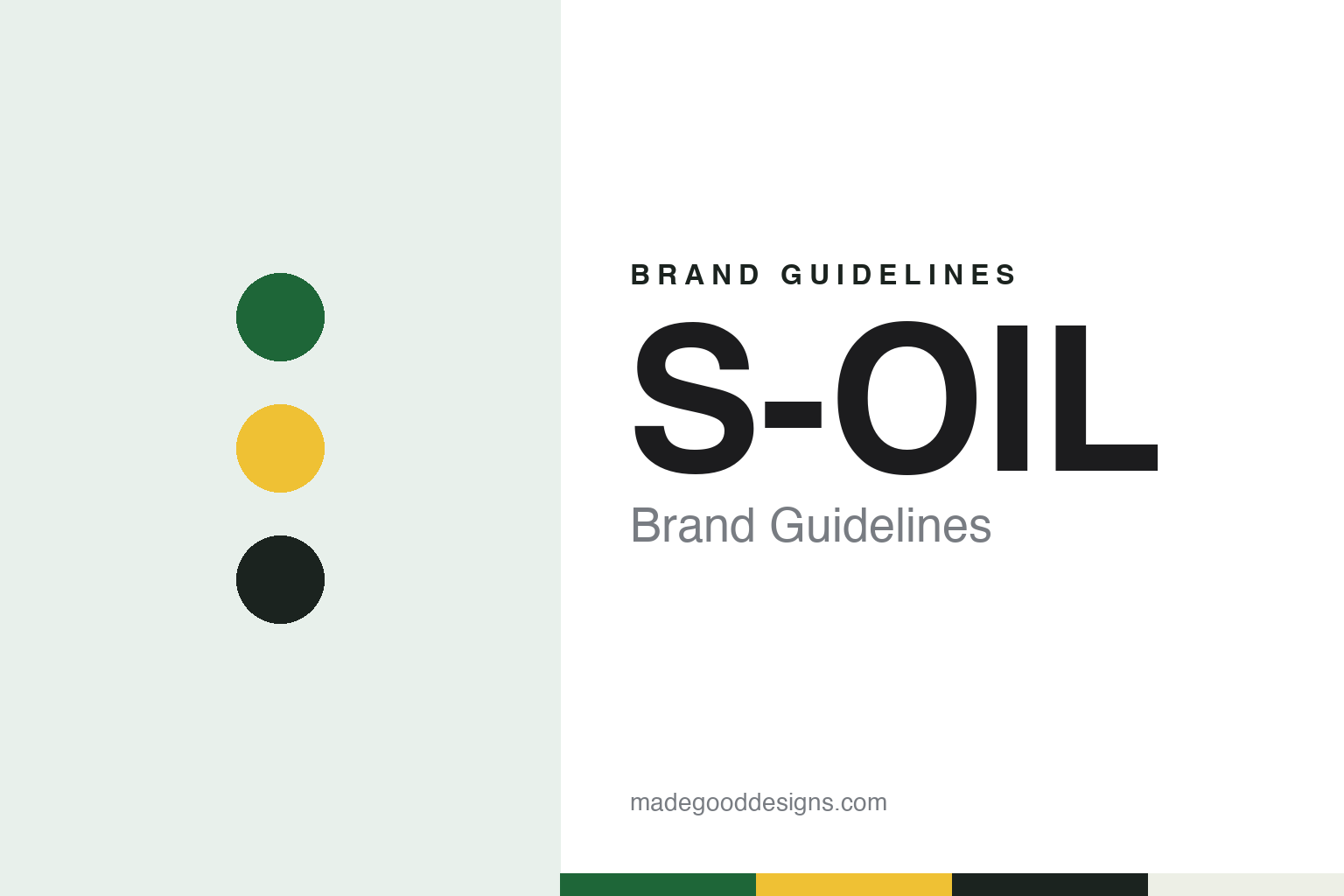
Two constants: a green and yellow palette and a plain sans register. Abstract homage — not an S-OIL product or mark; no logo, pump or signage is reproduced.
Korea-Iran Petroleum
A 1976 joint venture that changed partners twice.
S-OIL was incorporated in January 1976 as the Korea-Iran Petroleum Company, according to the company’s timeline. English Wikipedia, which gives the name the other way round as Iran-Korea Petroleum, says the National Iranian Oil Company held control of the venture until 1980. Construction of the Onsan Refinery in Ulsan, on Korea’s south-east coast, began in November 1976; the first tanker arrived in February 1980, and the first crude distillation unit started commercial operation that May, the company says.
In June 1980 the company was renamed Ssangyong Oil Refining, taking the name of the Ssangyong business group. Korean Wikipedia says the venture had been set up by Ssangyong’s cement company and the National Iranian Oil Company, and that in August 1980 the Ssangyong side bought the Iranian company’s entire stake. Under Ssangyong the refinery added a lubricant base oil plant in 1981 and an Incheon terminal in 1982, and the company went public in May 1987. It moved into the finished lubricants market in 1989.
A new partner arrived in 1991. In August that year the company signed a joint-venture agreement and a long-term crude purchase agreement with Aramco Overseas Company, a subsidiary of Saudi Aramco; English Wikipedia gives Aramco’s initial stake as 35%. In December 1999 the company says it adopted a stand-alone management system after separating from the Ssangyong Group, and in March 2000 it changed its name to S-OIL.
Colour
Onsan, lubricants and the Shaheen project.
S-OIL runs its refining, lubricants and petrochemical businesses from the Onsan complex, and its head office is in Mapo, Seoul, where the company says it opened its own headquarters building in 2011. Through the 1990s it added more crude units, its first aromatics complex in 1991 and the Bunker-C Cracking Center, completed in 1997, which converts heavy fuel oil. Lubricants are a large part of the business: the company says it set up mass production of Group III lube base oil in 2002, launched the fully synthetic engine oil SSU in 2005 and formed S-OIL TOTAL Lubricants as a 50:50 venture in 2008. On the forecourt it launched “RON 97” gasoline in 1994 and S-Gasoline Premium in 2006, it says.
Ownership moved again in the 2000s. The company says it sold a 28.4% stake to Hanjin Energy in April 2007, and that in January 2015 Saudi Aramco became its single largest shareholder by buying an S-OIL stake from the Hanjin Group. Hydrocarbon Processing reported in February 2025 that Aramco holds 63.4% of S-OIL, and Yonhap, writing in The Korea Times in November 2022, called the company Aramco’s Seoul-based subsidiary and Korea’s third-largest refiner.
Before that came a first petrochemical step. The company says it inaugurated a new complex in June 2019, known internally as RUC/ODC; Yonhap described it in 2022 as an expansion that makes propylene, propylene oxide and polypropylene by reprocessing low-value residue, such as heavy fuel oil, left over from crude refining.
The company’s biggest project is Shaheen, named after the Arabic word for a hawk. S-OIL’s board approved it in November 2022 as a steam cracker and related plants at its Ulsan complex, producing petrochemical feedstocks such as ethylene and propylene, Yonhap reported; the company said it aimed to raise the petrochemical share of its business from 12% to 25% by 2030. In October 2025 the Korea JoongAng Daily reported construction 85% complete and described the project’s thermal crude-to-chemicals reactors as the first at commercial scale anywhere. On 2 November 2026 The Korea Herald reported that commissioning was under way after mechanical completion of the main facilities, with full operation targeted for early 2027.
Typography
How refiners present themselves.
Refiners and fuel marketers sit between the oil field and the driver, and their identities have to work at very different scales. The same name may appear on a refinery gate, the side of a tanker truck, a forecourt canopy, a pump display, a lubricant bottle and a page of an investor presentation, so marks tend to be simple shapes and short words that survive distance, weather and night lighting.
Much of the public image is still built on the forecourt. Station brands carry the colour and the logo, while the company behind them may run several names at once: Phillips 66, for example, says it sells fuel in the United States under the Phillips 66, Conoco and 76 brands and in Britain under JET. Payment cards, loyalty schemes and apps extend the forecourt to the phone; Phillips 66 promotes one app, Fuel Forward, across its three US brands.
Lubricants give refiners a second, shelf-sized identity. Bottles and drums are often sold under their own names rather than the corporate one, such as Indian Oil’s Servo or Phillips 66’s Kendall, and they sit beside competitors in shops and workshops, where a pack has to be recognised quickly.
The newest part of the story is told in announcements and reports. Companies present renewable diesel, sustainable aviation fuel and electric-vehicle charging through press releases, sustainability pages and investor material; Phillips 66 describes converting a California refinery to renewable fuels, and Indian Oil has added charging points at its fuel stations. Safety pages, refinery photographs lit at night and annual reports complete a register that is usually more technical than the forecourt. The guides in this group set out what can be checked about each company: its origins, owners, plants and brands.
Aa
A plain, upright sans for a capitalised name. (Specimen set in Barlow, a sans STAND-IN; NOT the S-OIL logo.)
Five rays
A capital S, yellow rays and a green logotype.
S-OIL adopted its current corporate identity in July 2007, its timeline says. The company describes the logo as a single-point mark centred on a capital S, with five rays stretching out from it. It says the rays stand for “5S-SPIRIT,” a set of values shared by its employees, and are meant to suggest an image as fresh as the morning sun. The rays are coloured yellow, which the company calls its existing brand colour, and the logotype is green, which it says gives the new logo visual impact and stands for a consumer-oriented, environment-friendly image; it names the two colours S-OIL Yellow and S-OIL Green. The name itself is written in capitals with a hyphen.
The company has leaned on characters and music in its marketing: it says it ran an advertising campaign built on an “S-OIL Song” in 2006 and introduced a corporate character, “Good oil,” in 2012, and that it received a Presidential Award at the Korea Brand Awards in November 2013. It also says it won “Downstream Operations of the Year” at the Platts Global Energy Awards in 2009. The company plans a ceremony in the fourth quarter of 2026 to mark both its 50th anniversary and the completion of Shaheen, The Korea Herald reported.
For a design guide, S-OIL shows a fuel brand built on a single letter and two colours. Compare SK Innovation, another Korean refiner with a complex at Ulsan, and ENEOS, the Japanese refiner and fuel brand. For this guide we use a deep green and a warm yellow with near-black and a pale haze, with a sans, an unofficial interpretation; no product or logo is reproduced.
Explore & save
Keep S-OIL’s identity on hand — save it to a board in the Made Good inspiration library.
S-OIL identity set
Pin the S-OIL green and yellow palette and the plain sans register to your own board.