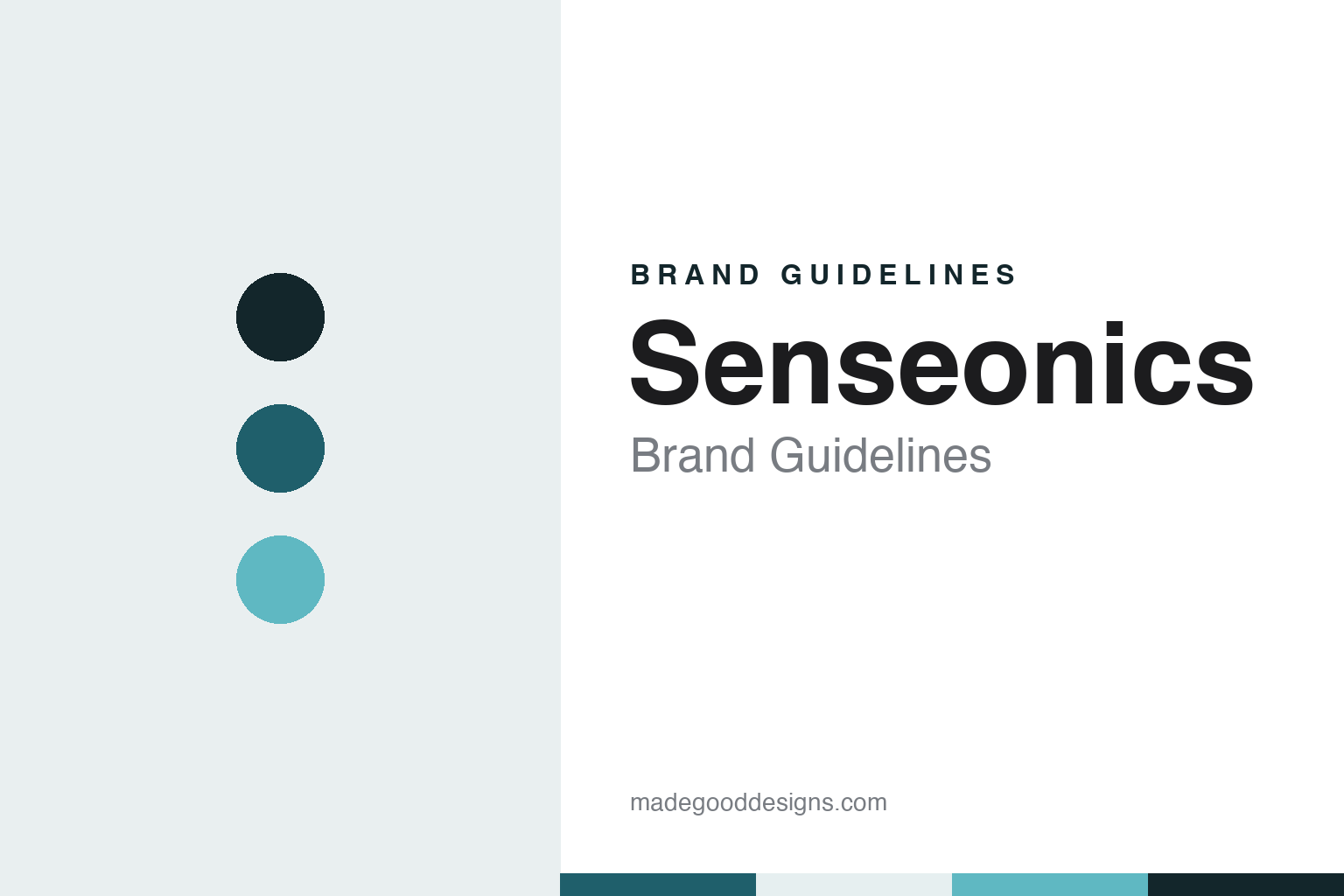
Senseonics Brand Guidelines
The Germantown company that put a glucose sensor under the skin.
Aa
Two constants: a teal, aqua and ink palette and a clinical sans register. Abstract homage — not a Senseonics product or mark; no device, logo or app screen is reproduced.
Sensors for Medicine and Science
A private Maryland lab with a light-based sensor.
Senseonics grew out of a privately held company in Germantown, Maryland, called Sensors for Medicine and Science, Inc. On 16 October 2012 it announced a new name. The chief executive, Tim Goodnow, explained it in the company’s release: “sense” for detecting, “eon” for a long time and “-ics” for a body of knowledge, chosen to signal a focus on glucose sensors meant for long-term wear. The firm was then working on what it described as the first fully implantable, long-term continuous glucose monitoring system, and Germantown has remained its headquarters.
The technology rests on light. The company’s releases describe a proprietary fluorescence sensing technology: a small sensor placed under the skin of the upper arm, a transmitter worn over it, and a smartphone app that receives the readings. In the same October 2012 release, Senseonics said it had submitted the protocol for a pivotal study called PRECISE to regulators in the United Kingdom and Germany, with three clinical sites in Germany and two in the UK and a planned wear time of 180 days. In February 2013 it announced ISO 13485 certification for its quality system, covering the design, development, manufacturing, servicing and distribution of implantable glucose sensors, according to the company.
The company became public through a merger. On 11 December 2015 Senseonics announced that it had completed a merger with ASN Technologies, a company quoted on the OTC bulletin board, which then changed its name to Senseonics Holdings, Inc.; ASN’s previous business was sold off at the same time. Abingworth, an investor in the company, says the company went on to list on the New York Stock Exchange in March 2016. In November 2025 Senseonics announced it would move its listing from NYSE American to the Nasdaq Global Select Market, with trading there from 17 November 2025 under the existing ticker.
Colour
Eversense: 90 days, then 180, then a year.
The product that carries the brand is Eversense. On 21 June 2018 the US Food and Drug Administration announced that it had approved the Eversense Continuous Glucose Monitoring system for adults with diabetes, calling it the first FDA-approved CGM system to include a fully implantable sensor. The FDA’s release described a sensor inserted just under the skin by a qualified health care provider in an outpatient procedure, worn for up to 90 days, and coated with a fluorescent chemical that gives off a small amount of light when exposed to blood sugar; the sensor measures that light and sends readings every five minutes to an app on a phone or tablet. Abingworth says Senseonics has marketed its systems since 2018.
The wear time then grew. In February 2022 MedCity News reported that the FDA had approved the next-generation Eversense E3, with a sensor lasting six months, against three months for the 2018 version; Goodnow said in the company’s statement that the review had been delayed by a year by Covid-19 priorities and that the launch would follow with its partner Ascensia. In September 2024 Senseonics announced FDA clearance for Eversense 365, which it calls the world’s first one-year CGM, and in October 2024 it announced the first commercial placement of the system at the health system Mercy.
The company’s own description of the product has stayed consistent: a small sensor inserted completely under the skin, a smart transmitter worn over it, and glucose data sent automatically every five minutes to a smartphone app. In 2026 it described two further programmes, Gemini and Freedom. On 26 October 2026 it announced the start of a first-in-human, early feasibility study of Freedom, an investigational system with an integrated battery and built-in Bluetooth, designed to send readings straight to a phone with no external transmitter on the body.
Typography
Design and documentation.
Diabetes device makers sell small things that people wear, carry or use many times a day: continuous glucose monitors worn on the upper arm or the belly, insulin pumps and tubeless patch pumps, blood-glucose meters with their test strips, and the pen needles and syringes used for injections. Their brand worlds are built around those objects, and increasingly around the data the objects produce.
A typical presentation pairs a close-up of a sensor or pump on skin with a phone screen showing a glucose graph and trend arrows. Apps and watch faces have become as central as the hardware: sensor makers describe readings sent wirelessly to phones, shared with family members and passed to insulin pumps, and that connection between devices is often the story the brand tells.
Photography in the category tends to be bright and active, with runners, swimmers, parents and children, while meter-and-strip brands lean on clean packshots of the meter, the strip pot and the lancing device. Regulation shapes the words as much as the pictures: product names come with indications, approval dates and age ranges, and marketing copy stays within what regulators such as the U.S. Food and Drug Administration have cleared.
The industry meets at medical congresses such as the American Diabetes Association’s Scientific Sessions, the annual meeting of the European Association for the Study of Diabetes (EASD) and the ATTD conference on advanced technologies and treatments for diabetes, where new devices and study results are presented to clinicians. This guide sets out what can be checked about each maker — who founded it, who owns it, where it says its products are made and what regulators have said — and marks clearly what rests only on the company’s own word.
Aa
A clinical sans for a quiet, technical medical brand. (Specimen set in Manrope, a sans STAND-IN; NOT the Senseonics or Eversense logo.)
Senseonics
From partner-sold to selling its own.
For most of its commercial life Senseonics relied on partners to sell Eversense. In December 2016 it announced an expanded distribution agreement with Roche. From 2020, Ascensia Diabetes Care, the Basel company owned by Japan’s PHC Group, held the exclusive worldwide distribution rights, according to Senseonics and Medical Device Developments, which reported in September 2025 that Ascensia had launched Eversense 365.
That arrangement is now unwinding. On 3 September 2025 Senseonics announced a memorandum of understanding under which it would take over all commercialisation and distribution of Eversense 365 and future products, assuming US sales and marketing from 1 January 2026 and using transition service agreements with Ascensia elsewhere. Ascensia’s chief executive, Koichiro Sato, said in the release that Ascensia would remain invested in Senseonics, and Ascensia’s head of CGM, Brian Hansen, was named Senseonics’ incoming chief commercial officer. In its August 2026 results release Senseonics said it had brought US commercial operations in-house and had closed the transition of the European business from Ascensia in June 2026, taking on sales and marketing in Germany, Italy, Spain and Sweden. It also described Eon Care, its own network of nurses who carry out Eversense insertions.
Partnerships continue. In June 2026 Senseonics announced work with Welldoc on a new Eversense 365 app, and on 14 September 2026 a partnership with Beta Bionics to integrate Eversense 365 with the iLet Bionic Pancreas insulin-delivery system. The company describes itself as focused on the development and manufacturing of long-term implantable CGM systems.
For a design guide, Senseonics shows how a company built on one hard idea — a sensor that lives under the skin — puts a product name, Eversense, at the front of its story. Compare Ascensia Diabetes Care, its long-time distribution partner, and Dexcom, another US glucose-sensor maker. For this guide we use a deep teal, a light aqua and an ink with a sans, an unofficial interpretation; no product or logo is reproduced.
Explore & save
Keep Senseonics’s identity on hand — save it to a board in the Made Good inspiration library.
Senseonics identity set
Pin the Senseonics teal, aqua and ink palette and the clinical sans register to your own board.