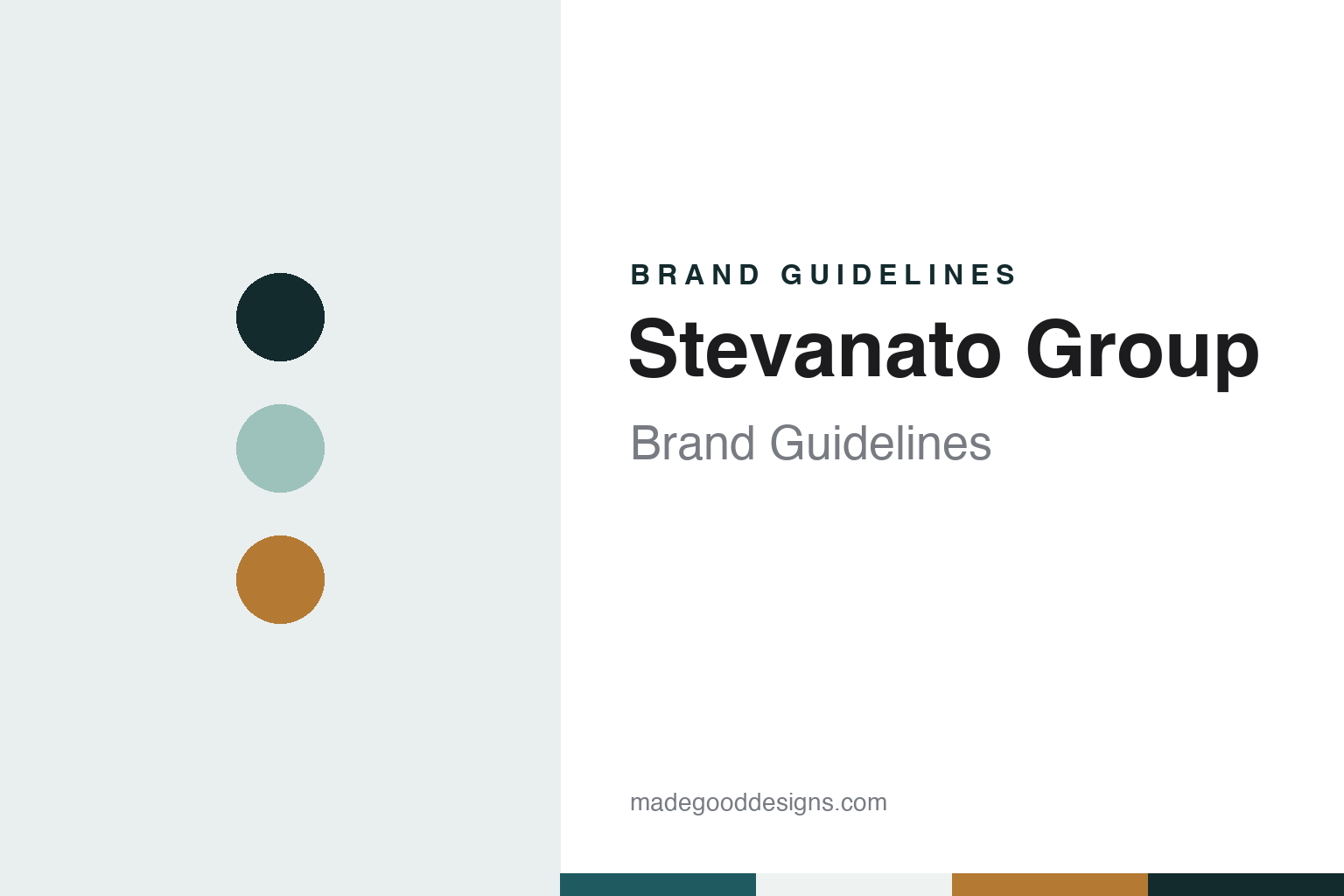
Stevanato Group Brand Guidelines
A Venetian glass works that became an engineering group for injectable medicines.
Aa
Two constants: a lagoon teal, glass green and amber palette and a Venetian serif register. Abstract homage — not a Stevanato product or mark; no container, device or logo is reproduced.
From Zelarino to Piombino Dese
A Venetian glass works and a family company.
Stevanato Group dates its history to 1949 and to Giovanni Stevanato, whom the company named as its founder when it listed in New York in 2021. Its heritage page traces the roots to Soffieria Stella, a glass-bottle works at Zelarino, near Venice; in 1959 the glassworks moved to Piombino Dese, in the province of Padua, and closed a few years later. English and Italian Wikipedia give a different first company, Nuova Ompi, founded in Venice in 1949 and moved to Piombino Dese in 1959. In the company’s own timeline, Ompi, its glass primary-packaging business, was born at Piombino Dese in 1969, and Spami, which designs and builds high-speed lines that form glass tubing into pharmaceutical containers, followed in 1971.
That pairing, glass containers and the machines that make them, remains the base of the group. Stevanato bought a glass-container plant at Latina, in Italy, through the acquisition of Alfamatic in 1993, and in 2005 added Medical Glass of Bratislava, Slovakia, which the company calls the first step in its internationalisation.
In 2007 it opened a department at Piombino Dese making EZ-fill syringes, supplied ready to fill and already sterilised, followed by ready-to-use vials and cartridges; English Wikipedia dates the extension to vials and cartridges to 2010. In the same year as the first EZ-fill line it bought Optrel, an Italian maker of inspection machines for pharmaceutical glass containers.
Colour
Glass, plastics and devices.
The group then spread abroad. It opened its first greenfield plant at Monterrey, Mexico, in 2008, a plant at Zhangjiagang, in China, after opening a commercial office there in 2012, and a third greenfield plant at Sete Lagoas, Brazil, in 2017, the company says. Acquisitions brought in the Danish inspection-machine maker InnoScan in 2013 and, in 2016, the Danish assembly and packaging-equipment maker SVM and Balda, a plastics business with plants in Germany and California serving diagnostics, drug delivery and medical components. English Wikipedia notes that Balda Medical, at Bad Oeynhausen, began in 1908 as a camera maker. The company added an analytical laboratory, SG Lab, in 2014, a commercial office in Nagoya, Japan, in 2018, and a larger syringe plant at Piombino Dese in 2019.
Services grew alongside manufacturing. The company opened a Technology Excellence Center in Boston, Massachusetts, in 2020 to offer analytical services to biopharmaceutical customers, and expanded a matching centre at its Piombino Dese headquarters in 2023, according to its timeline. English Wikipedia describes the group in two parts: a pharmaceutical systems side, with Ompi in glass primary packaging and Balda in specialty plastics and delivery devices, and an engineering side, with Spami, Optrel, InnoScan and SVM in glass processing, inspection, assembly and packaging. It adds that the Chinese plant began production in November 2013 and the Brazilian one in June 2017.
Today the company’s website groups its offer into drug containment (vials, cartridges, syringes and ampoules), drug delivery systems, in-vitro diagnostic and medical products, glass-converting, assembly and visual-inspection equipment, and analytical and testing services. Its delivery devices include the Aidaptus autoinjector, the Alina and Deora pen injectors and the Vertiva on-body delivery system, and its syringe platforms include Alba. Italian Wikipedia describes Stevanato as the world’s leading producer of insulin cartridges.
When it listed on the stock exchange in July 2021, the company described itself as a provider of “drug containment, drug delivery and diagnostic solutions to the pharmaceutical, biotechnology and life sciences industries.”
Typography
Design and documentation.
Drug-delivery device makers sell mostly to other companies. Their customers are pharmaceutical and biotech firms that fill a pen, an autoinjector or a prefilled syringe with their own medicine and put their own name on the box, so the device maker’s brand often lives one step back from the patient. That shapes how these companies present themselves: less as consumer brands, more as engineering partners that can be trusted with a drug company’s product.
The pictures follow from that. The typical image is a clean render of a pen or autoinjector on a white or pale ground, often shown from several angles or in a technical cutaway that reveals the spring, the plunger and the syringe inside. Product families are usually named as platforms, with one prefix running across a range, and shown in neutral greys and whites so that a customer can imagine its own colours on the device.
Production is the other recurring theme. Websites and brochures show cleanroom assembly lines, injection-moulding machines, operators in gowns and hairnets, and gloved hands holding glass syringes, cartridges and vials. These images carry the message that the work is precise and controlled, and they sit beside pages on quality systems, regulatory support and human-factors testing with patients.
Much of the industry’s public face is seen at trade shows. Makers book stands at events such as CPHI, the pharmaceutical ingredients and packaging fair, Pharmapack in Paris, and the conferences of the Parenteral Drug Association, where they show new platforms to drug companies. The visual language there is the same: white stands, large product renders, cutaway models and short films of devices being assembled and used.
Aa
A Venetian serif for a glassmaker from the Veneto. (Specimen set in Newsreader, a serif STAND-IN; NOT the Stevanato Group logo.)
Stevanato Group
A New York listing and an Indiana plant.
On 16 July 2021 Stevanato Group began trading on the New York Stock Exchange under the ticker STVN, the company announced that day; Franco Stevanato was then executive chairman and Franco Moro chief executive. According to the company’s investor website, Franco Stevanato resumed the chief executive role in May 2024, having led the group as CEO from 2010 to 2020, and now serves as executive chairman and chief executive.
In June 2021 the Indianapolis Business Journal reported Stevanato’s plan to build a plant in a life sciences park in Fishers, Indiana, creating 230 jobs by the end of 2025; it described the company as an Italian producer of syringes, vials and glass containers for the pharmaceutical industry, headquartered in Piombino Dese with 4,300 employees worldwide. In July 2025 Pharma Manufacturing reported that commercial production had begun at Fishers in 2024, that several syringe lines were running and producing EZ-fill syringes, and that vial production was being brought online; it also noted a 2022 agreement with BARDA, the U.S. Biomedical Advanced Research and Development Authority, for standard and EZ-fill vial capacity. The company says plants at Cisterna di Latina, in Italy, and at Fishers opened in 2024.
For a design guide, Stevanato Group shows how a family glassmaker can present itself as an engineering group, with glass containers, delivery devices and the machines that make them under one name. Compare West Pharmaceutical Services, the American maker of stoppers, seals and syringe components, and Nemera, a maker of drug-delivery devices. For this guide we use a lagoon teal, a pale glass green and an amber with a serif, an unofficial interpretation; no product or logo is reproduced.
Explore & save
Keep Stevanato Group’s identity on hand — save it to a board in the Made Good inspiration library.
Stevanato Group identity set
Pin the Stevanato Group lagoon teal, glass green and amber palette and the Venetian serif register to your own board.