Candela Brand Guidelines
The 1970 laser maker named after a unit of light.
Aa
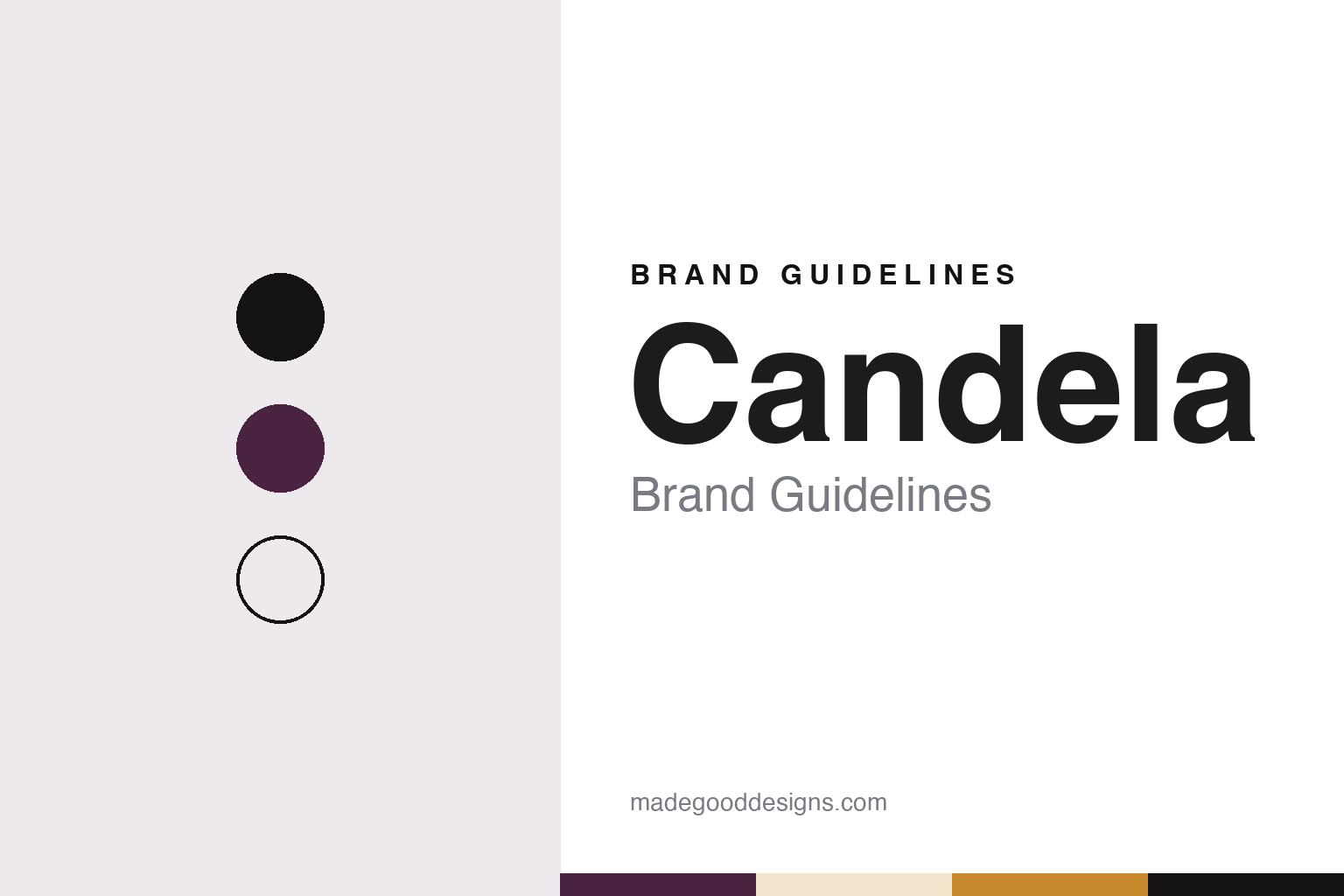
Two constants: a Candela deep plum, candlelight and amber palette and a Classic serif register. Abstract homage — not a Candela product or mark; no device, logo or nameplate is reproduced.
A unit of light
Custom lasers for scientists.
Candela was founded in 1970 in the Boston area by the physicist Horace W. Furumoto and his former NASA colleague Harry Ceccon, also a physicist, according to the company’s entry in Gale’s International Directory of Company Histories. Furumoto had worked at NASA’s electronics research laboratory in Cambridge and at the defence contractor Avco, where in the early 1960s he was involved in developing a high-energy dye laser. The new company supplied the scientific community with custom lasers and with flashlamps, the components used to control the length of a dye laser’s pulse.
The name came straight from physics. Furumoto named the company after the candela, the scientific unit of light, Gale says. Candela’s own website still describes it as “founded as an industrial laser company” in 1970, and for more than a decade it served a narrow scientific and industrial market. Gale’s entry gives the company’s headquarters at the time as Wayland, Massachusetts.
The turn to medicine came in 1981, when Furumoto began working with Dr John A. Parrish, the newly appointed chairman of dermatology at Harvard Medical School and chief of dermatology at Massachusetts General Hospital, on a laser for dermatology. Candela’s own timeline says that in 1983, with Massachusetts General Hospital, it developed the SPTL1, which it describes as the first pulsed dye laser, and that the SPTL1 received FDA clearance in 1986. Gale adds a second line of work begun at the same time: a laser for breaking up kidney stones, which received FDA clearance before the first twelve units shipped in June 1987.
Colour
A listed laser maker.
To pay for that expansion the company renamed itself Candela Laser Corporation and went public in June 1986. Once its products were medical, Gale says, it had to become far more sophisticated about marketing: after its urology laser shipped in 1987 it turned to an advertising agency for a corporate-identity makeover and a new logo. In early 1988 it formed a joint venture with the Japanese trading house Mitsui & Co., called Candela International Corporation, to reach markets overseas, where it expected nearly half its sales.
Its leadership changed in 1991, when Furumoto stepped down as chief executive and chairman after a boardroom dispute in which the board backed its finance chief, Gerard Puorro, Gale says. Furumoto bought Candela’s small non-medical laser business and, after a one-year agreement not to compete, his new company, Cynosure, brought out a dermatology laser of its own. Candela sued Furumoto and Cynosure for patent infringement in 1992; in 1994 the suit was settled in Furumoto’s favour. In the same years Candela set up a European operation based in the Netherlands and, in 1991, began giving doctors who bought its lasers ready-made marketing kits, later expanded into a partnership programme.
In January 1996 the company returned to the name Candela Corporation. A venture into its own LaserSpa clinics, opened in Scottsdale, Arizona, in 1997 and then in Boston, was short-lived; the Arizona site closed by the end of 1997, and management then said it would concentrate on manufacturing. Candela’s timeline lists its first Q-switched laser for pigment and tattoos in 1993, FDA clearance of an alexandrite laser for permanent hair reduction in 1998, and the Vbeam Perfecta in 2005.
Typography
Design and documentation.
Makers of aesthetic lasers and energy-based devices sell to clinicians first and to their patients second, and their brand material is built for both. The usual product image is a tall white console on castors, with a touchscreen and one or more handpieces on coiled cables, photographed in a softly lit treatment room. The machines are designed to look at home in a clinic and in a medical spa alike.
Around the hardware sits a familiar visual language: close-ups of glowing skin, clinicians in white coats, pale backgrounds, generous white space and clean, light sans-serif type. Product names tend to be short coined words, often styled with trademark symbols, and families are extended with suffixes such as Pro, Plus or a version number. Colour is usually held back to one accent against white, grey and skin tones.
Much of the industry’s calendar runs through medical congresses rather than consumer shows. AMWC, the Aesthetic & Anti-Aging Medicine World Congress; IMCAS in Paris; and the annual meeting of the American Society for Laser Medicine and Surgery (ASLMS) are among the places where new systems are shown to doctors. Candela, for example, says it unveiled its Vbeam Pro at the 2025 ASLMS meeting and launched its Glacē system in Europe at IMCAS in January 2026.
The companies behind these brands have changed hands often, through mergers, private-equity buyouts and restructurings, and several now trade under names different from the ones they started with. This guide sets out who founded each maker, who owns it now and what it says about its own products, and gives the company’s claims as its own.
Aa
A classic serif — a name drawn from physics. (Specimen set in Fraunces, a serif STAND-IN; NOT the Candela logo.)
Candela
Syneron, Apax and Marlborough.
The next owner came from Israel. Syneron Medical was founded in 2000 by Shimon Eckhouse, who had earlier founded Lumenis, English Wikipedia says; Candela’s own timeline dates Syneron’s acquisition of Candela to 2010, and the combined business traded as Syneron Candela. In April 2017 optics.org reported that Syneron Candela, then listed on Nasdaq and based in Israel, had agreed to be bought by the private-equity firm Apax Partners. Candela says the purchase by an affiliate of funds advised by Apax was completed on 17 July 2017, taking the company private.
Under private ownership the business added the IPL maker Ellipse A/S in 2018, and in 2019 Syneron Candela rebranded as Candela and opened a new global headquarters in Marlborough, Massachusetts, the company says. Its website describes it as a US-based medical aesthetic device company that develops and manufactures laser, IPL and radiofrequency microneedling systems, sells in nearly 100 countries and has offices in North America, France, Germany, Spain, the UK, China, Japan and Hong Kong. Its current ranges include the Gentle Pro series, PicoWay, Vbeam and Nordlys; its chief executive is Geoffrey Crouse.
Candela launches products at medical meetings: it says it unveiled the Vbeam Pro at the 2025 annual meeting of the American Society for Laser Medicine and Surgery and gave its Glacē facial system a European launch at IMCAS in Paris in January 2026. It sums up its brand values in three words, “Science, Results, and Trust.”
For a design guide, Candela shows a name drawn from physics that has outlasted a founder’s exit, an acquisition and a merged name. Compare Cynosure, the company Candela’s co-founder started after leaving, and Cutera, a California laser maker founded in 1998. For this guide we use a deep plum, a candlelight cream and an amber with a serif, an unofficial interpretation; no product or logo is reproduced.
Explore & save
Keep Candela’s identity on hand — save it to a board in the Made Good inspiration library.
Candela identity set
Pin the Candela deep plum, candlelight and amber palette and the Classic serif register to your own board.